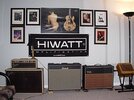
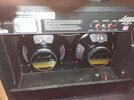
Maybe a more expensive ss that's designed to gig can do all this stuff; I haven't heard one, but I haven't heard many amps, and as folks say, in a club with bad sound and loads of general noise, maybe one cannot much tell the difference?
Now that I mentioned the AC30, I go back and read Grumpy Betty's post about them vs modelers.
In my experience listening to and also attending live musical performances, I did witness a certain older brand of SS Amp that not only delivered some pretty hot goods, but also had a lot of top Pro players who gigged and made loads of music with this line of amp and speaker cabs.
I have no experience or knowledge of the current amp using this moniker but the old school Acoustic brand SS amps had a great rep if I am not mistaken. I cannot count how many enjoyable nights I spent no more than 4-6 feet away from my buddy as he played his Music Man basses thru Acoustic Bass heads and giant speaker cabs with what I think he told me had 18 inch speakers.
A good writeup can be seen here. Plus I will post the text for anyone who wants to read less than the full text.
6 Classic Amps Every Bassist Should Know
Acoustic 360/361
Chief proponents: Larry Graham, John Paul Jones, Jaco Pastorius
The volume of guitar amplifiers was on a hyperbolic curve throughout the entire decade that gave us The Boomers. If you start with the guitar volume of the Everly Brothers in 1960 and end with Jimi Hendrix in 1969, the volume differential is similar to the one between a sewing machine and a Saturn V rocket. The Ampeg B-15 was simply not designed to win a head-to-head collision with a Marshall stack set to “kill.” Something had to be done on behalf of bass players everywhere.
In 1967, enter the Acoustic 360, a 200-watt, solid state head designed to drive the 361 cabinet, a rear-firing 18” speaker enclosure modeled, I believe, after the Panzer tank. The 360/361 absolutely towered over the B-15, physically and sonically, and got the bass world ready for the Woodstocks, Altamonts and giant festival concerts to come.
In December of 1967, the Acoustic 360 actually helped The Doors get arrested for noise violations and put them - and the amp - on the cover of Life magazine. This notoriety had a very predictable response, which is that it made the amp a must-have for serious rockers who would love to be arrested by The Man for bass notes alone.
Not that this was an easily accessible piece of gear. The suggested retail price of the 360/361 package back in 1967 was $1250.00, which in 2014 dollars comes to USD$8,850.00 Not. A. Typo. There is not, to my knowledge, another bass amp that costs nine grand, unless you’re cutting an SSL console in half and dragging that around, which is actually a pretty awesome idea.
Nevertheless, price be damned, the best bassists of the era knew that this was a killer amplifier. Larry Graham himself used these towering stacks for the thumb, the stank and the funk. Led Zeppelin’s virtuosic bassist John Paul Jones had to keep up with Jimmy Page, for the love of Pete, and with the Acoustic 360 (or, say, a wall of them) he could. And there was a young bassist from Florida who knew that if he was going to be The Best, he had to play The Best Amp. That’s when Jaco Pastorius saved all his money (legend has it, sleeping on the beach when his bandmates on the road slept in hotel beds) and eventually purchased an Acoustic 360, which gave Jaco’s fretless J-bass that instantly-recognizable bump in the upper-mids that provided him bassdom’s most enduring, original voice.
CALLOUT: Check out Bobby Vega’s paean to the Acoustic stack
here, and dig his Zeppelin riffs


 Rock On!"