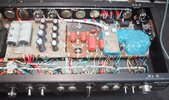
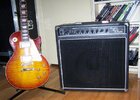
Here's a clip of my main (modified) DSL40C - 7025-WA preamp tubes, Electro-Harmonix EL-34's and a 90 watt Creamback - Nothing else. I don't hear a fizzy sound, but am I missing something???
You also have nothing in the video for audio comparison or point of natural / organic tube overdrive reference. I would suggest that if you had say that 25/25 Jubilee or better yet, an early 70's JMP or even an amp from the first several years pf the JMP Master Volume '76-'77 & could A/B the sound then not only would fidelity & frequency range be more apparent but so too would the type of driven gain / Overdrive. Things were done different back then & technology seldom walks backward.
Let's not forget, the first real Overdrive amps were Marshall Non-Master home made Master Volume & Pre-amp conversions that allowed the pre-amp section to be run hotter than a normal low volume setting would run it (OK, Fender, Mesa Boogie & other shop creations were being experimented on too). But the point is,.. The driving the pre-amp genie was out of the bottle!
I love the Randall Smith Mesa Boogie story of amp evolution & development too. Maybe you guys heard of Randall's prank that went Bad, or Good depending on how you look at it? He sneak surprised Barry Melton of Country Joe & the Fish by converting his tiny Fender Amp (Princeton?) into a hot rodded high gain Fender Bassman & barely wedging a 12" speaker in the cabinet! That was in 1967 & people actually loved it! Including Carlos Santana.
After Carlos Santana tries the little amp & was blown away by how it 'Boogies' Randall would soon be modifying lots of California Fender amps come 1968 until starting Mesa Boogie & building his own amplifiers in 1972. But even these early conversion Fenders were missing Randalls true crowning achievement in R&R amplifier breakthrough! That came when Randall was asked to design a pre-amp for a Crown DC-300 power amp & he developed subsequently came up with his revolutionary Cascaded Gain Stage pre-amp! I'm going to quote the story here because it just a great read that dramatically tells the tale with Randall's own insight & enthusiasm.
" I had no idea what it would take to make the Crowns work, so I started with my favorite Bassman circuit but figured I’d better cover the bases by adding another tube stage. To make it controllable, I also put in three level controls. We took it over to his studio and the first thing Lee did was plug the preamp straight into a 4x12 cab, which, of course, didn’t work. When I noticed this, we plugged it right with the preamp driving the Crown, which was now connected to the speakers. By this time everything was also turned up really high too, so Lee hits this big power chord and it felt like we got blown across the room! With the preamp set clean it was like the biggest Fender-style sound you’d ever heard, but you could also unleash a new realm of gain by turning up the first two controls and turning down the output level. Lee was just getting these hellacious crunch chords and endless sustain, and the thought occurred to me, “That’s what Carlos needs.” But instead of the Crowns, this preamp should be driving some 6L6s in the little 1x12 package I was pioneering at the time."
It then took Marshal almost 10 years to catch up to this extra tube cascading gain stage. Starting in 1976 Marshall finally started putting out their Master Volume series in 50 & 100 watts. FYI: interesting side note in the first 50 watt Master Volume Marshalls the design did not use a cascaded gain during the first half of 1976 but the 100 watter did. This makes those unmodified 50 watt amps rare birds.
But that is how it started, with a tubes characteristics of saturation, compression, clipping & it's added even order harmonic distortion fattening the sound. This was a very organic guitar tone with little to no fizz or bee buzz factor involved in the sound reproduction of creation gain, drive & saturated overdrive.
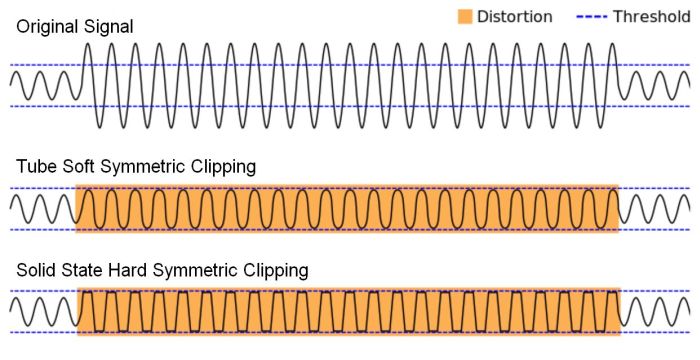
While on the SS vs Tube thang, here's a great visual of Tube clipping vs Solid State clipping & why I use the 'square wave' vs the 'compressed & rounded wave' descriptions for each.....
Although your amp sounds surprisingly good for a newer mass produced Marshall, I do hear a fixed frequency fizz but it's really not too bad or excessive at all & actually seems to comes & go with how hard you are playing (diode clipping??) Fixed frequency fizz is exactly what it sounds like, an added square wave type of generated tone that remains fixed in the same frequency / tonal range & does not change or modulate as the notes & chords change. It's like the square wave fizz has it's own group of resonant frequencies that stay unchanged & static regardless of changes in guitar chords & notes. SS configurations (Diodes) are usually responsible for this because they just aren't as complex as a tube in generating overdrive / distortion.
Sometimes we get so used to this square wave tone built into our amps & our pedals that we almost tune it out & don't hear it! I know I used too! We are after all busy listening to so many things
& playing our guitar at the same time etc etc.
This amp (DSL 40) does a much nicer job than what the JCM 900 de-volved into! Your amp sounds really decent. I could work with it!
Hey, check this Tube vs Solid State comparo!
Is this a 'Her' vs 'your hand' analogy??