Ahhh Yes, I caught the reference to the bridge pins, That is what I remembered. I kind of thought the pickguard/electronics were now different than stock as well.
Thanks.
It's a super mid-humped guitar, and it cuts through above all the others...

Ahhh Yes, I caught the reference to the bridge pins, That is what I remembered. I kind of thought the pickguard/electronics were now different than stock as well.
Thanks.

It's a super mid-humped guitar, and it cuts through above all the others...
Totally agree. I will tune the guitar up and wiggle and snap the strings individually, which instantly detunes them. Retune, snap again until basically it quits dropping drastically. At that point, it largely holds its tune. That and i have stringed it over one wrap, under on the rest of wraps to kinda lock the string. Works ok but will snap from tension if you are bending really hard, so thats something i normally only do on something id play rhythm only on.

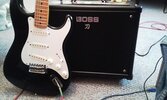
Thats a great amp thoughSince the Katana replaced the '66 Princeton Reverb 4 years ago, this is my main rig
View attachment 51081
Exciting ain' it?
The biggest issue is
stretch - retune
stretch - retune
until the string stops slipping.
If people did this they wouldn't have all the string slip issues.
It's a surprising number of players who don't realize this.
You must do this regardless of locking tuners, locking nut.....
Since I live in a rain forest most guitars will not stay in tune. Out of all my guitars two will stay in tune.
The old blister Fender Esquire and the new Hydra 7 string
View attachment 26722View attachment 26724

Just an old school trick that works good if you have an issue with strings binding at your nut and you dont want to replace it as long as its still good: lube the string grooves with a graphite pencil. Works like a charm


People ask me whats your fav jcm 800..i go umm,ya mod em all anyways...so my answer is always SLX..here is my baby . donated it to my friends studio. It gets on a bunch of recordings,,View attachment 51033
Right so technically the SLX really wouldn't be a JCM800 not to nitpick. My Jubilee is 1987 and uses diode clipping but is not part of the 900 family.Yeah the SLX is a part of the JCM900 family but its a bit of a strange bird. The 800 family of heads are separated by basically two amps: the 2203/2204 and then the 2205/2210.
The 2203/2203 were carry overs of the first Master Volume series JMPs and were single channel, valve amps with few electronic components. The 2205/2210 were split channels that contained a bit more electronic components like diode clipping namely and added reverb.
The 900s were first broken into two amps ( MkIII Hi Gain master volume and Dual Reverb) , which the dual reverb had probably the most solidstate technology in a valve amp from Marshall at that time and is pretty much its own circuit design. The MK3 was sort of a continuation of the 2205/2210 in its circuit but went to a single channel and removed reverb.
The SLX replaced the 900 MKIII a few years after the series began, but removed a good bit of the electronic components, namely the diode clipping and added an extra preamp tube for gain. Its circuit is somewhat closer to the 2203/2204 but certainly updated and what i guess many consider, as a factory modded version of the famous 2203/2204
I prefer the SLX. Thats just me,,i like the sensitively knob vs a TS. Just a great answer to everybody ripping there 800's apart. Right from the source itself,Right so technically the SLX really wouldn't be a JCM800 not to nitpick. My Jubilee is 1987 and uses diode clipping but is not part of the 900 family.

Hey 67, since we are on this Main AXE thread, it reminded me of one that gets little mention by any of us except you here.
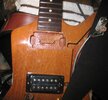
Still Have the Parker Fly?
Crap. Another amp for me to look at!I prefer the SLX. Thats just me,,i like the sensitively knob vs a TS. Just a great answer to everybody ripping there 800's apart. Right from the source itself,
We get to a/b all these Marshall's on a regular basis. my friend has 35+ heads. There is so much myth out there its crazy,
Marshall, turn it up in the zone where they were designed to be used(kick drum level ironically)..every single one of em i ever played..was fantastic.
You sir, are dialed in !!! Keep up the great music !!Crap. Another amp for me to look at!
Oh no you are indeed correct, its a 900 no questions asked. Just uses a lot of the 800s design concepts vs its other two siblings in the 900 family. Call it an 850 lolRight so technically the SLX really wouldn't be a JCM800 not to nitpick. My Jubilee is 1987 and uses diode clipping but is not part of the 900 family.
Thats good...850...Oh no you are indeed correct, its a 900 no questions asked. Just uses a lot of the 800s design concepts vs its other two siblings in the 900 family. Call it an 850 lol
Just an old school trick that works good if you have an issue with strings binding at your nut and you dont want to replace it as long as its still good: lube the string grooves with a graphite pencil. Works like a charm
Everything is slightly bigger then on the double neck?I pay very close attention to the nut sot dimensions I got from Gibson Historic's Archives. Thanks to Simon Higgs (Gibson Artist Relations) for the hook up. These are the specs given for the factory setup of all Les Paul, SG, Firebird/Exp and Semi Hollow Models:
E: 0.058"
A: 0.048"
D: 0.038"
g: 0.028"
b: 0.019"
e: 0.014"
Take note that, according to Gibson Historic, the setup spec for the EDS-1275 is unique:
String Dimensions
E: .11684 cm / .046W
A: .09144 cm / .036W
D: .06604 cm / .026W
G: .04318 cm / .017P
B: .03302 cm / .013P
e: .0254 cm / .010P
Dimensions of String Slots
E: 0.1778 cm / 0.070"
A: 0.13716 cm / 0.054"
D: 0.1016 cm / 0.040"
G: 0.0635 cm / 0.025"
B: 0.0508 cm / 0.020"
e: 0.0381 cm / 0.015"