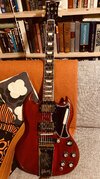
Plugging holes

I can easily, but I work on CNC machinery, and everything is set up behind the scenes in Metric. Even if the customer is using imperial measurements.

I grew up in California, and working in Dad's machine shop, so in my head, 7/8" is .875" and 1/2" is .500" etc., but I've gotten better at metric conversion than i ever imagined.
 
Now, the question is: Will the StewMac files work on the old brass nut installed on my SG Junpir as well?

If you use a little bit of fine oil like WD-40 or tapping fluid, the files will last a lifetime cutting brass. Make sure you also keep them clean. There is a little wire flat brush (file card is what it's called) that you can get from almost any hardware store that is used to keep file teeth clean.
 
If you use a little bit of fine oil like WD-40 or tapping fluid, the files will last a lifetime cutting brass. Make sure you also keep them clean. There is a little wire flat brush (file card is what it's called) that you can get from almost any hardware store that is used to keep file teeth clean.
Good idea. It's not that my nut files see much use, really, but that's no excuse for not taking proper care of them. My ambition is to acquire enough luthier's tools for me to do most types of maintenance work on my guitars myself.
 
Good idea. It's not that my nut files see much use, really, but that's no excuse for not taking proper care of them. My ambition is to acquire enough luthier's tools for me to do most types of maintenance work on my guitars myself.

Good tools should last a lifetime if you take care of them. I have Machinists tools I bought second hand over thirty years ago that were over twenty years old at the time. They still pass QC inspections. There are even metal files in my tool box that I've used aggressively over the years, and those are forty years old at this point.

I do have some cheap tools, but they were purchased not expecting them to last into someone else's life span. Just for a job at hand that needed to be dealt with.

If you buy the right tools, you'll end up passing them down to your kids. The price might put you off at first, but the reward of always having them be there and ready to use more than pays for itself once several years have gone by.
 
If you use a little bit of fine oil like WD-40 or tapping fluid, the files will last a lifetime cutting brass. Make sure you also keep them clean. There is a little wire flat brush (file card is what it's called) that you can get from almost any hardware store that is used to keep file teeth clean.
Have you ever chemically "sharpened" your files with acid? I have not but bought the acid and plan on trying soon

 
Have you ever chemically "sharpened" your files with acid? I have not but bought the acid and plan on trying soon

Never tried it. I use an aluminum block in a similar fashion as the copper. I have always just tried taking care of them. They all still seem quite sharp.
 
So, onTuesday this week the package that the super helpful @RVA sent me arrived. It contained a block of mahogany and a cherry red nitro lacquer touch-uo marker pen. Today I finally got to work on the guitar.

Since I don't really have any serious tools, I decided to take the easy way out with this job. Instead of removing the tailpiece bushings, I figured I would just cover the holes by making two small "buttons" that would fit over the bushings. Using a saw, I cut out a small sliver of wood that would be big enough to make at least four buttons. I cut it as thinly as possible, but naturally I had to sand the sliver down a lot to get close to the thickness I wanted. Luckily I have an electric sander (handheld), and that made the job a lot quicker.

After sanding for a while, I cut out two rough buttons a bit larger than the holes. I then used a small file to get the shape and thickness I wanted. The buttons were slightly convex on the underside, making it easier to fit them in the hole. I then used regular Uhu super glue to glue them in place. This way, it should be fairly easy to remove them should I want to revert the guitar back to its original state.

After the glue had dried, I applied some lacquer to the bare wood. The color is a touch lighter than the guitar's color at the moment, but as it dries I'll apply more, and I guess that will bring the color closer.

The buttons are not 100 % flush with the surface of the guitar, but since it would be impossible to make them completely invisible anyway, I don't really care. The point is that the holes will be a lot harder to detect at a short distance now, you don't know they are there or are looking for them. And of course, the Vibrola will partially cover them as well.

I decided to leave the grounding for now. I'll most likely get a long drill bit and drill a narrow hole from the control cavity to the underside of the Vibrola. But I don't have the right bit at the moment, so it will have to wait a little while.

Some pics of the work so far:

The wood, pick added for size:
hwPoRMw.jpg


The buttons ready for glueing:
sDe0uRs.jpg


Glued in place. Nice and messy:
ECLnyMU.jpg


The first coating of lacquer applied. The big pics reveal how sloppy my really work is, but considering my lack of experience I am satisfied so far:
JpP3hTS.jpg
 
How many coats of lacquer do you reckon I need? And is there a SIMPLE way I could give the buttons a slight shine?
 
  • Like
Reactions: RVA
Ok, being an impatient bastard, I put the Vibrola back on as soon as things were «dry». Looking directly at the covered holes, the work is definitely visible, but when the light is not shining directly on the guitar, and when you are not looking for it, I think the operation was a reasonable success. I think of it as camouflage more than a «proper» job. All in all I am happy with it.
CDD53AEA-08EF-4FE2-B66D-02388B2F162F.jpeg
 
Looks good.i barely see it lookin for it.
The shadows in the picture are covering the holes a bit, but I guess that kind of proves the point. At a few feet away in «real» life, the cover-up works the way it should. I won’t win any prizes for the quality of my work, but I’m not going to turn pro anytime soon, so that’s ok. :D
 
Nice work so far. Not sure that you'll need many layers of lacquer because you're fairly close now (2 more coats?). Also, and I'm off in lala land here... could you use a small black marker before you add the next coat in an attempt to imitate some of the wood grain around the holes; kind bringing in some of the guitars grain 'lines' into the hole, disrupting the circular edges, that kinds thing... :io:
 
Nice work so far. Not sure that you'll need many layers of lacquer because you're fairly close now (2 more coats?). Also, and I'm off in lala land here... could you use a small black marker before you add the next coat in an attempt to imitate some of the wood grain around the holes; kind bringing in some of the guitars grain 'lines' into the hole, disrupting the circular edges, that kinds thing... :io:
I have applied three quick coats, and the color is actually dark enough already. I’m not going to mess much more with it, I think. I can see that the lacquer from the touch-up pen is melting the guitar’s finish around the edges of the holes, so I’m not risking ruining stuff completely. Hell, If I wanted to do this really properly, I would have taken it to a pro to have the holes plugged and have it refinished in a color that would cover the plugs completely. I would have loved an aged pelham blue (green) SG...
 
Back
Top