
SG John
Ambassador of Cool Guitars and Amps.

John, does that have a roller bridge?
No, just a standard ABR-1 with steel saddles.

John, does that have a roller bridge?

Soooooo much awesome! Love it! Enjoy it!Played this at band practice last night. I really love this guitar. It really is way too much fun to play. I was having a blast with it.
Got to get some more recent photos.
View attachment 36623


Now that you have a John Cipollina guitar, you should copy his insane amplifier setup as well!Played this at band practice last night. I really love this guitar. It really is way too much fun to play. I was having a blast with it.
Got to get some more recent photos.
View attachment 36623

That seems to be a very common problem, yes. I can't say I've noticed it yet with this one. I don't know why that is, though. I haven't done anything special to avoid it, really. The saddles are nylon, all I have done to slot them is give the strings a very light whack with a small plastic hammer to create tiny dents in which the strings can rest. And I lube the saddles and the nut slots with Big Bends Nut Sauce every string change.
I think expectations and mindset are key factors here also. For most of my musical "career" I have played less than ideal guitars; My Tokai Stratocaster was really a killer Strat, but I never really dug Strats that much, and Because of a badly set up tree and worn nut, the tuning stability was below par. My second guitar, the 1975 Gibson SG-II had a wraparound compensated for a wound G and was thus impossible to intonate properly, But those were the tools I could afford, so I learned to work with what I had. There is nothing noble about this whatsoever, but I think it taught me a couple of lessons. I can make do with almost anything, I just need to adapt to how things work. Sure, I love modding guitars, and could probably mod all of them into stable tone monsters, but sometimes I mod just for the sake of (my very personal) mojo. And that's were the Maestro Vibrola comes in. There are certain things it just cannot do. Dive-bombs and heavy-handed action are among them. What it can do is light shimmers and subtle coloring. And if the guitar goes slightly out of tune, I just tune it. That's how I have always done it with all of my guitars, and they have served me well. Of course, a lot of guitarists will disagree with me here, but that's ok. Whatever floats your boat. Maestro Vibrolas are slightly finicky tools that do a very specific job.
That thumbwheel idea is pretty good. To be honest, a roller bridge is not an option for me. I want this guitar to be as close as I can get to a 1964 Gibson. Silly, I know, but that's just the way it is.Honestly, you should be able to perform some fairly dramatic dives without problems.
Ive replaced many nylon saddle bridges and did not notice a difference in tone, TBTH, although some claim to be able to tell a difference.
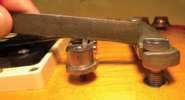
When i set up a 'vibrola' such as this one, i quite often put an extra set of thumbwheels (or a SS flat washer and small nut) under the bridge and use them to lock the bridge posts in place. This eliminates the rocking action of the bridge.
Its presence is almost unnoticeable. I have also slid a felt disc over the extra thumbwheels on some guitars to hide them.
I use the $15.00 roller bridges from Philadelphia Luthier Tools on almost everything short of a vintage relic. They are avaiable in a wide vareity of finishes and post diameters too.
The nut should be cut on the same 17° plane as the headstock and each slot should be .004" to .005" larger than the string being used.
I actually have Gibson's published nut slot specifications i can dig up for you, but .005" to .005" is a good starting point.
Wishing you all the best...
That thumbwheel idea is pretty good. To be honest, a roller bridge is not an option for me. I want this guitar to be as close as I can get to a 1964 Gibson. Silly, I know, but that's just the way it is.
As for heavy vib use, this one works really well so far. As I have said, I don't really use the vib much, but I am able to use it to drop the low E down a whole step to D without having any trouble. If it goes flat, a light upwards tug sets it straight. Compared to my old Tokai Stratocaster this one is better. And this is without any extra mods to the bridge (other than replacing the stock one with a nylon saddled one...) or the nut. I still don't think Vibrolas are very well suited to heavy-handed use, but for my playing they work fine.
As for cutting and filing nut slots, I am not going to risk doing it myself on this guitar. I have not practiced enough on other guitars to risk it. I have only done light nut work on a couple of other guitars (they both ended up ok, but still), and this being my nr. 1 guitar, I will had it over to an experienced luthier when the time comes.
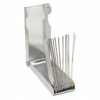

Robert, I wish you were my neighbor!I use a common set of welding tip cleaners.
View attachment 36628
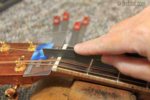
I use a micrometer to find the correct size and then gently pass it through the nut. The angle is very easy to maintain.
The tip cleaners are very gentle in material removal. They give the slot floor a rounded profile. A fret slot saw gives a flat floor profile, which then has to wear in, resulting in action that drops in the first few weeks after you deliver the guitar back to the client.
Note in this image, the file is following the angle of the headstock:
View attachment 36627
EVERY nut I make is finished with a welding tip cleaner to give the slot floor a round profile.
It is also the best tool to use to create slots in the saddles.
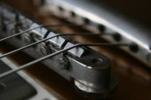
I do NOT like this type of slotting on a ABR or Nashville bridge, where the string sits up high off the edge of the saddle:
View attachment 36629
This IS how I set up all ABR's or Nashville's - Note that roughly 1/2 of the string is down into the slot in the saddle.
View attachment 36630
This also keeps the string on the saddle with dramatic vibrola use. I do guitar tech for a guy who has a 'Stray Cats' style band and he divebombs into oblivion on his 335 and I have been able to keep it in perfect tune.
Here is a good approximation of how the bridge saddle angles are done:
View attachment 36631
Robert, I wish you were my neighbor!
I have a set of nut slot files from StewMac (.010-.046 gauge). They are rounded, so I guess they would work fine.
Hahaha!You can easily do this. Slotting the saddles and opening the nut is easier than the Lyre installation!!!
Embrace your inner Luthier!!!
 I just don't want to screw things up royally bu filing the nut slots too deep...
| E: | 0.058" |
| A: | 0.048" |
| D: | 0.038" |
| G: | 0.028" |
| B: | 0.019'' |
| e: | 0.014" |
Hahaha!
But you can get the extra clearance by tilting the files gently from side to side.Yes. the rounded files eliminate the profile problem. My files are all squared off on the face, so I follow-up with the welding tip cleaners...
The reason for the welding tip cleaners is, the nut slot files don't give you the added clearance necessary for free string movement.

Yes. I have a bunch of Stewmac's gauged nut slotting files. They will cut through brass saddles pretty easily. I'm also assuming that cutting through brass saddles will cause the files to wear out faster, but unless you do a set of saddles everyday, those files should last you a long time.Will the StewMac files work on the old brass nut installed on my SG Junpir as well?
I also want to add, that these welding tip cleaners suggested by Robert are an excellent and very useful tool in proper shaping and sizing of the nut slots. Plus, they are very inexpensive... $5 maybe?I use a common set of welding tip cleaners.


Here are the specs from Gibson Historics Archives - Special thanks to Simon Higgs:
String gauge:
E: 0.046"
A: 0.036"
D: 0.026"
G: 0.016"
B: 0.011"
e: 0.009"
Measurements shown below are for the actual width of the nut slots:
E: 0.058" A: 0.048" D: 0.038" G: 0.028" B: 0.019'' e: 0.014"
Don’t worry. String gauges are measured the ‘murican way here as well, so inches are just fine.OK Robert, you have to convert those to mm for Gahr.
Robert, I wish you were my neighbor!
I have a set of nut slot files from StewMac (.010-.046 gauge). They are rounded, so I guess they would work fine.
OK Robert, you have to convert those to mm for Gahr.
But you can get the extra clearance by tilting the files gently from side to side.
Will the StewMac files work on the old brass nut installed on my SG Junpir as well?