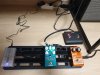
Please help me with my pedalboard...

In 1974 I was playing at a dance in Brooklyn.
After the first set someone came up to me
with a puzzled look on his face and said
"You don't sound like anybody else."

I am still riding on that compliment.
:)

The way it ought to be.

I don't think I will ever understand why people chase other players' tones.
 
Are Marshall amps all about the crunch and distortion? Everything I hear, read and research tells me so. I'm not a fan for my personal use...
Actually my JCM800 4210 clean channel sounded great to me but the dirt wasn't so nice, unlike the earlier or later combo models where they sounded great dirty.
 
To be fair though, those tones have been beaten to death by a million guitar players. There's nothing wrong with those sounds, but they seem so...dated now. I mean, I get nostalgic for that music from time to time, it's what I grew up with after all, but I really don't want to sound like those guys. I want to make a sound nobody's heard before, just like they did.

My sound is my own for sure. I have no idea how to begin to sound like someone else...

However I'm leaning toward a Pink Floyd or Porcupine Tree

 
OK, this conversation has taken an interesting turn - and I'm pleased that Plexi has turned up because he has forgotten more knowledge than I'll ever learn...

The Origin is no DSL. It is not a high gain amp and does not work in the same way a DSL does or have the same characteristics that a DSL does; but because I've owned both and most of you have knowledge of the DSL, I will compare/explain the two - and why this leads to the problems I am having... (Then, Plexi can correct the nonsense I've written... :D).

The DSL and Origin both have 3 similar preamp tubes and 2 EL34 power tubes, but that's where the similarity ends - these preamp tubes and power amp tubes work very differently in the two amps.

The DSL has a lot of preamp gain and low headroom - it is easy to get drive at any volumes because the preamp tubes are doing a lot of work on the sound, and, thus you have a low headroom and pedals, such as a tubescreamer, work ok at any volume (I didn't say work well...).

The Origin has very little preamp gain and very high headroom - the amp wants the power tubes cooking before you close the headroom and get the underlying tone that would take drive pedals well. On high volume, i.e. volume and gain from the power tubes, something like a tubescreamer sounds amazing. On any volume, without the power tubes working hard, drive pedals sound poor...

The two amps are just very differently designed. The Origin has really nice cleans, and I can get to nice breakup sounds with the SGs powerful P90 - sounds great (better than I ever got the DSL to sound for bluesy tones, to my ears).

The only way to get drive pedals working well on the Origin is to crank the power tubes/Master Volume - this can be done at low volume levels with an attenuator because the power tubes would be pushed.

What amp are you playing the pedal board through?

Marshall Origin 20 combo - comes with a Celestion V30 10" speaker which sounds good.

I'm surprised that you couldn't find harmony with that Tube Screamer.

I don't think you can find the right soundspace without pushing the power tubes hard - at my pre-85db levels, even at 3w, I am not pushing the power tubes enough to get the sonic space required for a tubescreamer. Having said that, if I twiddle the knobs enough I should be able to find some decent tubescreamer sounds, you would have though - & some are decent, just not as good as the SG and the amps boost, to my ears anyway. At high volume, at a rehearsal or gig, then a TS would sound really nice (I'm pretty sure).

How does your experience compare to what you see and hear from this following video demo?

It sounds the same without pedals. But, these demos all sound much better than I can get when they add drive pedals because thye are usully on the 20w setting and around 100db.

Reading on the Marshall forums, some folks say the Origin is great with drive pedals and others say it's terrible - they are both right. It's great if the volume is up, crap if the volume is not cranked. I think this is a well known plexi style amp characteristic, but I just never owned an amp of this type to fully understand what I'd read many times over...

Are Marshall amps all about the crunch and distortion?

No. Some are, some are not. Now that Scando fella that does the amazing videos makes even the low gain Plexi amps sound amazing (the Origin is in that general style), but he cranks the power tubes to get those amazing sounds.

Can be maddening especially when you cant crank it into "the zone" due to volume restrictions

Yeah, basically that's it. But, at sub 80db levels I still get really nice blues/classic rock sounds as long as the guitar has a bit of oomph from the pickup(s). I really like the sounds I'm getting with the SG. &, the Origin's boost works great at all volumes.

My point is Early Marshall amps are not high gain

You, Sir, are correct. &, they have really high headroom too if they are anything like this Origin 20.
 
Last edited:
&, I have a question:

Here's the Origin 20 combo's amp/speaker connection:

bnkeymebuit7woq2nfv3.jpg


Here's a DSL 1 watt head connection:

Screenshot 2019-04-24 at 13.11.27.png

Both are 16 ohm, so if I didn't turn on the Origin amp, disconnected the speaker cable and connected it to the DSL head (using a longer cable, obviously) - would it work OK? Or, would I blow something up? Effectively, I'm just asking if the combo's speaker can be used as an independent cab.

The Origin speaker sound good, and I've read that a 10" V-Celestion suits the DSL well.

The little DSL1 head is available on sale locally for $240 - I could send back the TS and get the head to solve my low volume higher gain issues.
 
Just so you know...I do it all the time with a bass combo cab...
098A40DE-D148-4DDD-A83B-795F391E4638.jpeg


See the lit up Orange amp?...it’s plugged in to the Tube Works cab....the Tube Works head died “not in my presence”....now I feed the cab whatever...
 
I use the speaker in my combos with the amps in other combos or heads regularly as well.
The Silkyn speaker is plugged into the Micro Terror here.

I used to pull the mains fuse for any combo that had the speaker disconnected but I got lazy (ier?)
Now I ALWAYS look to see the speaker is connected before applying power.
The master is down low and the gain cranked to 3:00.
It works well with the hybrid because the power section is ss, but of course tone is subjective.
Part of the tube power section - or the need to get things cooking - also will include speaker break up.

That Orange is / was an incredibly loud 20w in a small package.

IMG_1566-2.jpg
 
Liking that double cut LP thingy, what is it?
iT is a Blake Wright Guitars Santa Fe.
Small builder contracted a China factory for 2 runs of them couple years ago.

It was supposed to be more symmetrical horns like a Gibson DC, but ended up being more PRS ish including 25" scale.
Basic to keep the cost down, overall good bones, set neck decent fretwork.
Typical cheap but usable hardware and a terribly cut plastic nut.

Has a Tusq XL nut and Wilkinson vintage green keys tuners now.
The Musiclily Pro vintage green keys I recently put on an Agile DC P90 are noticeably better.

The ceramic pickups were pretty bland. I tried magnet swaps and another cheapy bridge pu but an upgrade is in the offing.
I really like it.
It is light and hangs just right on my body, as does a strat / strat shaped object.
 
That sounds great. So, low power mode - how loud did you have it turned up? Was that room-filling loud or say, conversation level?

ON that guy's settings it was over 80db (it seems that in this apartment above 60db is noticeable to the wife in the other room while above 70db appears pretty loud to others - when I'm watching quite loud videos it's around 60db) - a sensible areas, for this apartment seems to be 50db to 60db. On that guy's settings, I just turned the volume down a bit, and it still sounded good with the SG at reasonable volumes, and that was without the boost which adds a nice girth and lower end.

I had been playing on the 3w setting as I couldn't find as good a sound as the video gets on the .3w setting - but both work well.

You can imagine, if that's how it sounds on the .3 w setting with master volume on half way-ish, then with the volume up on the 3w or 20w settings it sounds fantastic, but very loud.
 
I think I have come to accept that I will never get the "ideal" sound I hear in my head when I'm playing at low volumes. But I can get reasonably close. And I have also realized that what I want will not be found by using lots of pedals. I only really get what I want when the amp gets to shine.

This is the reason I have downsized my pedal collection massively lately. I simply end up not using the pedals anyway, so why keep them... Naturally, how many pedals you use will largely depend on your musical preferences, but for me the basics have become all-important. Get a good sound with a nice pickup/amp/speaker combo and then take it from there. I use a few pedals to color the sound every now and then, but I have found that there are certain things I simply do not need most of the time.

I hardly ever use an overdrive pedal anymore. When I do, the Crowther Hotcake gives me what I need, and I usually keep it at a very low gain setting.

I use a bit of delay from time to time, mainly just slapback. The MXR Carbon Copy gives me what I need. It's easy to tweak to where I want it, and the build quality is good. It is not a fancy pedal, and doesn't have a million options, but it sounds good.

Once in a while I need a bit of fuzz. I like the low/medium gain Sunface NKT275. It seems to work well with the amps I am using. again, build quality is good.

When it comes to reverb, I have found that I think I prefer plate reverb. I really love the Catalinbread Talisman. I feel reverb often muddies up the sound too much, especially the lower frequencies. The Talisman has a low pass filter that takes care of this. It also has a knob that adjusts the pre delay, meaning you can set the reverb to kick in a little after you strike the strings. This also prevents muddiness and makes for a cleaner attack in the sound. There is also a preamp in the pedal, but I keep that one turned all the way down most of the time. But it is an additional "weapon" for solos, if need be. This is probably the pedal I have been the most happy with with all the pedals I have ever owned. It does not give you lots of different reverb types, but what it does, it does really, really well.

I still have a few other pedals as well (a vibe, a phaser, a compressor, a boost, a multi-transistor fuzz made for me by a friend, a Fuzzface on loan to a colleague, and a couple more), but I very rarely use them. Some of them might be up for sale soon, but a few of them will stay. They are all pretty good pedals, and might come in handy from time to time.

So, what is my point? Well, I guess it is the old idea that one should focus on the basic sound first. Get the guitar/amp/speaker to sound like you want it first. Then start looking at some pedals that will give you the little extra you want. And life became a lot easier when I simply accepted that the ideal sound will only be possible at a certain volume. It doesn't have to be extremely loud, but it might be too loud for everyday living room playing. I now play slightly lower than I really want, but it's ok, because every now and then I know I can get a shot of what I really want.
 
I use the speaker in my combos with the amps in other combos or heads regularly as well.
The Silkyn speaker is plugged into the Micro Terror here.

I used to pull the mains fuse for any combo that had the speaker disconnected but I got lazy (ier?)
Now I ALWAYS look to see the speaker is connected before applying power.
The master is down low and the gain cranked to 3:00.
It works well with the hybrid because the power section is ss, but of course tone is subjective.
Part of the tube power section - or the need to get things cooking - also will include speaker break up.

That Orange is / was an incredibly loud 20w in a small package.

View attachment 24467

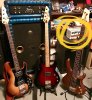
Can you find the Epiphone?
 
I think I have come to accept that I will never get the "ideal" sound I hear in my head when I'm playing at low volumes. But I can get reasonably close. And I have also realized that what I want will not be found by using lots of pedals. I only really get what I want when the amp gets to shine.

A lot of sense in that post, Gahr.

A lot of my recent nonsense has been seeking tone through acquisition instead of practice.... They're are some good points, and stuff I agree with you on (much, actually): the basic amp tone is good, and that's the most important thing; it's even better a bit louder, but that isn't for everyday practice.

Pedals, meh, yes, no, easy and cheapish to buy and justify, probably not needed nearly as often as we pretend. I like the Wampler because it has delay and reverb which can be soft to just increase the soundspace, but can also be whacky fun which makes practicing scales more fun - the pedal is easy to dial in (Wampler seems to consistently do this better than just about anyone else). I also like the plate reverb more than the other reverb options I've tried which is why the Wampler and Keeley which might turn up one day (USPS, so maybe it won't...) both have plate reverb - one with delay, one with tremelo.

I'm enjoying practicing through the Gminor 5 positions playing alongside a nice Blues backing track, and now have a teacher who's a bit of a bastard if I don't practice! &, I get to play his lovely Les Paul at high volume when I go to his studio (he charges $200 for 4 one-hour lessons in a month - I'm not sure if this is expensive or not?)...

Practice, good basic tone which the Origin has, and a bit of loudness when the luxury affords itself - and, sometimes some pedal action (I'll keep the pedals I have and bring them out from time to time - might get an Analogman fuzz too although I just can't make fuzz work at lower volumes, so rarely enjoy it).
 
Back
Top