@NewReligion
A lot of great work there to be certain. I apologize if my comparison (comment) seemed like a negative, because it's not intended to be that way at all. You've done some incredible work on that amp.
First and foremost, tone and gain production are both very subjective I think.
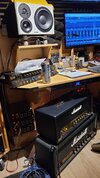
The main studio where I work (for a living) has a Mike Morin Modded JCM800 - 2204. It has the Tim Casswell style extra gain stage, numerous cap value changes and a rear panel FX loop with a switch. I am always so disappointed in that amp when we use it, because to get any real saturation from it, I still have to use a TS-9 and that increases the noise floor, so to me, it's just such a waste of time when I can plug in just about any other amp in the studio and get more grit from them. I feel the same way about the studio's, hugely overrated Overdrive Special.
When I discovered the HF mod for the Origin, and struck up an online friendship with JT, It was the first time I heard an amp that I really liked without a full pedalboard. Forum members
@ivan H and
@syscokid put their talents together and did not only the HF mod and the Jose Arredondo diode clipping mod on my Origin 50, but also changed the amp's voicing through the use of different cap values, and developed a method for scaling back the excessive voltages with modified droppers as well.
Since nobody has ever posted stock origin voltages, we were "in the dark" so to speak when we encountered extremely high voltages following the HF mod on the Origin 50. The Origin 20 is cathode biased and the Origin 50 is fixed bias, so when you perform the origin 20 mod to the Origin 50, you start seeing things like 385 volts on V2 pin 1 and nobody has ever documented this until
@syscokid charted out all the requiste voltages and took steps to bring them down into acceptable limits.
Good comments on the clipping diodes. I see the "Jose" mod to work more like an attenuator than a gain producer, IMHO anyways.
Nothing but respect for your work.
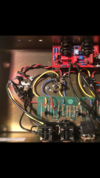
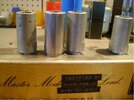
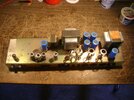
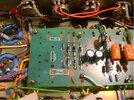
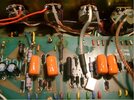
Here's some inside shots of the Morin Modded JCM 800 owned by the studio:
View attachment 73377
View attachment 73381
I saw some of the absolute worst, sloppiest work ever inside this amp. I was asked to get it running again after it stopped working.
He sanded the values off some of the capacitors, sufficiently (in some cases) to allow Mylar to be exposed and attempted to "hide" resistor values by painting them with conductive paint. The amp had such incredible hum/buzz that it really was shocking. I found one of the coax braids was very near, almost touch a voltage source, so I re-routed and shrink wrapped it and virtually eliminated the noise.
View attachment 73382
View attachment 73384
All I saw here was a huge mess and trying to "hide" your work by sanding/painting over color codes is ridiculous since you can easily test any component and determine its relative values.
May all that you do be blessed...