NWAOAFD

But you've said stuff about gain...and not being able to get enough from a smaller amp...and that smaller amps don't have enough "balls" for you...and that you can only get "your" tone at high volumes.
That's ok and all, but not all of us agree with that idea...and some of us have them set up side by side, and can hear it for ourselves.
Like I said, that's ok. I'm guessing that what you really like is power tube distortion from a 6L6, or EL34 amp. Like the amps that you have. You might even be ok with a 20watt 6V6 circuit if you tried one with the right speakers for you. You also might like a single 6L6/EL34 amp...who knows...

You know, Don, maybe if I sat down with somebody who was successfully running a smaller amp with good results, I could be educated in how to get a good tone from a smaller setup??? Every small amp I have tried sounds like a toy to me. We bought our daughter a new Fender Frontman recently and it doesn't sound too bad actually, but I've never taken it to a practice session.

In my previous (rock) bands, I was driving this (DSL40C) amp really hard, so hard, in fact, I started using a 90 watt Creamback, which allowed me to run very high volumes without the speaker breaking up. Now, I am with a band where I play with much less gain, and the 90 watt Creamback doesn't sound as good at those volume levels, so I went with a WGS Veteran 30. That was a step in the right direction.

Tell you something...for as long as I could recall, all my stuff could be setup and adjusted in minutes. I had one tone that I dialed in for. Now, I am playing this strange, early 60's music, and everything is out the window. Amp settings have to be changed on the fly between songs, some songs have to be "green channel," it's really hard to keep up with.

Let's just say I got myself in a position where I am so far outside my comfort zone that nothing sounds "right" to me, so I am just going by the bandleader's feedback, and everyone seems to like the direction it's going.....I've never seen amp settings like I am running on my DSL40C right now - Bass 10, Mid 10. Treble Half, Gain 1/4, Tones rolled off to 4 or 5 on the SG. With the .03uf/.015uf K40Y tone caps, the SG never gets dull and muddy, even rolled off, but it's just so different....Oh, and don't you dare show up to practice without the SG. I took the Schecter and they didn't like the tone at all....
 
.but--- TBTH --- I do not have HOURS of FREE TIME to dick around when I want to play-- I need turn the amp on adjust a knob or two for the guitar I have selected and my mood ---and GO! ---

That was the rabbit hole I choose to avoid.

There is enough to keep me busy with just a couple 'o few knobs each on amp and guitar and a pedal or two on at any one time or not.
 
Hey Robert glad to see you and that SG are finally bonding!!

Yes! Thanks!!! I think I got over being pissed off at it because I had to strip it out and rewire it. So far, it's working out great. The band gets nervous if I show up without it. It seems to compliment the bandleaders clean Strat very well....
 
Every small amp I have tried sounds like a toy to me. We bought our daughter a new Fender Frontman recently and it doesn't sound too bad actually, but I've never taken it to a practice session.

Here's what I've learned to be the mistake people make with smaller amps in a live setting: they are listening to the amp!

That sounds really counter-intuitive, but it's true. People are expecting the amp to be the big driving force, but due to it's size, it isn't. Consequently, they are dissatisfied with the amp.

The way to think of the amp is that it is your final tone shaper. It is the last element in creating the sound. The PA provides the loudness and the volume. The monitors are your audio clue about your amp. Learn to listen to the monitor.

When I play on stage with my little 5 watt Marshall, I don't even hear the amp! In fact, I use it to drive a speaker in an isolation cabinet. The microphone in the cabinet runs to the house mix. I get my audio either through a foldback monitor or in-ears. If you were to go to the FOH and listen (which I've done because I sometimes use a wireless) the sound is nothing short of huge.

So, if you expect to have a small amp "feel" like a big amp on stage, you'll be disappointed. But, if you realize you are using your amp to be the sound source for the PA, you'll learn the value of it, and the audience will actually have a better experience than if you are just running wild sound from your amp on stage.
 
Here's what I've learned to be the mistake people make with smaller amps in a live setting: they are listening to the amp!

That sounds really counter-intuitive, but it's true. People are expecting the amp to be the big driving force, but due to it's size, it isn't. Consequently, they are dissatisfied with the amp.

The way to think of the amp is that it is your final tone shaper. It is the last element in creating the sound. The PA provides the loudness and the volume. The monitors are your audio clue about your amp. Learn to listen to the monitor.

When I play on stage with my little 5 watt Marshall, I don't even hear the amp! In fact, I use it to drive a speaker in an isolation cabinet. The microphone in the cabinet runs to the house mix. I get my audio either through a foldback monitor or in-ears. If you were to go to the FOH and listen (which I've done because I sometimes use a wireless) the sound is nothing short of huge.

So, if you expect to have a small amp feel like a big amp on stage, you'll be disappointed. But, if you realize you are using your amp to be the sound source for the PA, you'll learn the value of it, and the audience will actually have a better experience than if you are just running wild sound from your amp on stage.

We have a big outdoor show January 15th. I will be playing the new Double Neck for that venue with the VS265 on the 12 string neck and a DSL40C on the 6 string. That venue will be miked. All our other small, private party venues could likely be done with a Blackstar ID Core 40watt.

I told the bandleader, "Hey, I don't really need a 40 watt Tube Marshall to cover Neil Young." He responded, "Hell, you don't even have to be in tune or be able to sing to cover Neil Young!"
 
Hmmmm, I may have a good chance of learning more Neil Young songs than I thought.
 
Hey Robert what pickups are coming out of that SG and what are you doing with them?
 
But, if you realize you are using your amp to be the sound source for the PA, you'll learn the value of it, and the audience will actually have a better experience than if you are just running wild sound from your amp on stage.

As a follow-up to the above post, I think it's worth pointing out that in huge arena rock concerts, the audience is not hearing a Marshall stack, even though that may be what is on stage. That stack is mic'ed because even a 100 watt Marshall is woefully insufficient to provide sound for a stadium of 30,000 people. The microphone feeds a mixing console that feeds amplifiers capable of THOUSANDS of watts which are driving huge speaker stacks and line arrays. So, the audience is not directly hearing the Marshall stack; they are hearing the mic'ed signal after it has been mixed, EQ'd, and amplified to the PA.

So, my practice of mic'ing a 5 watt amp for an audience of a couple hundred is functionally no different than the largest names in rock and metal playing to arenas of thousands. The difference is only one of scale.
 
Last edited:
Back in the day we played in a lot of tiny clubs where the P.A. was only enough for vocals and snare/hats. Guitar and bass were all stage volume, hence one of these:

430982000306000-00-500x500.jpg


By the early/mid '90's pretty much every place we played had a decent P.A., so the switch to:

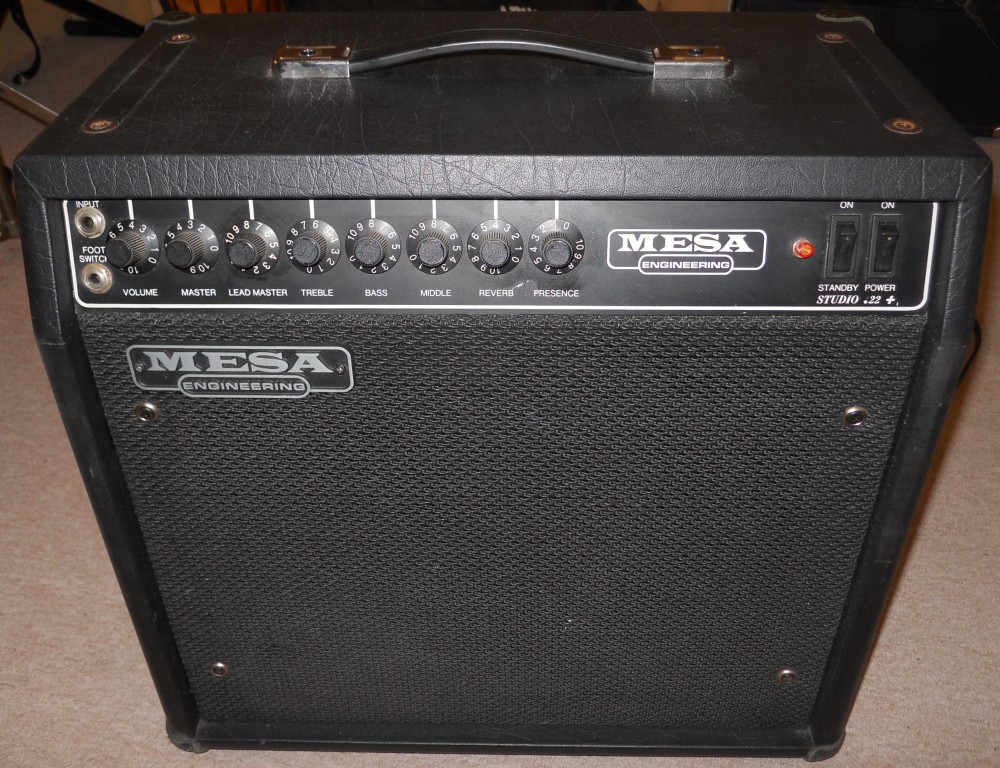
mesa-boogie-studio-22-317505.jpg


So I went from a 50-watt through a 4x12 to a 22-watt through a 1x12 open back and was happier for it. Through the P.A. nobody in the room knew the difference, and I wasn't blasting my own head off any more. Got the amp into power tube distortion at a reasonable volume and then let front of house figure out the rest. Best part is we could all hear each other properly for once. Second best part is it was portable.

When I have had other amps that needed to be turned up louder to get the sound I wanted I stuck in a good attenuator - for combo amps I have found the Dr. Z BrakeLite hard to beat.

Now that I've switched over to channel-switching amps, I don't really think about the power section that much. 90% of the tone is coming from the preamp anyway, so I retain the same overall tone at any volume except maybe bedroom levels.
 
Here's what I've learned to be the mistake people make with smaller amps in a live setting: they are listening to the amp!

That sounds really counter-intuitive, but it's true. People are expecting the amp to be the big driving force, but due to it's size, it isn't. Consequently, they are dissatisfied with the amp.

The way to think of the amp is that it is your final tone shaper. It is the last element in creating the sound. The PA provides the loudness and the volume. The monitors are your audio clue about your amp. Learn to listen to the monitor.

When I play on stage with my little 5 watt Marshall, I don't even hear the amp! In fact, I use it to drive a speaker in an isolation cabinet. The microphone in the cabinet runs to the house mix. I get my audio either through a foldback monitor or in-ears. If you were to go to the FOH and listen (which I've done because I sometimes use a wireless) the sound is nothing short of huge.

So, if you expect to have a small amp "feel" like a big amp on stage, you'll be disappointed. But, if you realize you are using your amp to be the sound source for the PA, you'll learn the value of it, and the audience will actually have a better experience than if you are just running wild sound from your amp on stage.

I'm not often able to be miked, although I prefer it.
 
Last edited:
Back in the day we played in a lot of tiny clubs where the P.A. was only enough for vocals and snare/hats. Guitar and bass were all stage volume, hence one of these:

430982000306000-00-500x500.jpg


By the early/mid '90's pretty much every place we played had a decent P.A., so the switch to:

mesa-boogie-studio-22-317505.jpg


So I went from a 50-watt through a 4x12 to a 22-watt through a 1x12 open back and was happier for it. Through the P.A. nobody in the room knew the difference, and I wasn't blasting my own head off any more. Got the amp into power tube distortion at a reasonable volume and then let front of house figure out the rest. Best part is we could all hear each other properly for once. Second best part is it was portable.

When I have had other amps that needed to be turned up louder to get the sound I wanted I stuck in a good attenuator - for combo amps I have found the Dr. Z BrakeLite hard to beat.

Now that I've switched over to channel-switching amps, I don't really think about the power section that much. 90% of the tone is coming from the preamp anyway, so I retain the same overall tone at any volume except maybe bedroom levels.

I been eyeing the Blackstar ID-CORE for a while....very portable.
 
I been eyeing the Blackstar ID-CORE for a while....very portable.

Have you played one at volume yet? I'm gonna go out on a limb here and predict that if you already think going to a lower-powered tube amp will lack "balls" you will be quite disappointed by what a modeler is going to give you.

I know I sound like a broken record, but a 18-25 watt tube amp should be all you ever need. Get a head, and run it through a sealed back cabinet and you will have all the volume and punch you could ever need and be able to get into power-tube saturation at a much more manageable volume. If not, get a decent attenuator. Heck, for certain sounds I run my Mesa's in 10-watt mode and it's way more than enough to compete with a full band.

Come to think of it, don't those DSL's operate at half-power? Knock that thing down to 20-watts and you get the crunch going at a lower volume.
 
Have you played one at volume yet? I'm gonna go out on a limb here and predict that if you already think going to a lower-powered tube amp will lack "balls" you will be quite disappointed by what a modeler is going to give you.

I know I sound like a broken record, but a 18-25 watt tube amp should be all you ever need. Get a head, and run it through a sealed back cabinet and you will have all the volume and punch you could ever need and be able to get into power-tube saturation at a much more manageable volume. If not, get a decent attenuator. Heck, for certain sounds I run my Mesa's in 10-watt mode and it's way more than enough to compete with a full band.

Come to think of it, don't those DSL's operate at half-power? Knock that thing down to 20-watts and you get the crunch going at a lower volume.

Yep. The DSL40C does have a 20 watt switch. I've never used it on the 20 watt setting. Maybe I will experiment.

My main desire for a smaller amp (physically) is just to transport a smaller, lighter amp to practice sessions and very small venues...athough my DSL40C fits in the trunk of my.Mustang, its pretty heavy at 50 pounds
 
Back
Top