Non-Reverse Thunderbird Bass build

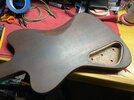
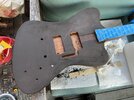
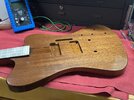
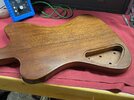
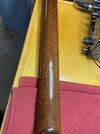
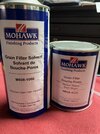
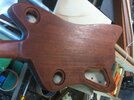
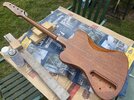
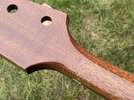
Yesterday I did manage to get a few coats of the grain filler into the back of the body, neck and headstock. Tonight I did the front of the body. After sits a bit longer, I’ll wipe it down and take it back to the cellar. I hope to have it sanded before I go to the twin cities on Friday. After I get back from a work trip a week later, it should finally be ready for clear coats. May have to do one coat of stain again if I go too heavy with sanding down the grain filler.


7952E669-8BA1-4DE3-A7D5-B0D865E913B2.jpeg

5DD20D08-F99B-4B6B-B0CD-00427BBDE3F8.jpeg
 
So I just did grain filler before stain and you did grain filler after stain. Does it make a difference? I was working with Ash (or whatever Fender is using these days) versus Mahogany. Plus I didn't do any kind of a sealer coat.
 
20210731_184145.jpg
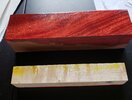
This piece of African Mahogany got 1 coat of ebony grain filler, the same red stain I used on the Strat and then a couple quick coats of nitro to get a true idea of the color. I need more nitro and a bunch of finish sanding to make it like glass, but what would I gain with a sealer coat and grain filling after stain?
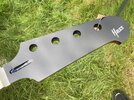
 
This piece of African Mahogany got 1 coat of ebony grain filler, the same red stain I used on the Strat and then a couple quick coats of nitro to get a true idea of the color. I need more nitro and a bunch of finish sanding to make it like glass, but what would I gain with a sealer coat and grain filling after stain?

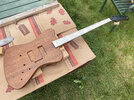
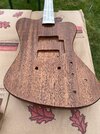
Hey Chris, since there are so many differing views, I thought I would try to experiment. In the past I would make an egg white slurry and spend the entire course of a day sanding with fine sandpaper and egg whites. The omelet that I would make that morning would be pretty tasty with several yolks. With the amount of work it takes, the necks would usually come out like glass, but the bodies would still be porous and suck the lacquer into the grain.

This time what I did was a very light coat of sanding sealer, then sanded it back so it was only left in the pores. Then I used the antique cherry stain for three coats. It's the same stain that I used for the body and neck of the Billy-Bo. I figure it should be deep enough into the wood now. Then I used a walnut tinted oil based grain filler. When I sand it back, I hope that the grain will look like it has faux mineral streaks. I'll use 300 grit for sanding, and hope to not mess up the antique cherry. If I do, I should be able to stain it again, and the grain filler will stay dark.

Then I'll work on all the nitro clear coats.
 
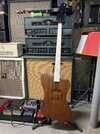
After spending most of September in Germany for work, I was slammed ever since I got back. Today, I’m trying to make the best of a beautiful dry autumn day, and sprayed several coats of clear lacquer on the bass. It’s 51” long, so it’s a bit too tall to hang from the clothesline pole like I normally do. Trying a two step approach instead. Tomorrow, it should be done. Then, I just have to wet sand, polish, assemble, and set up.

704858AE-EA8F-4E66-9827-DE819E7A1E4A.jpeg


C6E33FD5-19E5-44DF-9A19-0CF606C26C3A.jpeg


A367CDF7-85C5-4FC0-B866-ED0F42D2A214.jpeg
 
Went at it with a very rough micro-plane rasp and then some sandpaper to smooth it out. I’ll give it a go with a spokeshave tomorrow night. With such a long neck, it will be interesting.

View attachment 64342
Why do you glue the neck in before shaping? I would think it would be safer to wait until after shaping in case you were unhappy with the result.
 
Why do you glue the neck in before shaping? I would think it would be safer to wait until after shaping in case you were unhappy with the result.

Usually I’ll rough it on my belt sander first. Since this neck is so much longer, I felt uncomfortable doing that. I also don’t have any kind of bench vise to grab it with. Although at times a bit awkward, it’s easier for me to grab the body while working on the neck. I can also clamp the body to my drill press table table.
 
Last edited:
Well, I think I‘m done with spraying lacquer. I ordered a few more cans just in case something shows itself later.

Now, to wait a few weeks before I can do all the stuff like wet sanding, polishing, fret leveling and crowning, nut making, wiring, etc.

DF395A10-89F2-4FC5-A751-4434885BEBDC.jpeg

D5C90874-5AA6-40EE-AFB2-8E7C47F467FE.jpeg
 
Last edited:
Nice job spraying! I always think I nailed it...until I look closer! You seem like you got this one though!
 
Trying to catch up on this great thread too. Very nice work so far, SG John. So, can you tell me more in how you prefer to roll those edges?


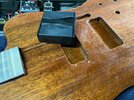
Thanks. After I dress the fret ends (but, before polishing), I'll use real fine sandpaper to take a bit of the wood out. I make sure to leave a bit to each side of the fret end. That way, it looks like natural wear. After I've gone the length of the fingerboard on each side, I'll grab a large screwdriver and run the shaft along the edge of the fingerboard. If it's bound, I'll only use sandpaper. Either way, I'll have to be careful, as I always make sure lacquer covers the sides of the fingerboard whether it's bound or unbound. I try to sand the lacquer near the unfinished board so that it resembles wear and has a comfortable feel. After it's comfy, then I finally polish the frets.
 
Thanks. After I dress the fret ends (but, before polishing), I'll use real fine sandpaper to take a bit of the wood out. I make sure to leave a bit to each side of the fret end. That way, it looks like natural wear. After I've gone the length of the fingerboard on each side, I'll grab a large screwdriver and run the shaft along the edge of the fingerboard. If it's bound, I'll only use sandpaper. Either way, I'll have to be careful, as I always make sure lacquer covers the sides of the fingerboard whether it's bound or unbound. I try to sand the lacquer near the unfinished board so that it resembles wear and has a comfortable feel. After it's comfy, then I finally polish the frets.
Thanks... :cheers:
 
Despite my shoulder and elbow hurting like hell from wrestling machinery, I managed to wet sand the T-Bird this weekend. Started with 600 grit, and worked my way all the way to 6000 grit. Maybe tomorrow night, I'll buff it out. Hoping to crown and dress frets this weekend.


600 grit.

100_Wet sand 600_resize.jpg


101_Wet sand_600_Resized.JPG


And, this is what it looked like after the 6000 grit paper.


102_Wetsand_6000_01_Resized.JPG


103_Wetsand_6000_02_Resized.JPG


104_Wetsand_6000_03_Resized.JPG
 
Back
Top