NCD: Peavey 430A 412 cabinet

Dave, Thanks for posting the Speaker videos, I think I simultaneously posted them elsewhere in one of my threads.

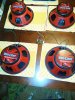
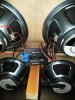
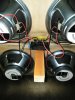
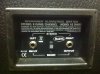
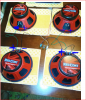
I pulled out my speakers and took pics of how they are wired. Including the Mono/Stereo switch. I plan to make my cab/cabs 16 ohm only whether it be a pair of 2x12's or a single 4x12.

In addition, I may basically load this Behringer MDF cab with different 12's and wire it properly with the Stereo/Mono jack then sell it off to pay for the Cabinet materials I'll need to load the Eminence Governors in it I am saving for me.
 
OK By these 2 pictures and even before I removed the speakers and Jackplate from my cab, I sensed the rig was wired up wrong from my OHMs readings on the speaker cord with my Digi Meter. I was getting like 57+ ohms in the right Jack with it switched in mono and a screwy reading in the left jack whether in mono or stereo mode.

Hence my decision to remove speakers from the cab and recheck.
Now, I am getting measurements I expected based on the 57 Ohms+ in the right side.
With Switch in MONO I get like 57.2 and when put in the stereo mode, I get 28.5 ohms.
My theory is it is reading to where 4x16 ohms =64 Less some continuity loss = the 57+
So this number gets cut in half and yields 4x16/2 or 32 ohm minus loss and hence we get 28.5 ohm.


So, as I see it, my best solution will be to pull the back off my Marshall 1960A Stereo Cab and copy the way the wires are laid out in it. This cab is verified correct 16 ohm Right side jack as I face the jack, 4 ohm left when in Mono switched mode. In stereo switched mode, both sides read good for 8 ohm on the Marshall.


Governors wiring 1.jpg
 
Last edited:
The cab I have is fine. I am not bothered about the weight of this one, I lifted it up and down into my vehicle as well as the Ashton one. It is the Orange PPC412 straight-front 18mm birch ply cab that I absolutely need help with. The Peavey cab is fine, it's just needs a new backboard. The rewiring part is easy

I re- read my post. I think I meant to say, another option for me... Is 2x12's.
 
OK, I got my Marshall Back off. The fix for the Behringer Red Coat cab will be easy. I just have to acquire some more wire and then relocate all the existing wires correctly as per my Marshall.

From how I see it, the Behringer has the polarities all bass ackwards and not enough bridge wires to the Mono/Stereo Jack plate.
Marshall Pics


Marshall 1960A 1.jpg Marshall 1960A 2.jpg
 
Last edited:
Marshall 1950 A Stereo cab. Facing into the back of the speakers I get a red wire from each positive of the left 2 speakers and a black from each negative. Likewise for the right pair. Then as I called them, red and black bridge wires from the + and - of the 2 top speakers to the contacts on the switch/ jackplate. In this case it goes left to right again. On the Upper left speaker, the red bridge wire goes from speaker + tab down to the left jack tab, then the (BLACK -) bridge wire goes to the same jack/ right side tab. For the Upper Right Speaker the bridge wires do the same. Red+ goes to left tab on the right side jack, and the ( Black - ) bridge wire goes to the right side jack plate right tab.

SO, the Marshall Jackplate goes Red /Black L/Side Jack and Red Black Rt/side Jack, The Behringer goes RED BLUE, WHITE /BLACK
However, as I received the Behringer, it seems to me as it is all cross polarity connected wrong.

If the Behringer's little circuit board traces on the Jack/switch plate are the same as my Marshall, the red and white should be + coming from both top speakers which they are. Now for the Blue and Black, which should also come off the - of the top pair, they do so from bottom speakers instead.

This leaves the greens, which cross from + to - on each pair of speakers instead of matching +'s and -'s.

To make work like the Marshall I should remove the green wire altogether. Then make the left pair of Eminence Red Coat speaker +'s get red wire, Blue on the left pair -'s ( essentially Black on the Marshall). The right pair of speakers would get white on the +'s ( essentially Red again Marshall), and black on the -, which would make it the same Black on Marshall.
 
To make work like the Marshall I should remove the green wire altogether. Then make the left pair of Eminence Red Coat speaker +'s get red wire, Blue on the left pair -'s ( essentially Black on the Marshall). The right pair of speakers would get white on the +'s ( essentially Red again Marshall), and black on the -, which would make it the same Black on Marshall.

OK, so I got out my snips, got a few test leads with croc/alligator clips on em, and set about to wiring the cab like the Marshall.

Clipped out the green wires, and set everything else up like the Marshall.

The only issue I am now having is getting the readings as 16 and 8 for mono/stereo on the one pair/jack

But when switched to the other jack, I get 8 ohm in either stereo or mono ( I am a little confused since the Jack plate is somewhat different with the Behringer vs 1960. The 1960 is either 16 or 4 ohm in Mono, 8 in both jacks if Stereo. The Behringer says INPUT and OUTPUT by each jack.
and definitely not 4 ohm. Maybe the circuit board runs a different wiring path for the Behringer vs the Marshall circuit board. Either way, I am not at 64 or 32 ohms like I was getting before. Further research needed from Behringer schematics on the cab, if I can find em.

behringer-guitar-speaker-cabinet_360_9a68fde319fe1f9df28f5ee7edf05759.jpg
 
Gee, I sure was slow minded. DUH, why not google the cab model INSRTUCTIONS?

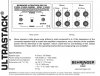
BEHRINGER ULTRASTACK BG412H USER MANUAL Pdf Download.

OK after reading the Behringer literature, it is saying the cab normally had 4- 8 ohm 100 watt speakers. So, it seems it would have a specific way of wiring to be 8 ohm in stereo, but 16 in Mono. Looks like I will see what else can find out since my speakers are 16 ohm ones.
 
Last edited:
Gee, I sure was slow minded. DUH, why not google the cab model INSRTUCTIONS?

BEHRINGER ULTRASTACK BG412H USER MANUAL Pdf Download.

OK after reading the Behringer literature, it is saying the cab normally had 4- 8 ohm 100 watt speakers. So, it seems it would have a specific way of wiring to be 8 ohm in stereo, but 16 in Mono. Looks like I will see what else can find out since my speakers are 16 ohm ones.

Alright Chili,

The manual states that the stock speakers were each 4Ohms(in the lower, stats, paragraph from the manual screen shot), and rated at 100 watts of power handling:
F743399E-B6B1-41DD-8991-90039E65E2FA.jpeg

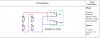
The diagrams infer that the 4 speakers are wired in series when the switch is in “mono” position.
Like this:
09C47615-516A-45B1-B8E5-EBE0427E0EB6.jpeg

When the switch is in “stereo” position, each vertical pair of speakers is wired in series. Each pair of 4Ohm speakers, when wired in series, would present an 8Ohm load.
 
Thanks Bdon, you are exacty right, 4 ohm 100 watt. I musta type 8 by accident.

Also, Okie Dokie, sorry to be so verbose and helter skelter.

Now I did a verification check with the Redcoat speakers setup like the Marshall wiring scheme. This time, I removed the Behringer Mono/Stereo Switching Jack plate and inserted the Marshall. Rechecked Ohms and got 4 and 16 for the mono, and 8 for the stereo as checked in both positions for both jacks. So, the Marshall wiring and jackplate give the expected readings.

I will review your pictorial wiring diagram above to understand it.
 
Last edited:
When the switch is in “stereo” position, each vertical pair of speakers is wired in series. Each pair of 4Ohm speakers, when wired in series, would present an 8Ohm load.

OK good bro don,

Let's do some math by the common multiplier method and see what we get.
If four 4 ohm speakers are wired this way. we get as you say, in the stereo mode / 2 vertical pairs equaling 8 ohms load
In Mono, I would presume we add all 4 and get our 16 ohm.

SO, if we have four 16 ohm speakers wired the same way, in stereo we should get 2 vertical pairs equaling 32 ohms
and in Mono it should add up to 64 ohms. Seems like this is how the cab was reading on my meter when I took the pics and could get good readings with the guts out of the cab.

I won't say much more than I was thinking that maybe somehow things were in series and that was the only way I could explain getting 57+ ohms ( essentially 64) when in Mono in the one jack and 1/2 that in the same jack when switched to stereo.
 
Last edited:
Governor Polarity.PNG

09c47615-516a-45b1-b8e5-ebe0427e0eb6-jpeg.24705
 
Last edited:
I'm a bit lost here. That video I shared shows how to check if speakers are out of phase. The wiring setup in the video is series-parallel, which in a 412 cab basically gives you at the jack the same load as each of the speakers individually, i.e., if you wire it that way you get 16 ohms cab using 4 16 ohm speakers, 8 ohms using 8 ohm speakers, etc. With a 212 if you wire it in series you should get double the load at the jack, e.g., two 8 ohm speakers = 16 ohm cab. If you wire it in parallel I think you get half, i.e., two 8 ohm speakers = 4 ohm cab. Not sure how you wire for two 8 ohm speakers = 8 ohm cab etc
 
I'm pretty sure series math is addition, parallel math is division. So 16 + 16 =32 then parallel it treats it like two 32 ohm speakers divided by 2 so it's 16
 
Sorry for the confusion Dave.
Here is my best attempt in a summary.

Forget 2 speaker and only concentrate on 4x12. Now, I started out in life with 4x12 with a Chequerboard Marshall 1972-1973 100 watt 16 ohm cab wired in Series Parallel with one simple input jack. Had to sell it.

Next, I got a Marshall 300 watt Stereo/Mono cab, which you see the pics of above. It is wired so that in Mono you get 16 ohm in the right side jack in mono and 4 ohm mono if you plug into the left jack. Both @ 300 watt. Then if you switch to stereo, BOTH jacks will measure as 8 ohm 150 watt.

SO this is it for Marshalls I have or had.
 
Last edited:
Next I bought the orange color, Marshall Super Bass 100 watt head and Behringer Eminence Red Coat loaded cab that had it's original speakers replaced. Upon my initial attempt to play it at home, it immediately blew fuses, SO I figured I better err on the safe side with no Ohms mismatch chances and service my amp. Once fixed, then DO NOT plug that amp into a cab with unknown Impedance. When I checked the impedances of both jacks in the Behringer, in mono and stereo, I got differing values from what the Jackplate called for. In other words, I was getting enough Ohms for a 64 ohm or 32 ohm cab instead of 16 or 8 ohm like the jack plate said.


SO, in order to confirm the wiring and jack hookups, I pulled everything out and re measured. Got the same, so I pulled the back cover off the 1960A to view the wiring which I knew the readings were in spec.
The wiring for the Behringer was off, so I laid them on my table and unwired everything to rewire wire it like the Marshall to test impedances. Then with the Behringer Jack plate in circuit, I got 16 ohm and 8 ohm only, not those 64 and 32 ohm readings. The new results were also not 16 and 4 in mono and 8 in stereo like I figured it would turn out if the Behringer jack switch circuit was the same as the Marshall one.

Then for my final check, I simply swapped the Behringer jackplate for the Marshall and the speakers now acted exactly like they would if they were in the Marshall cab and wired the exact same way the Marshall Celestians were. 16 and 4 ohm mono, 8 ohm stereo.
 
I'm a bit lost here. That video I shared shows how to check if speakers are out of phase. The wiring setup in the video is series-parallel, which in a 412 cab basically gives you at the jack the same load as each of the speakers individually, i.e., if you wire it that way you get 16 ohms cab using 4 16 ohm speakers, 8 ohms using 8 ohm speakers, etc. With a 212 if you wire it in series you should get double the load at the jack, e.g., two 8 ohm speakers = 16 ohm cab. If you wire it in parallel I think you get half, i.e., two 8 ohm speakers = 4 ohm cab. Not sure how you wire for two 8 ohm speakers = 8 ohm cab etc

I'm pretty sure series math is addition, parallel math is division. So 16 + 16 =32 then parallel it treats it like two 32 ohm speakers divided by 2 so it's 16

I am pretty sure I follow you, DD and know why the confusion. Where I see things get a little confusing for me, even if we keep the Series or Parallel or S/P wiring scheme math in order, where it can sort of get tricky is what happens when a switch is introduced and it manipulates signals across a PCB within the jackplate and hence it can alter the loads depending on if the cab has Four 4,8,or 16 ohm speakers and how they are wired, ( properly or improperly)

From How I read the Marshall Jackplate I have, I believe in the left jack and switch in Mono, one gets 4 speakers at 75 watts per at 4 ohm and 300 watts total.
If in the right side jack, and mono, the load is 16 ohm @ 300 watts.
jcm900-1960a-06.jpg


Then, if one plugs one input into either the left or right jack and switch is in Stereo, one gets 2 speakers @ 150 watt total and only 8 ohm load.
If the other jack is simultaneously used with a stereo amp then the other 150 watts comes in thru the other pair of speakers @ 8 ohm so 4 speakers are making sound, but at 8 ohms stereo.

As Per the Marshall Operating Instruction Manual

4x12 Mono/Stereo Switching Facilities (1960A, 1960B, 1960AV & 1960BV). To ensure maximum flexibility, four of our 4 x 12 cabinets boast a Mono/Stereo switching system on the back.When ‘Stereo’ mode is selected, the cabinet is split into two 8 Ohm ‘halves’ for use with a stereo power amp (e.g.: EL34 100/100, EL34 50/50, EL84 20/20, 8008 or VS 120/120) such as used in a rack system. When ‘Mono’ isselected you are offered two different impedance inputs (4 Ohms or 16 Ohms) from which to choose. Alwaysensure you select the correct one to match the impedance of your amplifier and NEVERuse both inputs at the sametime when the cabinet is in ‘Mono’ mode.1) Mono/Stereo Selection Switch.Selects either Stereo or Mono operation mode.2) Right* inputWhen switch (1) is set to:i) Stereo, this provides connection to the right* side pair of speakers.Rated at 8 Ohms.ii) Mono, this provides connection to all four speakers. Rated at 4 Ohms.3) Left* InputWhen switch (1) is set to:i) Stereo, this provides connection to the left* side pair of speakers. Rated at 8 Ohms. ii) Mono, this provides connection to all four speakers. Rated at 16 Ohms.*Note: No, we're not insane here! ‘Right’ & ‘Left’ here refers to the two stereo sides of the cabinet as seen (and heard!) when facing the front of the cab.
 
Last edited:
As I understand it, if you run two speaker leads to one cabinet set in stereo mode you get the same sound out of both sides and it treats it like a two cab stack, i.e. 120W into 2 x 8 ohms, you set the head at 4 ohms (because that's what it sees) and the power handling remains whatever it was in mono because you are splitting the signal from one amp between two cabs that make exactly the same noise. The effect is mono, not stereo, just that you have wasted money on a second speaker cable.

On the other hand, if set in stereo with two amps running into it, then each amp would see 8 ohms as the cab and the cab would only provide half of the speakers to each amp to handle the load. For example here each side of the cab would provide only 150W handling capacity. You will hear two different sounds but you lose clean headroom (at best) or blow a speaker (at worst) due to the lower handling capacity, and the speakers are too close to each other to give a true stereo effect. I still rate this as pointless compared to two separate cabs placed further apart.

If you leave the two cables in and switch to mono you will have one jack providing a 4 ohm load while the other provides a 16 ohm load. Pretty much all of the output will go via the speakers connected to the 4 ohm jack. This is likely to cause problems. In mono you use only one jack and use left or right depending on whether you want a 4 ohm or 16 ohm load.

I don't like any of these options besides 16 ohm mono
 
Back
Top