NCD: Peavey 430A 412 cabinet

Dave Sloven

Ambassador of DOOM!
Country flag
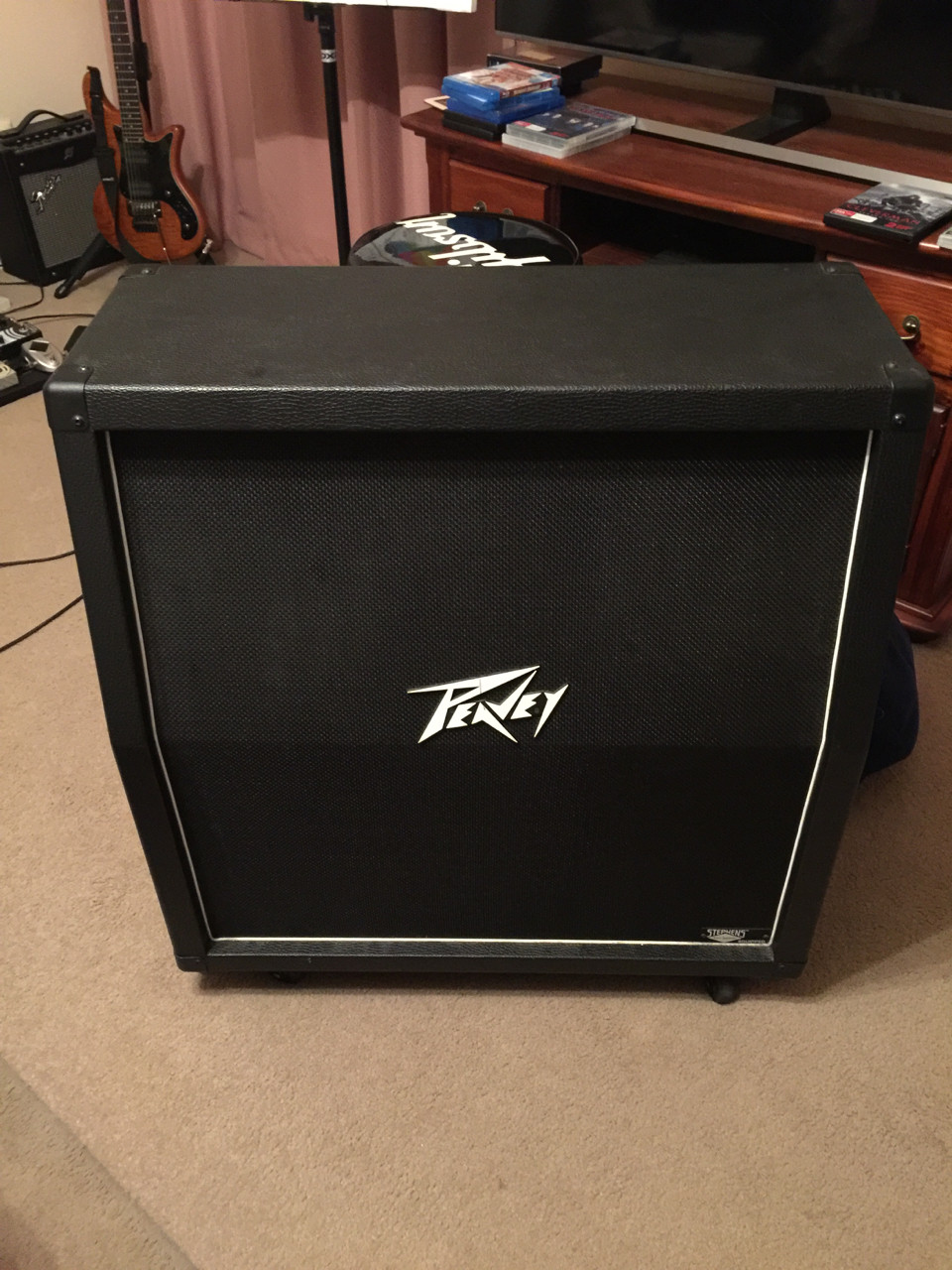
New cab day! Well, a couple of days ago, anyway. So I posted a photo of it in the thread about my retube but I've had it apart since and found out a couple of things.

1. The Stephens badge is metal and quite easy to remove with two philips head screws
2. The cab has removable casters - the clip type which I haven't quite worked out how to remove yet - and rubber feet as well
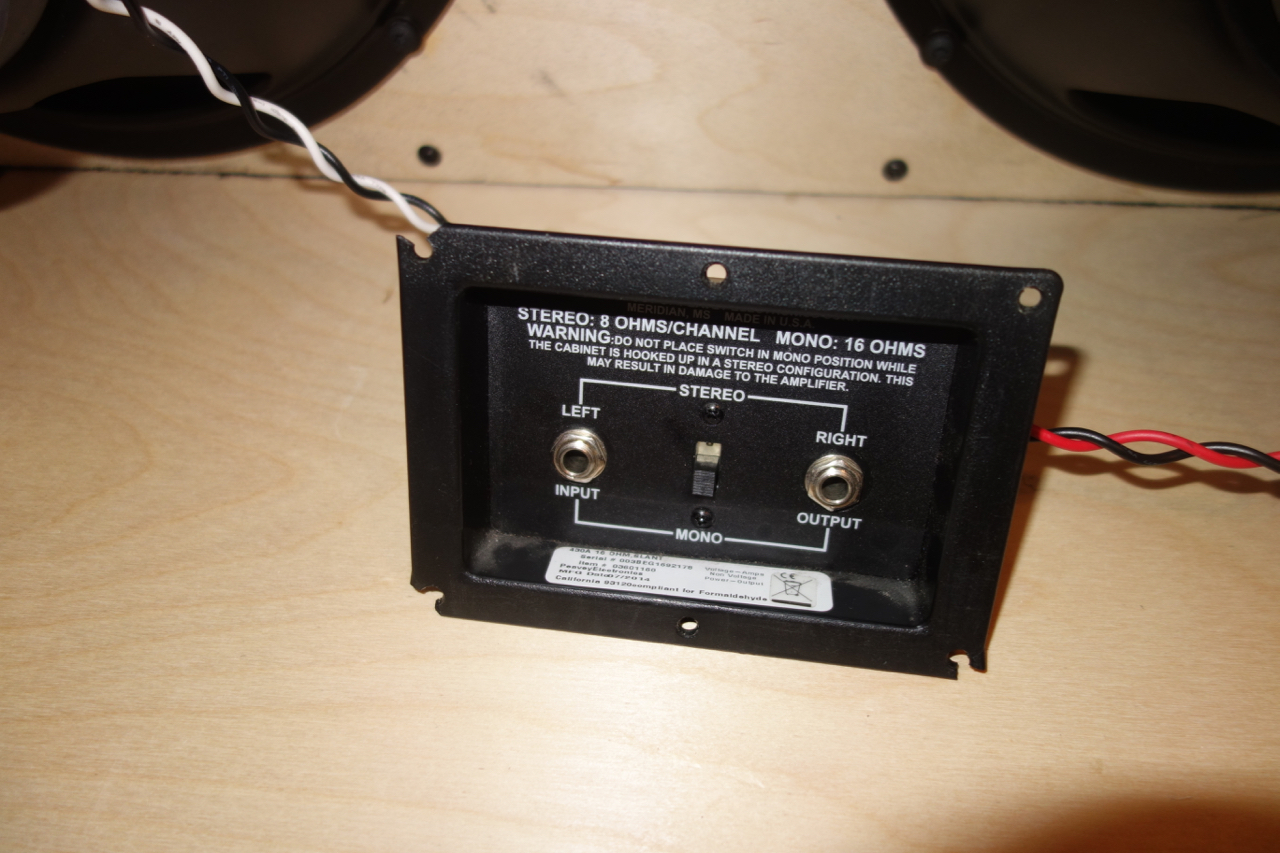
3. The worst part of the cab is the ABS plastic dish that contains the PCB for mono/stereo operation, three out of six screw holes (on the corners) broke when I removed them to free up the jack plate so that I could remove the back board of the cab.

The cab is constructed from 15mm 18 ply baltic marine birch. The sides are fingerjointed together and the baffle seems to be screwed or nailed to the sides. The centre brace for the backboard seems to be a block of regular birch ply and the back board is MDF. The tolex seems to be the same hard-wearing type on my 6534+ head. Everything in the cab seems to be in good condition although I think someone at the factory overtightened the screws on the plastic jack plate and cracked them

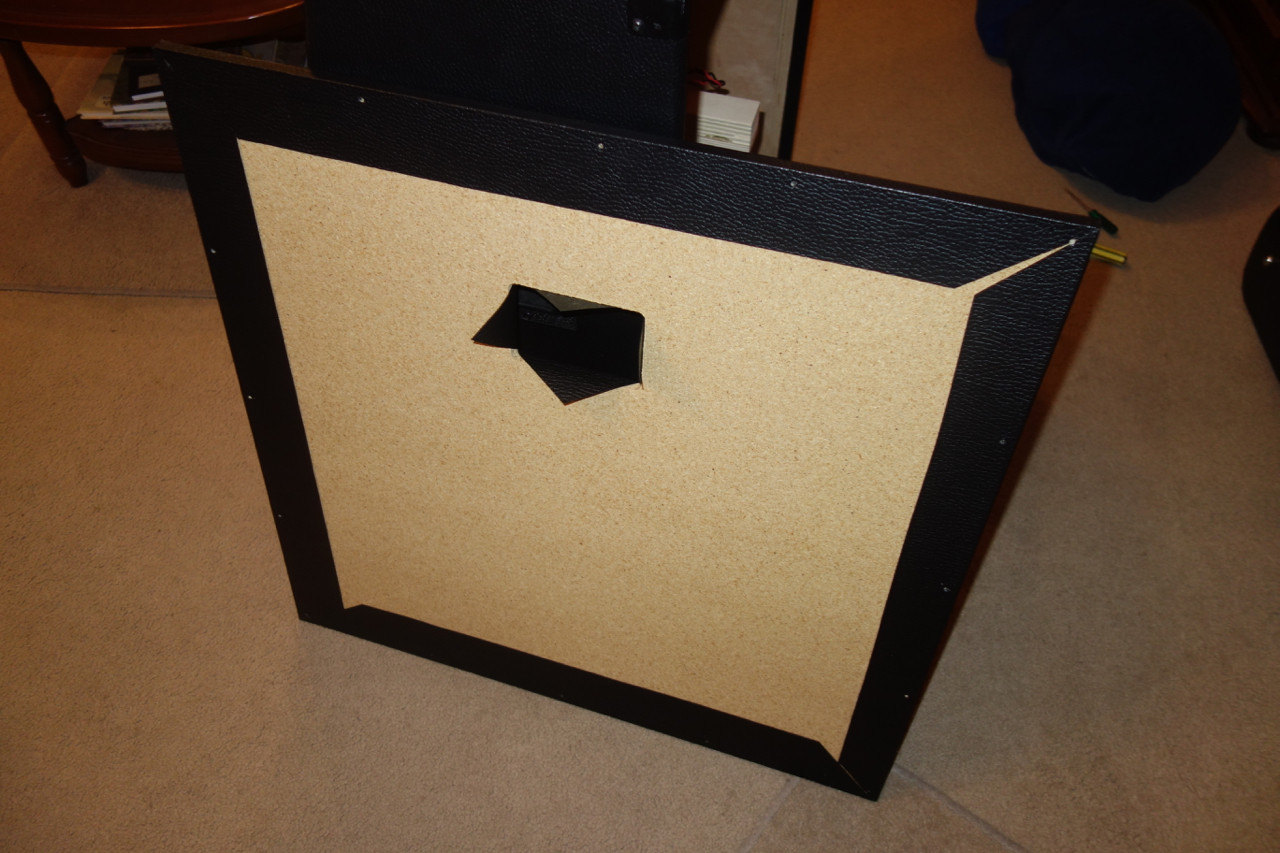
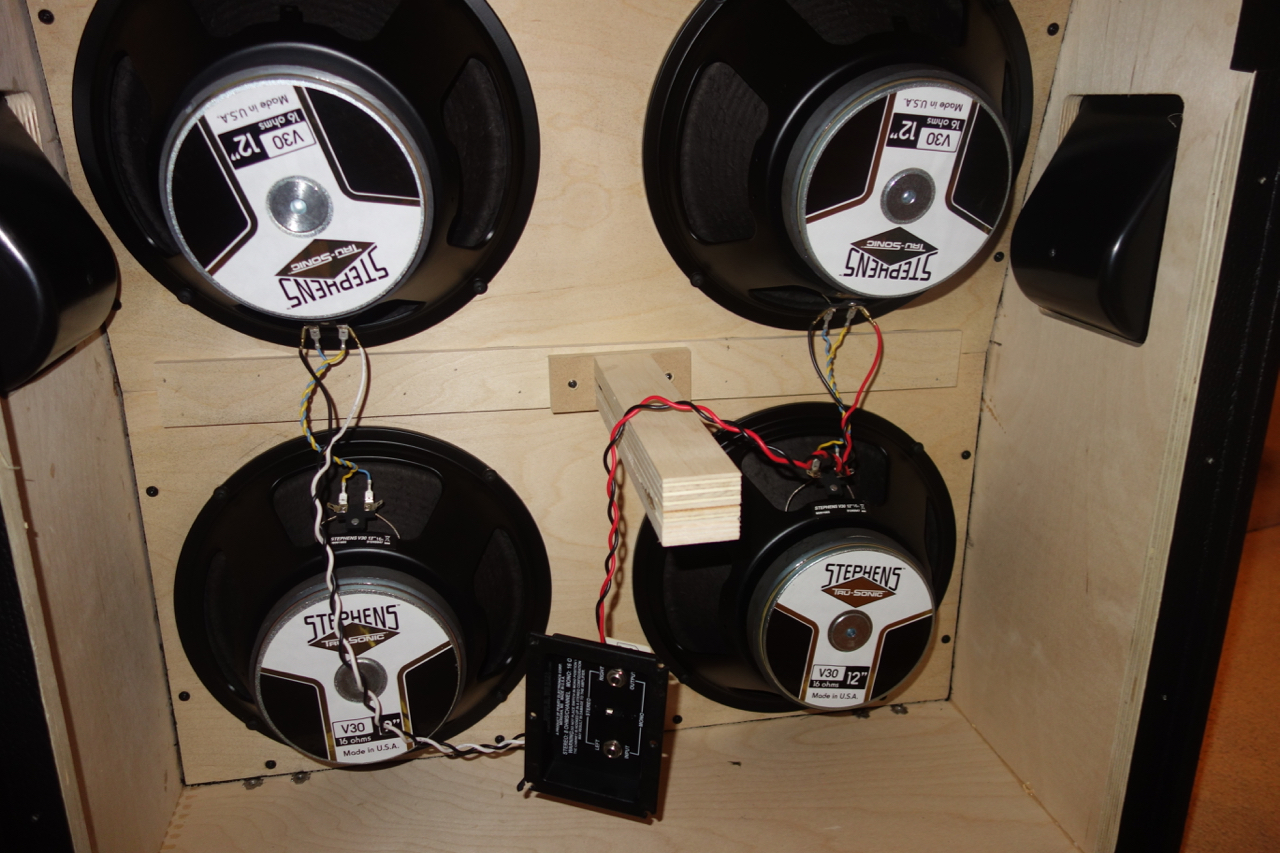
The hole on the back board for the jack plate is larger than most of the simple metal dish type jack plates out there. I will have to go with a bigger six screw hole dish. All of the ones I see for sale have multiple holes in them (e.g., for speakons) so I am looking to source undrilled blank plates so that I can drill a single hole in the middle to take one mono Cliff jack (like on Marshall cabs). I will ditch the mono/stereo PCB and rewire it old school as series/parallel 16 ohms mono only with the one jack, with enough 22AWG wire that I can lay the backboard flat on the floor without disconnecting the jack. Together with installing the four Celestion Vintage 30 speakers out of the Ashton cab this should be an extremely nice cab. The Stephens speakers will be an easy retrofit into the Ashton, which has quite a nice simple mono wiring harness with no PCB. Then I will be able to sell the Ashton cab on maybe for $150-200.

I'll post some photos below if I can get some nice ones showing the damaged jack plate.
 
Not difficult to believe; the over tightening of the screws...the plastic gets brittle with a few years of aging too. From the photos in your other thread, I’m happy to hear that it’s a “mostly” ply cabinet. This should be a really nice cab for you when you’re done! Congratulations!!!:cheers:
 
The construction is basically the same as a Marshall 1960A cab as far as I can tell (15mm marine blrch ply baffle and sides, MDF back) and I would not be surprised if it was directly modelled on one, but with Peavey corners and handles. The cab was basically intended for use with the Butcher and 6534+ amps, which were aimed at the Marshall market broadly speaking. The other cab it seems to be modelled on is the the old Peavey 412MS cab, which was used with the original Butcher, a different amp from the recent one but also aimed at the Marshall market. It has the look (handles etc) of the 412MS but with the construction of the Marshall 1960A.
 
Last edited:
New cab day! Well, a couple of days ago, anyway. So I posted a photo of it in the thread about my retube but I've had it apart since and found out a couple of things.

1. The Stephens badge is metal and quite easy to remove with two philips head screws
2. The cab has removable casters - the clip type which I haven't quite worked out how to remove yet - and rubber feet as well
3. The worst part of the cab is the ABS plastic dish that contains the PCB for mono/stereo operation, three out of six screw holes (on the corners) broke when I removed them to free up the jack plate so that I could remove the back board of the cab.

The cab is constructed from 15mm 18 ply baltic marine birch. The sides are fingerjointed together and the baffle seems to be screwed or nailed to the sides. The centre brace for the backboard seems to be a block of regular birch ply and the back board is MDF. The tolex seems to be the same hard-wearing type on my 6534+ head. Everything in the cab seems to be in good condition although I think someone at the factory overtightened the screws on the plastic jack plate and cracked them

The hole on the back board for the jack plate is larger than most of the simple metal dish type jack plates out there. I will have to go with a bigger six screw hole dish. All of the ones I see for sale have multiple holes in them (e.g., for speakons) so I am looking to source undrilled blank plates so that I can drill a single hole in the middle to take one mono Cliff jack (like on Marshall cabs). I will ditch the mono/stereo PCB and rewire it old school as series/parallel 16 ohms mono only with the one jack, with enough 22AWG wire that I can lay the backboard flat on the floor without disconnecting the jack. Together with installing the four Celestion Vintage 30 speakers out of the Ashton cab this should be an extremely nice cab. The Stephens speakers will be an easy retrofit into the Ashton, which has quite a nice simple mono wiring harness with no PCB. Then I will be able to sell the Ashton cab on maybe for $150-200.

I'll post some photos below if I can get some nice ones showing the damaged jack plate.

Sounds great!
 
I am having real problems with the Photos app on my Mac but I will try to post some later.

One thing I have decided: after the next gig (this Friday) I will swap speakers between the cabs keeping the factory wiring for each cab. Hopefully there is enough plastic left for the Peavey plate to tighten up. Then I will look around to purchase a 15mm baltic birch ply sheet and make a new backboard to replace the MDF one, and apply new tolex to that with the jack plate type and position I prefer, rather than cutting the toxic MDF hole bigger and using a bigger plate. I would just use the small old school type and the place it as high as possible because I hate groping about behind the cab on stage trying to plug in the speaker cable. Then I would just use a Marshall-style Cliff jack and wire it 16 ohms mono series/parallel. That way I have a better backboard and a much neater job.
 
Dave. My new to me Eminence Governor loaded Behringer 4x12 is so damn heavy as a closed back MDF box I am going to likely going to do similarly to it as your plan of old school jack and wire it series parallel. Only thing is I think it would be 8 ohm not 16 like my 1960a
 
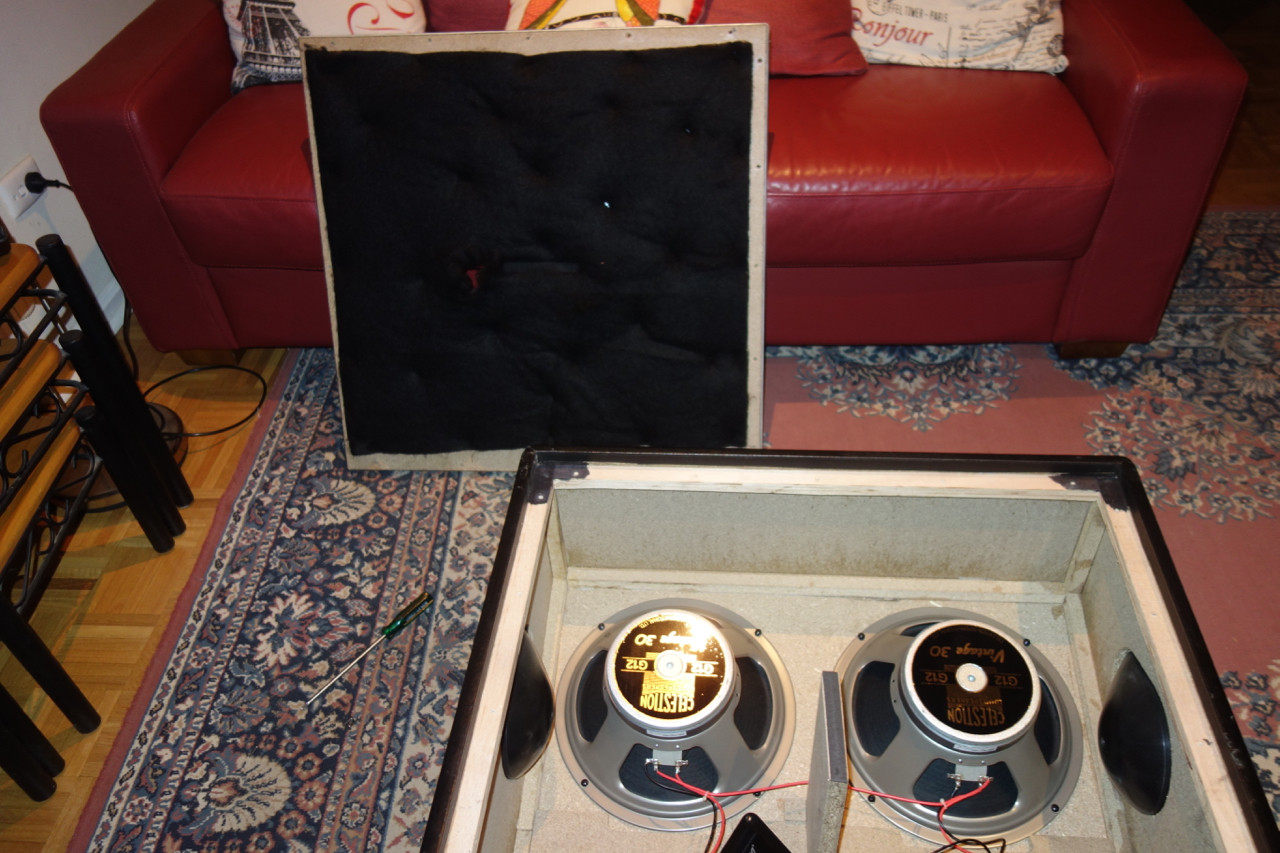
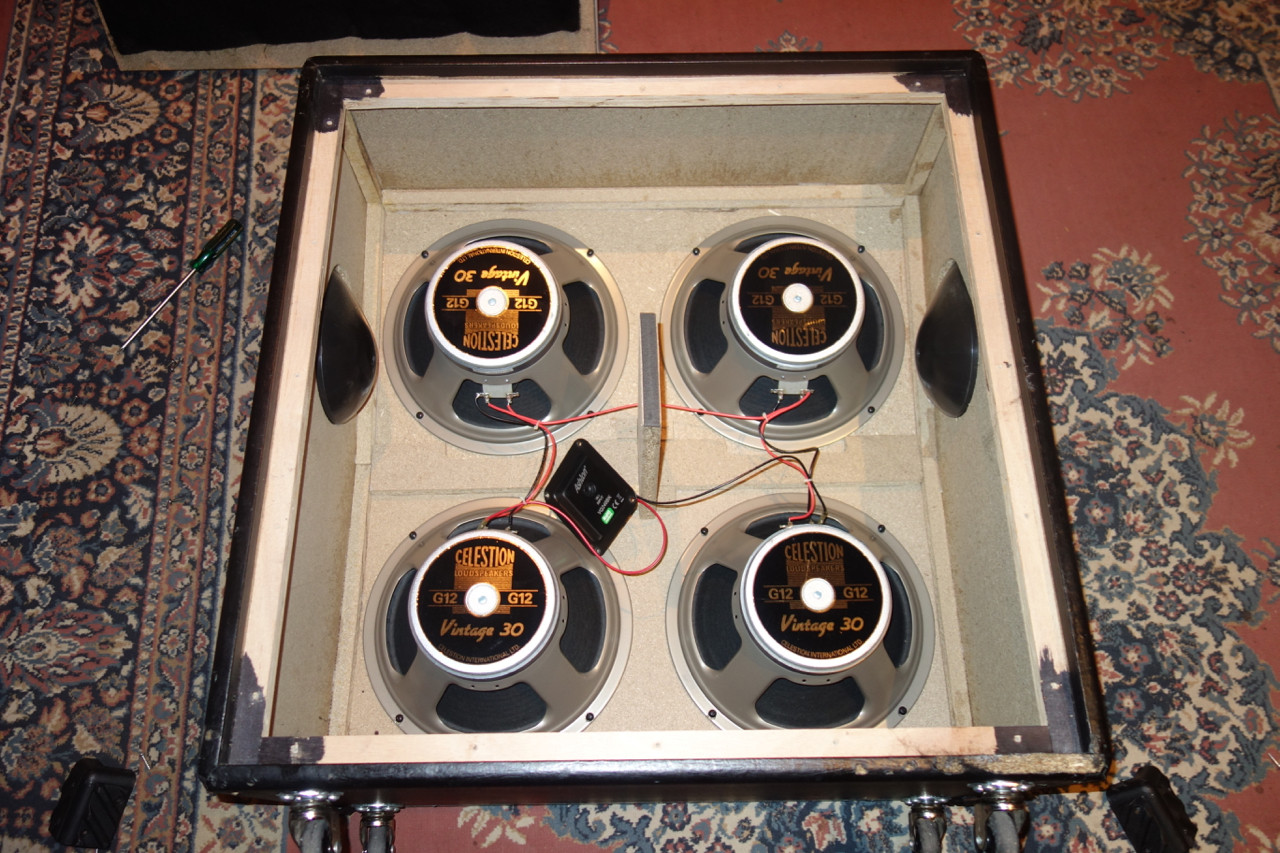
Okay here are some photos at long last. First the Peavey birch cab (with MDF backboard) and then the speakers in the Ashton particle board cab. The Ashton is well-constructed out of cheap materials. I definitely think a new birch backboard is the way to go; it will cost me $100 no doubt but most cabs these days only have MDF for the backboard. The Ashton has a black material on the back of its backboard and I am wondering whether that might he a good idea. You can see the damage to the particle board in the last photo. Usually that is covered with gaffa tape.

8YZQpd8.jpg


v1FbWxG.jpg


rx3oDl7.jpg


WP4ra7o.jpg


sKo3dkq.jpg


qcsthfz.jpg
 
Another option is to make 2x12 cabs. I am considering that option too.

The cab I have is fine. I am not bothered about the weight of this one, I lifted it up and down into my vehicle as well as the Ashton one. It is the Orange PPC412 straight-front 18mm birch ply cab that I absolutely need help with. The Peavey cab is fine, it's just needs a new backboard. The rewiring part is easy
 
The Peavey cab is fine, it's just needs a new backboard. The rewiring part is easy

Dave,Now about the wiring, Thanks for the pics. I have 2 front loaded cabs that kill me wiring wise. The 2nd is the Behringer one with the MDF and similar jack plate as yours. What I don't like is the odd result of Ohms in the left vs right jack hole. When I go to rewire it, I would love to have a BACK panel I could take off and wire it from the rear.

Next is my Mesa Road Ready Diesel cab with 4x10 David Eden 4 ohm 135 watt per speaker Bass speakers. Somehow I think I have it wired screwy and it is putting out 4 ohm, unless I get a different reading after hitting a switch on the back. This cab is particularly hard to wire for a number of reasons. 1. Closed Back, 2. Full insulation on the inside
3. A Horn in the mix, plus a junction strip where the wires go from speakers to this strip and then to the jack, ( If my memory is correct from the last time I reinstalled the speakers.)

I am so tempted to cut the backs off both these cabs and glue in some wooden rails on the inside so I can use fasteners to detach and attach the backs whenever I like.
Then again, I may sell the Behringer/Eminence loaded cab to recoup some of my amp servicing parts costs.

Hopefully I can get some good pics of the Mesa cab so I can run the wiring by you guys to make sure I get the Ohms result I am after.
 
Post photos of the Behringer. My advice might be just to sell it and get something you like better, but it's definitely possible to rewire it. If the jack plate is a standard size then it is an easy enough job. In the USA you could also easily get a larger metal jack plate to replace it if needed, but then there's the problem of safely enlarging the hole in the MDF to take it. You would need a fair amount of safety gear and good ventilation as that stuff is very toxic. You could definitely wire it mono easily enough. I really dislike stereo cabs, personally I think they are idiotic and fraught with possible issues. Personally I would do with the Behringer what I have done with the Ashton, i.e., find a cab that you like better and swap your speakers into it, then sell the Behringer. The bass cab I am really not sure how to rewire that. You could also install a large dish and drill it for a single mono jack with no switches if you want something idiot proof. If you remove or disconnect the horn / tweeter then it would be easy enough. I turned the tweeter in the 410TX off the whole time I had it because distortion can blow tweeters very easily, so it would have been no loss to have disconnected it. If you remove it you will probably need to make a blank that will screw into its place, unless you want a random port in the front. Easier to leave it in there and just disconnect it.

This is my thinking on guitar cabs, and why the 16 ohm mono option is ALWAYS best.

1. A true stereo rig is two separate mono cabs running stereo from the amp, not two sides of one cab. There's no separation of the sound field so the stereo effect is not going to be there. Even if you have two different amps running into it set up very differently the sound will run together and sound bad
2. A stereo cab halves the power handling of the cab. This cab be dangerous to the health of your speakers for obvious reasons. If you are running one amp stereo into one stereo cab that is stupid for obvious reasons. Unless you have stereo effects loops etc that will just be spending money on an extra speaker cable. If two different amps they would have to be half as big in terms of output as what you could run on it in mono.
3. A mono wired 240W+ 16 ohms 412 is pretty much idiot proof. There are no switches that some idiot could move and then blow the cab (if they change it to stereo) and/or the head (if, for example, they drop the impedance to 4 ohms accidentally). 16 ohms will not blow a head or a cab, because the higher impedance can only reduce the effective output of the head, so if some toss connects a head set to see a cab of 4 ohms or 8 ohms it will just make the head work harder for less noise, rather than blow due to a low ohms load. 240W+ power handling is twice what most tube heads can put out, so even with effects and gain you're pretty safe. I wouldn't lend a greenback loaded cab to another band, but 240W is fine.

If you have a stereo cab and you don't want to rewire it my suggestion is always to set it to mono 16 ohms (or 8 ohms if it has 8 ohms speakers, in any case the highest it can go) and then tape up any switches or alternative inputs with cloth tape to prevent clowns using them.

Obviously given the variation for bass rigs my advice would be different. Basically though I would set the rig up for me and then quiz anyone who wanted to borrow it very carefully as to what they were going to connect it to, and in most cases I would prefer to lend my amp and cab rather than just a cab

I have a lot of experience in providing backline to idiots, especially on the punk scene ...
 
DD, I could almost quote your advice word for word as we are 2 peas in a pod.
I already taped over my 4 ohm jack on my 1960 A 300 watt cab and have the switch in Mono 16 ohm position just for me.

The Pictures of the Mesa Bass cab with David Eden speakers, The Behringer and Eminence Speakers in them will be forthcoming. BTW, the Mesa only has a single little jack not a large plate/cup type and a similar one for the horn switch. As far as the wiring goes, I believe my growing experience with Multimeters and croc clip patch cords, etc will help me to hook up the 4 speakers as I intend, so I get 16 ohm out of the 4 - 16 ohm speakers, and 8 ohm from the 4-8 ohm speakers.
 
Last edited:
This video shows how to wire up four 16 ohm speakers as 16 ohm mono and provides a diagram. The only differences would be introduced by the location of the jack, but the principles will be the same.


Bass cabs are generally 4 ohm or 8 ohm. The thing you need to remember about bass rigs is that generally the less load the more power goes to the cab, so 8 ohms is often safer. If you combine different ohm cabs most of the power will go to the lower load cab. The best setup in my experience is two 8 ohm bass cabs, which gives you 4 ohms total load. 2 ohms is too low for many heads to handle, except for the old Peaveys
 
Okay, so I spent part of today investigating prices of materials and labour. I have eliminated baltic birch as a realistic option. I would have had to spend $200 on wood just to do the back panel, because baltic birch is rare as a raw material here in Australia. So I am going to get a new one made in MDF instead, with the correct holes cut and drilled. This will cost maybe $30 for the wood to be cut, and I will use a 2" holesaw and a drill to add the relevant holes. Seeing as I am going with MDF I will check with my local hardware shop to see if they can match those prices, as I'd prefer to support someone in my town. The sound quality should be the same as what is in there now only with new tolex and a metal round bezel for the mono jack, and it will allow me to wire it up better using 22AWG from my local electronics shop. The metal bezel will certainly take more abuse than the plastic crap. Also the backboard has the most damage to the tolex of any part of the cab, so it's not a bad thing that I am changing it.
 
I took the original backboard to Otto's Timber and Joinery in Stepney today and Leon there is making me a new backboard from MDF identical to the original one except with a 30mm round hole for the jack plate instead of the current big oblong one (including drilling all of the screw holes through the backboard to match the originals) for under $40. Then I just need to buy some tolex and some lamp wire and together with the jack plate and jack that should arrive in the mail tomorrow I should be able to finish the whole thing for around $100 over the original $300 cost. Pretty decent cab for $400.
 
I also called Frank (my amp tech) for advice on which wire to use and he recommended this (in red and black) so I'll go with it ... bonus is that this shop is nearby and the price is good!

Black 15 Amp DC Power Cable - Sold per metre | Jaycar Electronics

Black 15 Amp DC Power Cable - $1.25 per metre
CAT.NO: WH3075

Flexible DC power cable suitable for general purpose automotive and boating applications. Tinned copper cable suitable for use in marine applications.

• Rated current 15A
• Stranding: 26 x 0.3mm
• PVC insulation
• Max temperature 80°C


Also available seperately
Red WH-3073
 
I also called Frank (my amp tech) for advice on which wire to use and he recommended this (in red and black) so I'll go with it ... bonus is that this shop is nearby and the price is good!

Black 15 Amp DC Power Cable - Sold per metre | Jaycar Electronics

Hey, Dave...

I used a similar 2 conductor, red and black stereo amp power supply cable for my project. Got 3 feet of it from local car stereo shop for free.

Bought a pack of three 90 degree patch cables off Reverb and used the ends to make my cable.

This is long enough to pull out and connect an attenuator....

20190502_064554.jpg
 
Last edited:
Back
Top