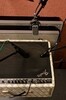
Microphone Placement On A 4/12 Cab

Need a humidifier on the furnace.
I got a large external humidifier unit, actually because of this that works really well, but an internal WOULD be simpler.

Electric heat ( a heat pump in my case) plain sucks and dries the air far too much. Gas heat can feel bad but they do produce some level of humidity naturally. Most homes, you never want below 40% humidity or more than 65% which will cause mold and mildew. Heat pumps and baseboard heat can drop it down to as low as 20% , gas tends to hover around 40-45%
 
I got a large external humidifier unit, actually because of this that works really well, but an internal WOULD be simpler.

Electric heat ( a heat pump in my case) plain sucks and dries the air far too much. Gas heat can feel bad but they do produce some level of humidity naturally. Most homes, you never want below 40% humidity or more than 65% which will cause mold and mildew. Heat pumps and baseboard heat can drop it down to as low as 20% , gas tends to hover around 40-45%
In winter here without humidifier gas heat tends to sit at maybe 10 - 15%. When it is minus 30 etc oitside I turn humidifier down to reduce ice on windows and it sits at maybe 15.
It is extreme here.
Sorry for the derail Far
 
My .02.

I start at the crease between the dust cap and the cone. SM58 pointed straight at the cab, filter barely touching the cab grill cloth. I move the mic about 1/4" at a time towards the outside of the speaker until I find a balance of treble and bass, more on the treble side of things. Second mic, e609 is placed about half way between the SM58 and edge of speaker. That usually gives me a good solid bass response without being too "woofy." Phase comes into play with two mics, but is not too bad to figure out.

t4fQcLp.jpg


5vOkwvI.jpg


3tUv952.jpg


mpx4Y3V.jpg
 
I waited for others to post before adding my comments.

As I've previously mentioned, using guitar amps and cabs in a commercial environment had fallen off dramatically and most studios are using amp simulations with Blue Cat Destructor and Avid Eleven Mk II being the two most popular such platforms.

Having said that, we do, occasionally, record guitar amp cabinet combinations.

Some bands just want a SM57 close mixed and go, and that's fine.

When we record amp/cabs, our engineer tends to use 3 microphones.

He will generally use a SM-57 close to the grill cloth at about the 4:30 position, angled to about 45 degrees.

This is followed by a Nueman U87 about 12 to 15 inches back from the center (front) of the cabinet.

The next microphone used is a Neuman U67, on a stand raised to 3 feet and placed behind the cabinet, about 6 to 8 feet behind the cabinet.

During the mixdown, the ambient room tone from the U67 will be panned out as an individual track, as will the other two microphone feeds.

For example, on a recording with one guitar in only one speaker, the main SM57 feed will be panned about 40% then the feed from the U87 will be panned about 65% and the ambient room tone from the U67 will be panned about 80% respectively.

Once panned out, the volume levels will be adjusted so that you can hear the balanced feeds as a single track, and your ear can hear the layers of sound.

Those three tracks are then merged and become one audio track.

I've actually replicated this technique here in my home studio, bit you really need headphones to pick up the nuances this method creates...you won't hear it on a Bluetooth speaker.

FWIW....
 
Mark Opitz - sound engineer on AC/DC's Powerage and Let There Be Rock has long mentioned an "apex miking technique" was used on those albums.

Just to clarify what the engineer was saying about "one Dynamic Cardioid and one condenser at 90° at 8″ in several interviews....

He’s pointing the two mics so that they form an ‘A’ shape 8″ from the cone, with each mic pointing at the side of the cone

He then flips one of the mics out of phase and tries to get as much phase cancellation as possible (thinning of the sound) so that when he switches the phase back to normal the two mics will be ‘perfectly’ in phase the combination of one good dynamic and one good condenser is a good part of the sound IMO. the dynamic gives you more immediacy in the sound.

The U47 FET mic has the second generation K47 capsule which is a bit flatter on the top end than the U47 tube mic, which was designed to pick-up orchestras and voices from a distance. The U47 FET is also a raunchier sounding mic because of the early solid-state electronics. It is not a modern Phantom mic, and needs it’s own power supply like a U47 does.

While recording AC/DC's Back In Black, Tony Platt used a pair of condenser mics to pick up different speaker cones and give a wider sound to each guitar: "I developed a technique for recording guitars with two microphones roughly pointing at different speakers, which can be spread out in the stereo mix so it's not just a series of mono point sources. It makes for a more open-sounding guitar. That sound suited their particular technique, which involved Angus and Malcolm playing the same chords but with different inversions to get a very big unison guitar sound." Hugh Padgham adopted a similar tactic for recording Andy Summers' Roland JC120 when working with the Police: "The chorus [was] always switched on in order to produce the slightly out-of-tune guitar sound that was all the rage during the early '80s. The amp's two 12-inch speakers would each be close-miked with a Sennheiser MD421, panned left and right one speaker would produce a straight signal while the other would be chorused, and these would sometimes be double-tracked the other way around in order to produce an especially wide stereo picture." Of course, no-one says you have to use the same mic on each speaker cone. For example the SOS interview with Toby Wright shows an SM57 and an MD421 on separate speakers, and Don Smith mentioned using an SM57 and an AKG C451 on separate speakers when recording Keith Richards. Sylvia Massy Shivy also uses the SM57+MD421 combination, but sounds a note of caution when deciding on the exact positioning of the mics: "You have to be very careful with phase, just check it until the signal is the strongest."
 
Last edited:
Back
Top