I waited for others to post before adding my comments.
As I've previously mentioned, using guitar amps and cabs in a commercial environment had fallen off dramatically and most studios are using amp simulations with Blue Cat Destructor and Avid Eleven Mk II being the two most popular such platforms.
Having said that, we do, occasionally, record guitar amp cabinet combinations.
Some bands just want a SM57 close mixed and go, and that's fine.
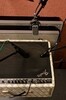
When we record amp/cabs, our engineer tends to use 3 microphones.
He will generally use a SM-57 close to the grill cloth at about the 4:30 position, angled to about 45 degrees.
This is followed by a Nueman U87 about 12 to 15 inches back from the center (front) of the cabinet.
The next microphone used is a Neuman U67, on a stand raised to 3 feet and placed behind the cabinet, about 6 to 8 feet behind the cabinet.
During the mixdown, the ambient room tone from the U67 will be panned out as an individual track, as will the other two microphone feeds.
For example, on a recording with one guitar in only one speaker, the main SM57 feed will be panned about 40% then the feed from the U87 will be panned about 65% and the ambient room tone from the U67 will be panned about 80% respectively.
Once panned out, the volume levels will be adjusted so that you can hear the balanced feeds as a single track, and your ear can hear the layers of sound.
Those three tracks are then merged and become one audio track.
I've actually replicated this technique here in my home studio, bit you really need headphones to pick up the nuances this method creates...you won't hear it on a Bluetooth speaker.
FWIW....