
You are using an out of date browser. It may not display this or other websites correctly.
You should upgrade or use an alternative browser.
You should upgrade or use an alternative browser.
Mexi P VS USA P
- Thread starter eSGEe
- Start date


Mr Grumpy
Ambassador of Comings and Goings

Hmmm, I'm not so sure.
I know you love the cheap stuff eSGe, but my bass teacher had a Fender USA P bass and it was bloody lovely. If a Mexican is anywhere near as good then it's amazing value; I haven't played one, so I don't know, but that USA P-bass was really beautiful.
I know you love the cheap stuff eSGe, but my bass teacher had a Fender USA P bass and it was bloody lovely. If a Mexican is anywhere near as good then it's amazing value; I haven't played one, so I don't know, but that USA P-bass was really beautiful.

Gahr
Ambassador of Blues & Brews

Do you still play bass, Grumpy?Hmmm, I'm not so sure.
I know you love the cheap stuff eSGe, but my bass teacher had a Fender USA P bass and it was bloody lovely. If a Mexican is anywhere near as good then it's amazing value; I haven't played one, so I don't know, but that USA P-bass was really beautiful.
Mr Grumpy
Ambassador of Comings and Goings
Do you still play bass, Grumpy?
Strangely, yes and no.
I only ever played bass left-handed and I only have my right handed SG, so no. But, I do like bass, so I often play on the bottom 2 or 3 strings bass style, bass lines, then add in the guitar parts here and there to try and make something that sounds like a song (I set the Yamaha THR10 to the bass setting). I did wonder about getting a 2015 SG standard with the wider fretboard to make this easier...
Gahr
Ambassador of Blues & Brews
Strangely, yes and no.
I only ever played bass left-handed and I only have my right handed SG, so no. But, I do like bass, so I often play on the bottom 2 or 3 strings bass style, bass lines, then add in the guitar parts here and there to try and make something that sounds like a song (I set the Yamaha THR10 to the bass setting). I did wonder about getting a 2015 SG standard with the wider fretboard to make this easier...
Nice! You could get yourself an Epiphone bass, though. Lots of bang for the buck there. I don't play bass very often, but it's fun, so I do pick up the EB-0 from time to time. Costs next to nothing. Sometimes I wish I had a more high end bass, but for my limited use there's really no point.

CabanaBoy
Ambassador of Electric Mayhem

Fender USA over MIM all day if you can afford it, if not MIM, if you can't afford that get a squier 
However, if your gigging an MIM will cost you a lot less if it gets stolen or broke somehow.
I've been called a cork sniffer because I prefer Fender USA, but I think there are as many MIM cork sniffer's as their are USA cork sniffer's - lol...
However, if your gigging an MIM will cost you a lot less if it gets stolen or broke somehow.
I've been called a cork sniffer because I prefer Fender USA, but I think there are as many MIM cork sniffer's as their are USA cork sniffer's - lol...
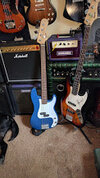

chilipeppermaniac
Ambassador of Decibels
I have a MIJ P bass and a Made in wherever Squier Vintage Modified are made one. Indonesia or China somewhere.

Session 5
Ambassador of Strings & Wings

Squire affinity --- "el crapo" according to most reviews----it slays---
best 50.00 guitar Ive ever purchased
View attachment 20197
I agree, I owned a Squire Affinity in the price range new for $240 CDN, you wont in my opinion get a better axe for that price range.


Col Mustard
Ambassador of Perseverance
I sold my USA Fender Jazz... 1966. I decided that I'm old now and should turn
that into money I might need later. That bass was the best instrument I've ever
played. Solid as a rock, built like a tank, almost maintenance free, endless sustain and
tone so good that sometimes a sound man would come up after a show to ask about
it, and look it over, after mixing it all evening.
So a USA made semi-vintage instrument is hard to beat... (unless it's a dog).
You all know there are plenty of dogs out there... Instruments from the "vintage years'
that never worked right, or weighed a ton, or warped and checked and cracked...
You all know they are out there, mouldering away in some closet, hoping for collector
interest, since they suck onstage.
What I'm using now is a heavily modded MIC ex-Squier Precision bass, and
a hand built Warmoth fretless Jazz Bass, assembled and finished by me.
These are examples of the low-ball vs the custom el coolio IMHO.
The price I paid for the ex-Squier was zero. It was given to me free, in really
bad shape. I have about $550 in it now, including luthier work, excellent quality
parts and an SKB soft case. My labor and attention to detail was free... I rescued
this one because it was a challenge, and because I had a hunch...
The hunch paid off. A world class luthier got the neck straight for me, and I did the
rest, and I now own a fine Precision bass that sounds as good as any... including
the best. I've been playing it everywhere for about four years now, with no problems.
This bass has paid for itself several times over in that time.
There are hundreds of dollars to be made playing bass... *grins
I think I have about $900 in my Warmoth beauty, including a "Reunion Blues" soft case
which is one of the best there is. My labor and attention to detail was free. I built this
one for fun, and to get the unmistakable sound of a fretless electric bass, which I have
always loved. So I built my dream bass... and paid less than the cost of a USA Fender.
Part of what I paid went to Fender for licensing, so there. I've been playing the Warmoth
since like 2009, so I believe I'm in the black with that one too. I've prolly made a few
hundred playing that one, over the last nine years.
The point of this description is to say that a cheapo instrument can provide an excellent
mod platform, as long as the neck can be made (and kept) straight. Replacing cheap junk
with good quality parts is only worth it if the neck can hold up, and the instrument can be
made to play true.
Conversely, a high end instrument is only worth what it can do for you musically....
or Stylistically.
These are not good investments, unless you steal it, or swindle some grieving widow
out of the rightful price of her husband's time machine special. Which is not recommended.
A high end instrument is for struttin' ... And bassists don't strut too much, with a few really dorky
exceptions, such as Gene Simmons (schmuck). If you can afford one, then by all means
buy it and strut yer stuff. Bassists generally just quietly keep the band together. Sometimes we
sing, but if your talent is keeping the band together, that's enough. *smiles
To do that, you only need a bass that plays clean, and stays in tune, and fills its place in the
mix alongside the drummer. When the drums and bass are tight, the whole band sounds great.
The lead singer can strut and fret his hour upon the stage, the lead guitarist can do aerial
displays of awesome height and attention grabbing. They won't lose their place no matter how
crazy they get, as long as the bass and the drums are tight. There it is.
that into money I might need later. That bass was the best instrument I've ever
played. Solid as a rock, built like a tank, almost maintenance free, endless sustain and
tone so good that sometimes a sound man would come up after a show to ask about
it, and look it over, after mixing it all evening.
So a USA made semi-vintage instrument is hard to beat... (unless it's a dog).
You all know there are plenty of dogs out there... Instruments from the "vintage years'
that never worked right, or weighed a ton, or warped and checked and cracked...
You all know they are out there, mouldering away in some closet, hoping for collector
interest, since they suck onstage.
What I'm using now is a heavily modded MIC ex-Squier Precision bass, and
a hand built Warmoth fretless Jazz Bass, assembled and finished by me.
These are examples of the low-ball vs the custom el coolio IMHO.
The price I paid for the ex-Squier was zero. It was given to me free, in really
bad shape. I have about $550 in it now, including luthier work, excellent quality
parts and an SKB soft case. My labor and attention to detail was free... I rescued
this one because it was a challenge, and because I had a hunch...
The hunch paid off. A world class luthier got the neck straight for me, and I did the
rest, and I now own a fine Precision bass that sounds as good as any... including
the best. I've been playing it everywhere for about four years now, with no problems.
This bass has paid for itself several times over in that time.
There are hundreds of dollars to be made playing bass... *grins
I think I have about $900 in my Warmoth beauty, including a "Reunion Blues" soft case
which is one of the best there is. My labor and attention to detail was free. I built this
one for fun, and to get the unmistakable sound of a fretless electric bass, which I have
always loved. So I built my dream bass... and paid less than the cost of a USA Fender.
Part of what I paid went to Fender for licensing, so there. I've been playing the Warmoth
since like 2009, so I believe I'm in the black with that one too. I've prolly made a few
hundred playing that one, over the last nine years.
The point of this description is to say that a cheapo instrument can provide an excellent
mod platform, as long as the neck can be made (and kept) straight. Replacing cheap junk
with good quality parts is only worth it if the neck can hold up, and the instrument can be
made to play true.
Conversely, a high end instrument is only worth what it can do for you musically....
or Stylistically.
These are not good investments, unless you steal it, or swindle some grieving widow
out of the rightful price of her husband's time machine special. Which is not recommended.
A high end instrument is for struttin' ... And bassists don't strut too much, with a few really dorky
exceptions, such as Gene Simmons (schmuck). If you can afford one, then by all means
buy it and strut yer stuff. Bassists generally just quietly keep the band together. Sometimes we
sing, but if your talent is keeping the band together, that's enough. *smiles
To do that, you only need a bass that plays clean, and stays in tune, and fills its place in the
mix alongside the drummer. When the drums and bass are tight, the whole band sounds great.
The lead singer can strut and fret his hour upon the stage, the lead guitarist can do aerial
displays of awesome height and attention grabbing. They won't lose their place no matter how
crazy they get, as long as the bass and the drums are tight. There it is.
Col Mustard
Ambassador of Perseverance
Well, I changed them several times over the 46 years that I owned it.
The price I originally paid for the '66 J-bass was $100, in 1972. At that time,
it was only an old bass. No one I knew was worshipping them then, or if they
were, they were worshipping the earlier ones. A '66 was just an old bass,
with an out dated sunburst finish. But it had excellent tone, which never changed.

In the '70s, mod fever was sweeping the country. I remember some "engineer"
who invited us to come into his workshop where he wanted to try a number of
different components inside the control cavity. He wanted to be our "engineer"
and get paid for keeping us up to date with the latest new thing-ama-bob...
I remember he had a number of different components lined up, and he had the
connectors to try them out one by one, and he asked me, "do you like it like this
or do you like it like that..." and I listened and made my choice and we paid him.
He took out the "worn out" stock Fender (CBS) parts, and installed what I had chosen.
This would have been about 1976... The parts we replaced had worked fine.
That instrument sustained longer than any other instrument, bass or guitar,
that I've ever played. It had wonderful tone... great soulful highs, really powerful
midrange, and a deep growl and oomph like nothing else.
Controlled well by the pots.
And it did before the mods, and it did after the mods.
So I don't know what the mods accomplished, if anything.
I little later, I stripped the 'out dated" sunburst finish off the instrument, and
put the chrome covers and the pick guard in a box, and played it naked. I
thought it looked cooler and more radical that way, and it did. I inserted black
nails in the screw holes...
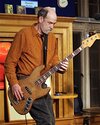
I don't remember what he installed, because I didn't understand all the techno-babble
at that time. I knew how to play music, but I didn't understand electronics so well.
The "engineer" told me there were advantages to what he installed in my bass, but
I didn't understand what he was talking about, so I just nodded and looked wise, and
played music on it. It worked fine, as it did before. *shrugs So my choices weren't
wrong... except that they removed the stock parts, and I didn't 'save' them.
Years later, I took my old '66 bass into a good luthier shop, and said to them,
"Get this back to factory spec." They understood what I meant, and did what I
asked. So the pots they installed were likely of equivalent value to the original, but
not antique parts. All the rest of the parts were stock... the jack, the pickups, the
bridge, the nut, the tuners, the chrome covers, the pick guard...
I found the old box where I had saved the chrome covers and the pick guard, and
put them back on. I felt that it looked cooler and more retro that way, and it did.

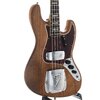
The above picture was taken by Elderly Instruments in Lansing Mi. who sold my bass on consignment
for me in 2018, and sent me a check. I don't think it was for sale for more than a month...
I accepted $3000 for it. Stripping the paint was an expensive mistake.
Whatever the pots and caps were, I believe they were equivalent to original equipment because I trusted my luthier to do just this. Nobody claimed they were original parts.
Those were long gone.
The price I originally paid for the '66 J-bass was $100, in 1972. At that time,
it was only an old bass. No one I knew was worshipping them then, or if they
were, they were worshipping the earlier ones. A '66 was just an old bass,
with an out dated sunburst finish. But it had excellent tone, which never changed.
In the '70s, mod fever was sweeping the country. I remember some "engineer"
who invited us to come into his workshop where he wanted to try a number of
different components inside the control cavity. He wanted to be our "engineer"
and get paid for keeping us up to date with the latest new thing-ama-bob...
I remember he had a number of different components lined up, and he had the
connectors to try them out one by one, and he asked me, "do you like it like this
or do you like it like that..." and I listened and made my choice and we paid him.
He took out the "worn out" stock Fender (CBS) parts, and installed what I had chosen.
This would have been about 1976... The parts we replaced had worked fine.
That instrument sustained longer than any other instrument, bass or guitar,
that I've ever played. It had wonderful tone... great soulful highs, really powerful
midrange, and a deep growl and oomph like nothing else.
Controlled well by the pots.
And it did before the mods, and it did after the mods.
So I don't know what the mods accomplished, if anything.
I little later, I stripped the 'out dated" sunburst finish off the instrument, and
put the chrome covers and the pick guard in a box, and played it naked. I
thought it looked cooler and more radical that way, and it did. I inserted black
nails in the screw holes...
I don't remember what he installed, because I didn't understand all the techno-babble
at that time. I knew how to play music, but I didn't understand electronics so well.
The "engineer" told me there were advantages to what he installed in my bass, but
I didn't understand what he was talking about, so I just nodded and looked wise, and
played music on it. It worked fine, as it did before. *shrugs So my choices weren't
wrong... except that they removed the stock parts, and I didn't 'save' them.
Years later, I took my old '66 bass into a good luthier shop, and said to them,
"Get this back to factory spec." They understood what I meant, and did what I
asked. So the pots they installed were likely of equivalent value to the original, but
not antique parts. All the rest of the parts were stock... the jack, the pickups, the
bridge, the nut, the tuners, the chrome covers, the pick guard...
I found the old box where I had saved the chrome covers and the pick guard, and
put them back on. I felt that it looked cooler and more retro that way, and it did.
The above picture was taken by Elderly Instruments in Lansing Mi. who sold my bass on consignment
for me in 2018, and sent me a check. I don't think it was for sale for more than a month...
I accepted $3000 for it. Stripping the paint was an expensive mistake.
Whatever the pots and caps were, I believe they were equivalent to original equipment because I trusted my luthier to do just this. Nobody claimed they were original parts.
Those were long gone.
Last edited:

Catmandue
Well-Known Member
Well, I changed them several times over the 46 years that I owned it.
The price I originally paid for the '66 J-bass was $100, in 1972. At that time,
it was only an old bass. No one I knew was worshipping them then, or if they
were, they were worshipping the earlier ones. A '66 was just an old bass,
with an out dated sunburst finish. But it had excellent tone, which never changed.
View attachment 21399
In the '70s, mod fever was sweeping the country. I remember some "engineer"
who invited us to come into his workshop where he wanted to try a number of
different components inside the control cavity. He wanted to be our "engineer"
and get paid for keeping us up to date with the latest new thing-ama-bob...
I remember he had a number of different components lined up, and he had the
connectors to try them out one by one, and he asked me, "do you like it like this
or do you like it like that..." and I listened and made my choice and we paid him.
He took out the "worn out" stock Fender (CBS) parts, and installed what I had chosen.
This would have been about 1976... The parts we replaced had worked fine.
That instrument sustained longer than any other instrument, bass or guitar,
that I've ever played. It had wonderful tone... great soulful highs, really powerful
midrange, and a deep growl and oomph like nothing else.
Controlled well by the pots.
And it did before the mods, and it did after the mods.
So I don't know what the mods accomplished, if anything.
I little later, I stripped the 'out dated" sunburst finish off the instrument, and
put the chrome covers and the pick guard in a box, and played it naked. I
thought it looked cooler and more radical that way, and it did. I inserted black
nails in the screw holes...
View attachment 21400
I don't remember what he installed, because I didn't understand all the techno-babble
at that time. I knew how to play music, but I didn't understand electronics so well.
The "engineer" told me there were advantages to what he installed in my bass, but
I didn't understand what he was talking about, so I just nodded and looked wise, and
played music on it. It worked fine, as it did before. *shrugs So my choices weren't
wrong... except that they removed the stock parts, and I didn't 'save' them.
Years later, I took my old '66 bass into a good luthier shop, and said to them,
"Get this back to factory spec." They understood what I meant, and did what I
asked. So the pots they installed were likely of equivalent value to the original, but
not antique parts. All the rest of the parts were stock... the jack, the pickups, the
bridge, the nut, the tuners, the chrome covers, the pick guard...
I found the old box where I had saved the chrome covers and the pick guard, and
put them back on. I felt that it looked cooler and more retro that way, and it did.
View attachment 21401
View attachment 21402
The above picture was taken by Elderly Instruments in Lansing Mi. who sold my bass on consignment
for me in 2018, and sent me a check. I don't think it was for sale for more than a month...
I accepted $3000 for it. Stripping the paint was an expensive mistake.
Whatever the pots and caps were, I believe they were equivalent to original equipment because I trusted my luthier to do just this. Nobody claimed they were original parts.
Those were long gone.
I have Bell and Howell pots on my 78 P Bass. I thought these as being after market but, after reading more I now feel my B & H pots might just be OEM.