Incoming Compression depression

Wonder how many guys electrocute themselves beating on amp tubes that fail---- while on -- running wide open.....with him touching it-----

Do I WANT tubes that some min wage schmuck has BEEN BEATING on ?? do they re test them AFTER beating on them---

HERE -- HERE ARE YOUR (TWICE AS EXPENSIVE) MESA TUBES WE BEAT THE SHITE OUT OF-- HOPE THEY WORK---
really?
 
Whether to spring for Mesa tubes or use the JJ's is up to you, but, without checking the bias with the JJ's installed there is a couple of things you can look at to ascertain they can safely be used.
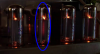
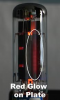
1) the most important: are the tubes redplating at any time from no signal through to full tilt when playing through the amp. To help you recognise what redplating looks like here's some pics15527725753693512838110712755542.png 15527727927461463767537375073441.png
Above we can see the plate (large grey structure) starting to glow red (a little).15527727301646031249180399682273.png
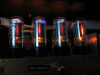
Above we can see the plates glowing a good bit more. Note in the pics above that it is glowing near the seams of the plates.15527728209068355545850476268633.png
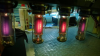
Above we see the tubes really redplating. These tubes will fail in very short order if run like this.
All pics show tubes "over biased" or biased too hot. An overly hot biased amp will often hum excessively.
2) Does the amp output it's full rated power (is it as loud as it was with original power tubes). Is there any nasty sounding distortion when playing the amp at a decent volume "clean" (crossover distortion). An amp that is "under biased" or "cold biased" will lack power & often produce nasty sounding crossover distortion.
So long as the amp is producing it's full rated output with no nasty distortion & the power tubes aren't redplating at any time you could consider it to be biased ok.
To expand on biasing, most amps with two or more output tubes are run in what is called "class AB". To safely bias for class AB we need the tubes to drawing a "minimum" idle current of 50% of the tubes "maximum plate dissipation" (the maximum current that the plate can safely dissipate the heat of), & a "maximum" idle current of 70% of the tubes "maximum plate dissipation.
You can see from this that we have a bit of leeway. Anywhere between those two parameters (50% ~ 70% of maximum plate dissipation) is ok.
Again, if the amp is properly putting out its full rated power & the power tubes aren't redplating at any time you could consider that they're biasing in between those two parameters & so good to use. Hope this is understandable & of help. Cheers
 
Last edited:
I see nothing of the sort the tubes have the middle glow but the grey sleeve is ---well grey --

I will try and check again -- by turning the amp around to face the wall and having the back exposed and then dime the volume and play --- and see what the tubes do?? would that be a fair assessment?
 
Yes, check at "no signal" (no guitar plugged in) & also plugged in & playing, all the way up to dimming the volume. It will help to have someone else playing the guitar while you look. Redplating is by far the most important condition to avoid as it will result in tube failure & possible amp damage.
You can't hurt the tubes or amp by by being biased too cold though. So if there's no redplating you're safe. Cheers
 
Well-- I know this -- a week ago after two hours flogging the on off switch was hot enough to be VERY noticeable when shutting off----as was the standby and the metal Mesa Logo badge---now only a TAD warmer then ambient temperature ---

:)
 
Thank you and thanks for the education!!! I learned more in 24 hours about tubes than I EVER did before :)

The seller did respond stating
"we match the tubes to each other and to Mesa guidelines for 2 parameters" --- er -- I guess that mens the 2 numbers on the box are within "spec" but they dont beat on em with a hmmer or some of the other testing ranges MEsa does --

Im sure for noodling around in my room they will live long and prosper -- :)

Oh -- BY THE WAY----in case you are new here

I HAVE A MESA!!!!!! :)
 
so against my better judgement-- and staunch long term -- BAss-cable-amp _BOOM system------------------I added this THING-- this--- pedal -- this depressing compression ----


HOLY JUMPING MOTHER OF
Jehoshaphat!!!!!!!!!!!!!!!!!!!!!

it makes the Hartke sound even fooooogin better!!!!!!!!!!!!!!!!!!!!!!!!!!!!!!!!!!!!!!

I can now-- actually hit a note -- go set the guitar down--- make a sammich---- EAT the damn SAMMICH -- take a piss get a beer-- and the note is still GOING!!!!!

:)
 
I found this explanation of what a compressor pedal does on another forum. I like it and think it does a good job describing what's happening...he is explaining things based on the knobs of a particular compressor pedal.

"Gain is how much signal you're feeding the circuit, so it will massively effect the feel.

Threshold is where the compression starts to come into play, below the threshold there's no compression.

Ratio is how much compression is applied after going beyond the threshold, 1:1 is no compression. Picture a kid jumping on a bed, if he jumps high enough he'll hit his head on the ceiling. Now, stretch a rubber sheet and attach it above the bed. The height of the sheet is the threshold. The sheet's tightness is the ratio. So the kid on the bed won't jump as high when his head hits the sheet. If the sheet is stretched tight he won't go much above the threshold. If the sheet is loose he'll go higher above the threshold.

Attack is the amount of time after you've crossed the threshold that the compression kicks in. You can have an uncompressed pick attack, but a compressed sustain.

RLS is release, or how long it takes the compressor to stop compressing once the signal falls below the threshold.

The last knob is likely output level, which (of course) allows you to vary the output level."
 
Good luck with your new pedal, Swamp Fella.

T.B.H. I've always found Behringer pedals to be awful and sold them (or given them away or just thrown them away) sharpish. However, I hope this one is fantastic and does everything you want from it: compression rather than depression.

 
uhm...........they sound good to me --

Ive had issues with Behringer pedals -- Ive had decent luck with them as well.

guess it just depends on that particular pedal ---the Compressor I have at present I like
 
I have my first ever compression pedal turning up tomorrow, so I'm looking forward to learning something and joining the conversation...
 
I think the big issue with these Behringer pedals is the plastic case. I read this, but don't have any so not sure it's true...
 
well my pedal board is a top shelf on a book shelf---

I dont step on it -- so its fine--
Im guessing a pro is NOT going to buy a Behringer anything---these are "home hobby" quality IMHO

THinking of getting the FUZZ --- just to use with bass-- easier to use than the DIGITECH (also plastic) BP50 Bass Modeling "processor "--- which is a P.I.A> and I only use it for the drum rhythms
 
Back
Top