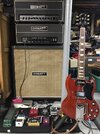
IM SO CONFUSED

this.............DSL 15H ...........has a switch triode/pentode ...........a la mode ;)
View attachment 55700
Glad you brought up the triode/pentode circuit switch into this already confusing thread. So, with some brief research and from what I understand so far, a tube operating in...
Pentode (5 elements): Anode; cathode; control grid; screen grid; & suppressor grid.

Tetrode (4 elements): Anode; cathode; control grid; & screen grid.

Triode (3 elements): Anode; cathode; & a grid.
 
Glad you brought up the triode/pentode circuit switch into this already confusing thread. So, with some brief research and from what I understand so far, a tube operating in...
Pentode (5 elements): Anode; cathode; control grid; screen grid; & suppressor grid.

Tetrode (4 elements): Anode; cathode; control grid; & screen grid.

Triode (3 elements): Anode; cathode; & a grid.
And the Diode clipping in my Jubilees must have 2 elements. But the LED clipping in that series is very tube like. Bery. For decades I had nomidea it was LED clip on lead channel. Can't care, they sound great!
 
Very cool of you clearing this up! So from what im gathering here, Marshall typically connects the suppressor grid ( pin 1)
to the cathode (pin 8) in the base, where as someone like Traynor doesnt and goes with a negative bias to the suppressor grid? ( hoping im getting this right, im not savvy in this but just find it interesting honestly) What would be the advantage to something like that?
yes

It changes a pentode into tetrode by connecting the two pins together.
Or a tetrode is already connected inside the bulb.

When the 2 are not connected together:
Connecting the bias negative volts to the suppressor reduces the sensitivity of the plate.
For one thing it will run a bit cooler like that. Not so extreme.

But Marshall just lets it run hotter and more extreme as a tetrode.
 
Last edited:
yes

It changes a pentode into tetrode by connecting the two pins together.
Or a tetrode is already connected inside the bulb.

When the 2 are not connected together:
Connecting the bias negative volts to the suppressor reduces the sensitivity of the plate.
For one thing it will run a bit cooler like that. Not so extreme.

But Marshall just lets it run hotter and more extreme as a tetrode.
So stupid question: is that the "magic" part to classic Marshall's sound: letting the power tubes run hotter, near the threshold of their plate voltage rating in the older NMV models?
 
Last edited:
So stupid question: is that the "magic" part to classic Marshall's sound: letting the power tubes run hotter, near the threshold of their plate voltage rating in the older NMV models?
The real Marshall sound (like a plexi) is output tube distortion. There is early break up from the power amp.
The preamp is relatively clean.
It's a clean pre amp overdriving the output tubes into distortion. Therefore very loud.

The later marshall sound is preamp distortion. Like a JCM 800 2203. It can break up without being super loud.

So the difference really is power amp distortion VS preamp distortion.

The Plexi distortion works fine if you don't mind standing 10 feet away from the loudest thang on earth.
 
So stupid question: is that the "magic" part to classic Marshall's sound: letting the power tubes run hotter, near the threshold of their plate voltage rating in the older NMV models?
The other part of it is that the Marshall EQ is like this: /
The highs are boosted way up and the lows are attenuated.
This causes the highs to distort and compress, but the lows (being attenuated) come out clean.

So what you are hearing
the higher the frequency, the more distortion.
The lower the frequency, the less distortion.
You get crunchy top end and cleaner low end. This prevents the low frequency from sounding overloaded and farty.

That is why a Marshall sounds like a Marshall. Crunchy top, clean bottom.
 
Important consideration:
I know it's confusing, so follow along step by step.

Some 6CA7 is a Tetrode. The cathode is tied to the suppressor inside the bottle.
Some 6CA7 is a Pentode ! The suppressor grid and cathode are separated / not tied together inside.

[A True 6CA7 (IMHO) is separate, and is not tied inside the tube. This is a pentode.]

If you install the Tetrode 6CA7 in a Traynor or PV Windsor, it will short the bias voltage to ground.
Because the Traynor and PV Windsor was designed for the pentode output tube.

Now watch out for this, and check your manufacturer data sheets !

View attachment 55719

View attachment 55721
There is much confusion about the 6CA7 being a beam tetrode or pentode, with much miss-information on the internet, even from tube distributor's sites.
Regarding the (Electro Harmonix) 6CA7EH, let's get it straight from the horse's mouth so to speak & go to Mike Matthews Electro Harmonix site
where it states the 6CA7 is a big bottle beam tetrode. I'm quite sure that Mr Matthews knows what type tube he is having made. If you look to this tube's datasheet's you'll see no mention at all of the g3 suppressor grid essential to a pentode.
IMHO, the beam forming plates not being internally tied to the cathode does not make the tube a pentode, & the Markoni Osram Valve Company (MOV) who designed this tube type (refined in conjunction with RCA in an info sharing arrangement) obviously thought the same, see the very well known KT (Kinkless Tetrode) series of tubes, for example. I'm sure the MOV design engineers knew at least just a little more than you & I about exactly what is an active electrode within a valve & what isnt, so if to them its a tetrode, that's good enough for me. Cheers
 
The real Marshall sound (like a plexi) is output tube distortion. There is early break up from the power amp.
The preamp is relatively clean.
It's a clean pre amp overdriving the output tubes into distortion. Therefore very loud.

The later marshall sound is preamp distortion. Like a JCM 800 2203. It can break up without being super loud.

So the difference really is power amp distortion VS preamp distortion.

The Plexi distortion works fine if you don't mind standing 10 feet away from the loudest thang on earth.


And then, if you want to play even louder.... Get a Hiwatt.
 
When the 2 are not connected together:
Connecting the bias negative volts to the suppressor reduces the sensitivity of the plate.
For one thing it will run a bit cooler like
To clear up this suppressor grid thing we first need to understand why the suppressor grid was added & also what happens inside the tube under heavy conduction.
Electrons travel toward the plate with very high velocity, enough velocity that some electrons bounce right off the plate. This is known as secondary emission, exactly what the suppressor grid was added to "suppress".
During heavy conduction, the (negatively charged) electrons accumulating on the plate cause it's high positive potential to be reduced somewhat, leaving the screen grid as having the highest positive potential within the tube.
Without a functional suppressor grid, electrons that bounce back off the plate as secondary emission are attracted by the high positive potential of the screen grid, screen current rises & the plate is not operating as efficiently as it can.
Now, to applying a negative voltage to the suppressor grid,,,.
Note that both times I mentioned it, I said that a negative voltage is often "derived" from the negative bias voltage. I did not say to connect the bias voltage directly to the suppressor grid, as some online tutorials say to do. This is too high of a negative voltage & will result in the suppressor grid acting as a second control grid, thus causing the effects AMS mentions above.
What is required is that the suppressor grid be negative with respect to the cathode, enough that it repells the "secondary emission" electrons bouncing off the plate "back" to the plate, without it being so negative that it acts as a second control grid.
A suppressor grid negative voltage that is say, 1/5th or 1/6th the control grid's negative voltage should be fine.
Compared to a pentode that has the suppressor grid tied to the cathode, this will result in reduced screen grid current & increased plate current, as stated in that "tube Bible", the Radiotron Designers Handbook. Cheers
 
Back
Top