Good catch AMS
The EL34 & the 6CA7 are basically compatible & even the pin-outs are the same. Although we sometimes see them labelled as EL34/6CA7 or 6CA7/EL34 & see them both drawn the same schematically on datasheet's, a "true EL34" is a pentode (that feature a suppressor grid) & a "true 6CA7" is a "beam tetrode" (that feature beam forming plates & no suppressor grid).
Most amps that use pentode type power tubes like the EL34 don't actually make use of the tube as a pentode in that they tie the cathode & suppressor grid together at the valve socket (pins 1 & 8), so are actually using the tube as a tetrode.
To use the EL34 as a pentode, pin 1 (suppressor grid) & pin 8 (cathode) are kept separate (not tied together at the socket) & a negative voltage is applied to the suppressor grid (pin 1). This works to repell any electrons that bounce off the plate (secondary emission) "back" to the plate, thus running the tube more efficiently. The negative voltage supplying the suppressor grid is often derived from the fixed negative bias supply.
Some Traynor amps run the EL34's as a pentode in this fashion, & though I haven't looked, I'm imagining that the Peavey Windsor does too.
A true 6CA7 beam tetrode is run by having the beam forming plates tied to the cathode, in fact, some beam tetrode type tubes have these elements tied together internally.
Because (some) Traynor's run the EL34's as a pentode by applying a negative voltage to the (pin 1) suppressor grid, a 6CA7 beam tetrode cannot be plugged straight in.
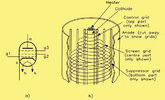
Here's a diagram showing the internal elements of a pentode
View attachment 55697
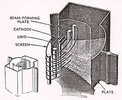
Here's a diagram showing the internal elements of a beam tetrode
View attachment 55698
Now after reading this long winded rant, I'm imagining that
@eSGEe is more confused than ever. Cheers