High Voltages After Headfirst Origin 50 Mod

Without researching, I don't know who actually manufacturers these "relabled as Marshall" tubes. Usually the manufacture will openly provide a datasheet with specs and operating limits of their products.

 
Nice... (y)

@old rocker
Can you find your Marshall tube codes and match them up to the list posted by Mr GregM?

Posted by big dooley (Marshall Amp Forum):

VLVE-00007 12AT7/ECC81 No selection White Logo
VLVE-00009 12AU7/ECC82 No selection White Logo
VLVE-00010 EL34 Svetlana
VLVE-00033 SV6550C Svetlana White Logo
VLVE-00038 6V6GT Shuguang White Logo
VLVE-00039 KT66 Shuguang White Logo
VLVE-00042 EL34B Shuguang Gold Logo
VLVE-00047 12AX7B/ECC83 Shuguang Low Microphony Gold Logo
VLVE-00049 12AX7B/ECC83 Shuguang High Microphony Gold Logo
VLVE-00055 12AX7B/ECC83 Shuguang No Selection White logo
VLVE-00063 12AX7B/ECC83 Shuguang A Low Microphony White Logo
VLVE-00064 12AX7B/ECC83 Shuguang B Low Microphony White Logo
VLVE-00065 12AX7B/ECC83 Shuguang Gain Selected >=4V White Logo
VLVE-00066 ECC83S JJ Low Microphony Red Logo
VLVE-00066S ECC83S Microphonic Selection A
VLVE-00067 ECC83S JJ Low Microphony Red Logo
VLVE-00067S ECC83S Microphonic Selection A
VLVE-00068 EL84 JJ Graded Low Anode Current Red Logo
VLVE-00069 EL84 JJ Graded High Anode Current Red Logo
VLVE-00070 EL34 JJ Graded Anode Current Red Logo
VLVE-00071 EZ81 JJ No selection Red Logo
VLVE-00077 KT66 Shuguang Graded Anode Current Gold Logo
VLVE-00080 KT88 Shuguang Graded Anode Current Gold Logo
VLVE-00083 5881/6L6WGC Shuguang Graded Anode Current Gold Logo replaces VLVE-00006
VLVE-00087 EL34B Shuguang Graded Anode Current White Logo
VLVE-00088 GZ34/5AR4 JJ No selection Red Logo Replaces VLVE-10043
 
Without researching, I don't know who actually manufacturers these "relabled as Marshall" tubes. Usually the manufacture will openly provide a datasheet with specs and operating limits of their products.

I posted the full decode here in TTR as well in Room Eleven in a thread titled Marshall Tubes.

Ok, the majority of Marshall branded tubes are Shuguang.

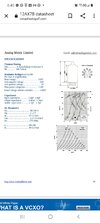
Here's the data sheet from Shuguang which shows the tube is rated for 330 volts:

Screenshot_20211023-064053_Chrome.jpg

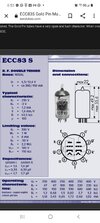
Here you can compare the Shuguang 12AX7s to a JJECC83S:

Screenshot_20211023-065342_Chrome.jpg

Note the JJECC83S has a lower maximum voltage rating.
 
Last edited:

 
Nice... (y)

@old rocker
Can you find your Marshall tube codes and match them up to the list posted by Mr GregM?

Posted by big dooley (Marshall Amp Forum):

VLVE-00007 12AT7/ECC81 No selection White Logo
VLVE-00009 12AU7/ECC82 No selection White Logo
VLVE-00010 EL34 Svetlana
VLVE-00033 SV6550C Svetlana White Logo
VLVE-00038 6V6GT Shuguang White Logo
VLVE-00039 KT66 Shuguang White Logo
VLVE-00042 EL34B Shuguang Gold Logo
VLVE-00047 12AX7B/ECC83 Shuguang Low Microphony Gold Logo
VLVE-00049 12AX7B/ECC83 Shuguang High Microphony Gold Logo
VLVE-00055 12AX7B/ECC83 Shuguang No Selection White logo
VLVE-00063 12AX7B/ECC83 Shuguang A Low Microphony White Logo
VLVE-00064 12AX7B/ECC83 Shuguang B Low Microphony White Logo
VLVE-00065 12AX7B/ECC83 Shuguang Gain Selected >=4V White Logo
VLVE-00066 ECC83S JJ Low Microphony Red Logo
VLVE-00066S ECC83S Microphonic Selection A
VLVE-00067 ECC83S JJ Low Microphony Red Logo
VLVE-00067S ECC83S Microphonic Selection A
VLVE-00068 EL84 JJ Graded Low Anode Current Red Logo
VLVE-00069 EL84 JJ Graded High Anode Current Red Logo
VLVE-00070 EL34 JJ Graded Anode Current Red Logo
VLVE-00071 EZ81 JJ No selection Red Logo
VLVE-00077 KT66 Shuguang Graded Anode Current Gold Logo
VLVE-00080 KT88 Shuguang Graded Anode Current Gold Logo
VLVE-00083 5881/6L6WGC Shuguang Graded Anode Current Gold Logo replaces VLVE-00006
VLVE-00087 EL34B Shuguang Graded Anode Current White Logo
VLVE-00088 GZ34/5AR4 JJ No selection Red Logo Replaces VLVE-10043

Hi syscokid, once again thanks for your help & again sorry about my lack of knowledge,but i'm learning SLOWLY :rolleyes: .

My valve are as follows (all Marshall branded) numbered in positions 1/2/3 from the Input end.

Pos 1: VLVE 90066. (ECC83) 12/17
Pos 2: VLVE 00067. (ECC83) 09/17
Pos 3: VLVE 00067. (ECC83) 09/17

Pos 4: VLVE 90105. (EL34) 12/17
Pos 5. VLVE 90105. (EL34) 12/17

The EL 34's have what looks like a JJ logo, i don't know if this helps, the only numbers that correspond to the list are the 2 x VLVE 00067, but mine are not stamped ECC83S as it indicates in the list.
Regards, Graham.
 
Hi syscokid, once again thanks for your help & again sorry about my lack of knowledge,but i'm learning SLOWLY :rolleyes: .

My valve are as follows (all Marshall branded) numbered in positions 1/2/3 from the Input end.

Pos 1: VLVE 90066. (ECC83) 12/17
Pos 2: VLVE 00067. (ECC83) 09/17
Pos 3: VLVE 00067. (ECC83) 09/17

Pos 4: VLVE 90105. (EL34) 12/17
Pos 5. VLVE 90105. (EL34) 12/17

The EL 34's have what looks like a JJ logo, i don't know if this helps, the only numbers that correspond to the list are the 2 x VLVE 00067, but mine are not stamped ECC83S as it indicates in the list.
Regards, Graham.
Looks like all your tubes are JJ's. The JJ ECC83(S) has a max cathode voltage rating of 180v. Robert's Origin 50 is putting out 196v at V2's pin-3 cathode. So, it looks like the JJ is underspeced by 16v at one of the cathodes of the V2 position. Some of these documented maximum operating limits are on the conservative side. It might be safe and reliable to operate at this level. Hopefully a more knowledgeable person can chime in here.

There are other 12AX7's that have higher cathode operating voltage specs than these JJ's. The Genelex Gold Lion's, Electro Harmonix 7025EH's, and the Russian reissues of the Mullard's, all have a max rating of 200v.
 
Looks like all your tubes are JJ's. The JJ ECC83(S) has a max cathode voltage rating of 180v. Robert's Origin 50 is putting out 196v at V2's pin-3 cathode. So, it looks like the JJ is underspeced by 16v at one of the cathodes of the V2 position. Some of these documented maximum operating limits are on the conservative side. It might be safe and reliable to operate at this level. Hopefully a more knowledgeable person can chime in here.

There are other 12AX7's that have higher cathode operating voltage specs than these JJ's. The Genelex Gold Lion's, Electro Harmonix 7025EH's, and the Russian reissues of the Mullard's, all have a max rating of 200v.

Thanks, it sounda like i would be better trying to source the Valves which are spec'd to run at the voltages you have worked out for Roberts Amp, are the Marshall spec EL34's ok for your specification ?, or do i need to look at an alternative ?.
Thanks for helping me with this, i've done the HF mods & the Amp sounds great, but i'd like to your voltage adjustments to complete the job.
Thanks, Graham.
 
I posted the full decode here in TTR as well in Room Eleven in a thread titled Marshall Tubes.

Ok, the majority of Marshall branded tubes are Shuguang.

Here's the data sheet from Shuguang which shows the tube is rated for 330 volts:

View attachment 74562

Here you can compare the Shuguang 12AX7s to a JJECC83S:

View attachment 74565

Note the JJECC83S has a lower maximum voltage rating.
The most important being:
Ik cathode current 8 ma
Wa plate limit 1 watt
you can exceed the voltage (and frequently is exceeded) as long as the current stays under the limit.
Like I told you
It's not unusual for a phase inverter to have a 400 volt supply.
And it will keep on working, because the current isn't exceeded.

So instead of being all obsessive about the voltage...you should measure the current.

Indecently when you measure the plate voltage:
you should be measuring between plate and cathode.
Not between the power supply and ground.
The true plate voltage is between plate and cathode.
or: DC voltage between pins 1 and 3.
Or DC voltage between pins 6 and 8.
So don't get confused about what really is the plate voltage.
Tube circuits do this all the time.
 
Last edited:
You can use the meter method but it's not as accurate as using a scope.
A lot of people do use a meter...
Biasing means we are setting the quiescent plate current, which a 'scope tell us nothing about.
The most accurate way to measure plate current is to break the connection between the OT primary half & the valve's plate, & to insert a milliamp meter in the circuit. We can get (or make) adaptor's for this that plug between the valve socket & valve base. These have the advantage of being external to the chassis, thus lessening the chance of inducing oscillations which would cause a wrongful reading. Still, leads are best kept very short.
I've posted this before
"Crossover Notch" Biasing - Why It Should Be Avoided.
Mr Aiken is known to know a little more than your average bear when it comes to valve amps. Cheers
 
... are the Marshall spec EL34's ok for your specification ?
I didn't bother to check the specs of the JJ EL34. I know that they're are operating very easily within the Origin 50's circuit. With a medium or 60% bias, the EL34 plate (pin 3) voltages should be between 425v & 430v on the Origin 50. According to Chris Merren of Merren Audio (Merren makes killer Marshall style trannies), 430v for EL34's is the sweet spot.
 
Biasing means we are setting the quiescent plate current, which a 'scope tell us nothing about.
The most accurate way to measure plate current is to break the connection between the OT primary half & the valve's plate, & to insert a milliamp meter in the circuit. We can get (or make) adaptor's for this that plug between the valve socket & valve base. These have the advantage of being external to the chassis, thus lessening the chance of inducing oscillations which would cause a wrongful reading. Still, leads are best kept very short.
I've posted this before
"Crossover Notch" Biasing - Why It Should Be Avoided.
Mr Aiken is known to know a little more than your average bear when it comes to valve amps. Cheers
The scope tells me everything I need to know.
And, after i set bias with a scope, the current can be checked with a meter...and it is indeed absolutely correct.
I don't use the meter first I use the scope first. And it works every time.
There's much more than 1 way to set bias....
I learned how to set bias with a scope from Dudley Craven. He taught me over the phone from Milton Keynes England.

This was how bias was set for Plexi amps at the factory: scope.

Now, if you would like to learn how...you can.
Mike Soldano will show you how. Just watch and learn.
Scope bias is not only accurate, it's far more accurate than using a meter.

 
Last edited:
I didn't bother to check the specs of the JJ EL34. I know that they're are operating very easily within the Origin 50's circuit. With a medium or 60% bias, the EL34 plate (pin 3) voltages should be between 425v & 430v on the Origin 50. According to Chris Merren of Merren Audio (Merren makes killer Marshall style trannies), 430v for EL34's is the sweet spot.
Well,
I just bias it so that the crossover distortion does not appear in the waveform, until just when the output clips.
Before clipping: the crossover distortion should be gone.
After clipping: that's when you should see the crossover distortion.
That's how Dudley taught me. And it's worked every time just great.

Then you can go back and test with a meter if you doubt it....
but I think you will find that the scope works just great.
 
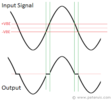
Top Waveform:
This is what you will see when the bias is correct.
This gives you the maximum clean headroom.
Bottom Waveform:
This is what you will see when the bias is set too cold. (crossover distortion)
This is going to sound fizzy, and the headroom will be gone.
1635043999915.png

So after a while you work with this, and you realize that you don't need a bias meter at all.
You start to learn that the wave form will show you what you need to know.
After some practice, bias adjusting becomes really easy without using any formulas.
You don't need to measure the plate volts at all.
You don't need to have a bias probe, or a 1 ohm resistor.

Besides which:
volts X amps does not = watts.
but many people assume it does.

Volts X amps = VA, not watts.

Then VA X efficiency = True RMS Watts

This is why the formula for bias is really wrong.
There is no number for efficiency in the formula.
Without a number for efficiency, you never know what the true wattage is.
(Ohms Law)

Just learn how to read the wave form. Then you can skip all the formulas.
 
Last edited:
The scope tells me everything I need to know.
And, after i set bias with a scope, the current can be checked with a meter...and it is indeed absolutely correct.
I don't use the meter first I use the scope first. And it works every time.
There's much more than 1 way to set bias....
I learned how to set bias with a scope from Dudley Craven. He taught me over the phone from Milton Keynes England.

This was how bias was set for Plexi amps at the factory: scope.
Dudley Craven may like the 'scope method, & each to his own, but Marshall MOST DEFINITELY DID NOT use the 'scope method for biasing for the Plexi amps.
These were biased by applying a calibrated signal to the input, all controls on 10, & adjusting the negative bias voltage to achieve the full rated output power (& a 'scope ain't needed for that).
If we look to the old Marshall service manuals we see absolutely no mention of biasing with a 'scope.

I did try the 'scope method, back when Mr Aspen Pittman (groove tubes founder) was touting it as the be all. First on a two fat bottle 6CA7 guitar amp, then on a four EL34, 120 watt bass amp. Got the same results as Mr Aiken.
The two 6CA7 guitar amp biased cold.
The four EL34 bass amp had a power transformer that featured two HT windings, one that put over 600VDC on the EL34 plates, another that supplied about 450VDC to the screen grids & also supplied the PI & pre-amp. Biasing out the cross-over notch brought about slight red-plating in all four EL34's.

If we look to the old valve technology text books, valve application manuals etc etc, we do not see any mentions of the "scope method of output tube biasing," at least, not in any that I've seen (& I've seen a few). It's always "plate current".

Each to their own though, if one wants to bias using the scope method, they're free to. Experience has just put me off it.

Top Waveform:
This is what you will see when the bias is correct.
This gives you the maximum clean headroom.
Bottom Waveform:
This is what you will see when the bias is set too cold. (crossover distortion)
This is going to sound fizzy, and the headroom will be gone.
View attachment 74597

So after a while you work with this, and you realize that you don't need a bias meter at all.
You start to learn that the wave form will show you what you need to know.
After some practice, bias adjusting becomes really easy without using any formulas.
You don't need to measure the plate volts at all.
You don't need to have a bias probe, or a 1 ohm resistor.

Besides which:
volts X amps does not = watts.
but many people assume it does.

Volts X amps = VA, not watts.

Then VA X efficiency = True RMS Watts

This is why the formula for bias is really wrong.
There is no number for efficiency in the formula.
Without a number for efficiency, you never know what the true wattage is.
(Ohms Law)

Just learn how to read the wave form. Then you can skip all the formulas.
The above diagram is not a 'scoped waveform" at all. This type cross-over notch distortion is seen in class B output stages, not the class AB output stages common in our guitar amps.
We bias around plate current & % of maximum plate dissipation. A 'scope does not give any indication of plate current.
Output power (watts) is calculated off the OT secondary (speaker output). The formular for this is W = Volts squared/impedance.
Cheers
Edit:
I defy anyone to, in a blind test, identify the onset of cross-over notch distortion in a class AB output waveform, or the moment at which the cross-over notch distortion is dialled out. Cheers
 
Last edited:
Dudley Craven may like the 'scope method, & each to his own, but Marshall MOST DEFINITELY DID NOT use the 'scope method for biasing for the Plexi amps.
These were biased by applying a calibrated signal to the input, all controls on 10, & adjusting the negative bias voltage to achieve the full rated output power (& a 'scope ain't needed for that).
If we look to the old Marshall service manuals we see absolutely no mention of biasing with a 'scope.

I did try the 'scope method, back when Mr Aspen Pittman (groove tubes founder) was touting it as the be all. First on a two fat bottle 6CA7 guitar amp, then on a four EL34, 120 watt bass amp. Got the same results as Mr Aiken.
The two 6CA7 guitar amp biased cold.
The four EL34 bass amp had a power transformer that featured two HT windings, one that put over 600VDC on the EL34 plates, another that supplied about 450VDC to the screen grids & also supplied the PI & pre-amp. Biasing out the cross-over notch brought about slight red-plating in all four EL34's.

If we look to the old valve technology text books, valve application manuals etc etc, we do not see any mentions of the "scope method of output tube biasing," at least, not in any that I've seen (& I've seen a few). It's always "plate current".

Each to their own though, if one wants to bias using the scope method, they're free to. Experience has just put me off it.


The above diagram is not a 'scoped waveform" at all. This type cross-over notch distortion is seen in class B output stages, not the class AB output stages common in our guitar amps.
We bias around plate current & % of maximum plate dissipation. A 'scope does not give any indication of plate current.
Output power (watts) is calculated off the OT secondary (speaker output). The formular for this is W = Volts squared/impedance.
Cheers
Edit:
I defy anyone to, in a blind test, identify the onset of cross-over notch distortion in a class AB output waveform, or the moment at which the cross-over notch distortion is dialled out. Cheers
This is what you can do with a scope, that you are not doing now:
Verify bias
Verify output tubes
Verify output power
Verify clean sine wave output
ALL at the same time.
It will cut your bench time by 60%.

Then you can verify with a meter last. (if you want to)
You will see why Mike Soldano, Amp Mad Scientist, Dudley (lord rest his beautiful soul), all use a scope.

Because it's faster and works just as well as other methods.

Students:
Learning to use a scope will broaden your tool kit.
Increase efficiency, decrease time, increase productivity.

You should really stop whining and moaning.
New techniques, new skills, make us better at our jobs.
Instead of fighting it all the time, rejecting other people's ideas, you can learn something new from it.

Instead of being angry, lighten up.
 
Last edited:
Back
Top