Fret Level Help

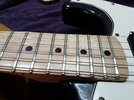
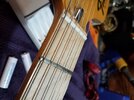
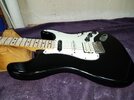
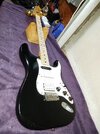
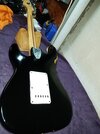
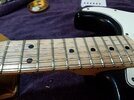
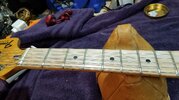
The fret work is done and this is strung up
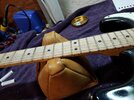
20181213_000304.jpg

20181213_000319.jpg


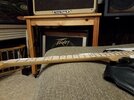
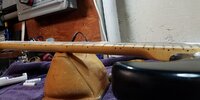
The neck had good reilef when I strung it up, so I did not touch it. Now that I see this pic, it looks like it has back bow. I will let it stay overnight under tension and put it through its paces tomorrow.
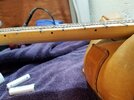
20181213_000311.jpg

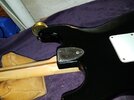
I made a custom shim. It is thick. It may be due to the amount of wood I sanded off, but I think this neck needed one anyway. I forgot to take a picture of the shim while it was out, which I regret because it came nice and was crafted from spare wood on the spur of the moment. Here is the edge
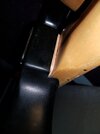
20181213_000240.jpg

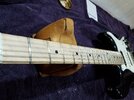
I also made a custom nut

20181213_000256.jpg
 
Last edited:
This guitar is done. The relief is fine. Maybe it was suffering from all the trauma it endured, but it seems to have settled down.

I spent some time with it tonight and it is a nice player! I would say it feels as good as any $1K Fender

I also took the time to give this a high speed buffing and polish up some of the metals. It is ready for a night on the town!!

20181213_194059.jpg
20181213_194123.jpg
20181213_192722.jpg


20181213_193747.jpg

20181213_193807.jpg

20181213_192842.jpg
20181213_192857.jpg
20181213_192905.jpg
20181213_192913.jpg

cleardot.gif
 
Last edited:
I am still wondering why it had to have that big shim? Was the neck pocket cut too deep? Is the neck now at an angle to the body? Or does the shim fill the neck pocket evenly and 100%? I am guessing the insertion of the shim was because from the nut to the bridge there was either too much gap, uneven gap, etc from an excessive concave bow. Or with the neck sitting flush, when the neck is straightened, the strings hit the frets? I am so dern confused. I wish I had my hands on the guitar before Ray opened it up.
 
I am still wondering why it had to have that big shim? Was the neck pocket cut too deep? Is the neck now at an angle to the body? Or does the shim fill the neck pocket evenly and 100%? I am guessing the insertion of the shim was because from the nut to the bridge there was either too much gap, uneven gap, etc from an excessive concave bow. Or with the neck sitting flush, when the neck is straightened, the strings hit the frets? I am so dern confused. I wish I had my hands on the guitar before Ray opened it up.
So here is how I think the story goes. At some point, this neck either warped, or was never good. It may be because it has been in a ridiculously tight case which keeps the neck bent. As a result, there came a point where low action could not be achieved and someone tried to solve this problem by cranking the micro-tilt to a macro-tilt. Since this is a 3 bolt guitar, and the micro-tilt screw was up so high, at one point, when the owner picked it up, the neck pivoted in the neck pocket, which is the issue he asked me to fix. In the end, the pivot was the easy part.
 
I'm guessing you removed almost as much wood from the top of the neck as the thickness of that shim. Would that be about right?
It was a lot, but I would not have thought that much. Interestingly, even with that shim, the strings to not touch the fret board. It would need to be about 2mm thicker to do that. With the action as-pictured, the saddles are bottomed out. The saddles are beefy, but not abnormal.
 
As I was seeing it, I would permanently add to the neck pocket the shim. Glue it in and touch up paint the edge to body area in black to make it as seamless a repair as possible.

As I also was seeing things, the DIP in the Fretboard below the notched straight edge seems odd in that if Ray says there was no T rod or String tension on it and he still got a dip, then the neck is not flat before or after fret work was done.

Another question I have is, if Ray puts a non notched straight edge on the tops of the frets, is there full contact with all of them, or are there rocking high and low spots? Does this or will this also likely change once tension is put on it with the strings on it? Also, in the one view, I think it was before frets were removed and installed, it appears the wood near the first few frets by the nut go flat, then there is a depression for a few frets, then it comes back up some and finally levels out in the 17-21 fret area. To explain it, picture a dead straight neck that a has a pothole in it. In other words a tighter or looser T rod won't take out a dent.

Oh and in case Ray or others don't know this, I have read it as being advised not to expect a T Rod to Straighten a neck. It is best to clamp the neck carefully and then adjust the T rod to hold it there.
 
Truss tods only really do their job on a neck which is in basically good condition. If there is a weak spot at some point along the neck, you get a sharp bend that can't be straightened.
 
Progress is steady. I started with the long beam, but was completely missing the middle, so I switched to the small block. I think I can go back to the long beam now. Such fun!

View attachment 19886

View attachment 19887

View attachment 19888

View attachment 19889

View attachment 19890

View attachment 19891

Where the sanding starts taking off material vs where the original finish still remains while Ray sands further and further is evident where the "pothole" existed
 
Back
Top