
syscokid
Ambassador of War & Peace

I know very little about their micro-tilt stuff, but that set screw is really cranked...I attribute the problem to the micro-tilt adjustment having been screwed forward substantially, causing a pivot.


I know very little about their micro-tilt stuff, but that set screw is really cranked...I attribute the problem to the micro-tilt adjustment having been screwed forward substantially, causing a pivot.

Was cranked. I aim to render it unnecessary!!I know very little about their micro-tilt stuff, but that set screw is really cranked...
This is cool, too. I see the soldering station... You're using it to heat up the frets?The frets are fighting me a bit, but coming out nicely.
View attachment 19850
View attachment 19851
View attachment 19852
Yes. It is very helpfulThis is cool, too. I see the soldering station... You're using it to heat up the frets?
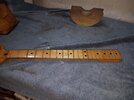

Frets are out. I left some marks on the higher parts of the FB. Some gave me a good fight. It is not a worry here since I will be re-raduising it, but I learned a few lesson of technique for the future. A 7.25" radius makes fret pulling garder than a flatter radius, since it is harder to grab a sizable portion to lift.
I will let the neck relax in this state over night, since there is much less tension without the frets.
View attachment 19856

Yes, the soldering iron was a big help.It looks like most of its life has been spent unplayed; there are no visible finger-wear patches in the lacquer. That could account for at least part of its condition. I saw a wire in the corner of one of your pictures. Did you use a soldering iron to heat the frets before pulling them? I always find that helps minimise tear-out.
To clarify, I re-cranked it for the illustration pic, but that is about how I remember it to be.I know very little about their micro-tilt stuff, but that set screw is really cranked...
Thanks, but it is just OK work. The last few fought me a lot and there was not much to grab, so there are some marks. It does not matter this time because I will resurface the board, but I hope to avoid that next time.Nice work RVA! I wouldn't know where to begin.
I am cutting a new nut from a blank. I will shape it accordingly.Since you're planning for a slightly flatter radius, how will you make sure the fret slots will follow the new radius?
Sorry, RVA... I don't understand that answer.I am cutting a new nut from a blank. I will shape it accordingly.
Sorry, a distracted answer (at work). They will be re-cut somewhat after I plane the top because I will need to make the slots deeper. If there is a small space somewhere between the fret wire bottom and the wood at points, it will be filled with crazy glue. Generally speaking, I do not consider this aspect to be a big issue, but I am always willing to learn.Sorry, RVA... I don't understand that answer.
Sorry, a distracted answer (at work). They will be re-cut somewhat after I plane the top because I will need to make the slots deeper. If there is a small space somewhere between the fret wire bottom and the wood at points, it will be filled with crazy glue. Generally speaking, I do not consider this aspect to be a big issue, but I am always willing to learn.
Yeah, me too.... but I am always willing to learn.

I have that fret saw, bought at your suggestion before my first job. It was a very good suggestion as it works great.I think Stewmac sell a fretting saw with an adjustable depth stop. I've not tried it so I can't speak for its quality. I generally just use an eyeball and a piece of plastic I cut to show the right depth. A bit of excess depth doesn't hurt. If it happens at the edge where you can see it, PVA glue and sawdust make it completely invisible.
Also, I don't like frets so tight you have to hammer them in. 22 x that force puts a lot of strain on the fretboard. Mine always go in with firm thumb pressure and then they get runny superglue trailed along the sides. This wicks in nicely under capillary action and the fret is set. When it has to come out again it responds perfectly to heat, and the fretboard never suffers damage.


