Fixed a MKII Boogie Yesterday - Bad Coupling Cap

Amp Mad Scientist

Ambassador of Heresy
Country flag
Problem: underrated coupling caps at PI output.
Symptom: Bias voltage pin 5 shows failure on 2 output tube sockets.
Heads up: if your PI output coupling caps are rated 400 volt, I suggest you change them to 600 volt rating.

This "is" the second bad capacitor I have replaced in the last 15 amp repairs.
It actually had a shorted coupling cap at the phase inverter output.

Standard Test Procedure: can help you find and solve this problem.
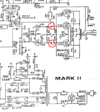
Boogie MKII Coupling Caps.png
 
How old are these MK II amps? 80's 90's?

'80's. If its a Mk IIB it'll be early '80's if it's a IIC/IIC+ it's from around '83/'84.

IIC+ is early Metallica sound in one box

-6XDfoXKcYQqp9xVhmVy3zN8IblCTtD7Q_bAgOknlDg.jpg
 
They had such smokin' deals in the place. I actually bought a Les Paul DC Standard there once when I was visiting my parents, it was just too good a deal to pass up. But I hadn't thought through how to get it back to CA - I didn't want to ship it or carry it on the plane, so it stayed at their house for I think a year and half and I would play it when I visited (I bought a little Crate practice amp for it) and eventually I gave up and sold it. That was a rad guitar, wish I had just brought it home and kept it.
 
Last edited:
what were the troubleshooting data points ?- positive / high DC voltage on the power tube control grids / DC leaked through cap from PI plates?
 
what were the troubleshooting data points ?- positive / high DC voltage on the power tube control grids / DC leaked through cap from PI plates?
Tested with standby set to warm-up. High voltage was turned off.
The bias voltage was normal on 2 power tube sockets, pin 5. (about -57 VDC)
The bias was way off on the other 2 sockets. Still negative but about 30 volts too high. (about 27 VDC)
One of the PI coupling caps was just dead shorted 0 ohms.
So I stuck some 600 volt orange drops in.

I test with the high voltage off first.

The funny thing is:
When I started doing this, about 90% of all people who worked on tube amps did not know:
that there is negative voltage (bias voltage) on pin 5 of the power tube.
They were completely unaware of this negative voltage, or what the negative voltage accomplished.

They didn't realize that this negative voltage is the most important voltage in the entire amplifier.

Even The "Guitologist" Who is a self proclaimed "expert," had no clue that this voltage existed --- never mentioned testing it---- not even once. :pound-hand:
and the whole time he was "fixing" amplifiers, he was fighting this unseen mystery.
Which is fking funny to me.
 
Last edited:
How old are these MK II amps? 80's 90's?
1980s for sure. But the coupling caps should have lasted 50-100 years easily.

Measure DC volts across the coupling cap.
On one lead of the cap there is PI plate voltage. On the other lead of the cap there is negative bias voltage.
Now add those 2 voltages together.
It's going to be more than a 400 volt cap can handle.
 
Amp Mad, U should see some pics I have of my Laney AOR Pro Tube Lead 50 watt head.
It has parts that should have lasted longer too. But a damn mouse ate some wires and some parts on the board either were chewed or damaged by electricity.

I have held off repairing it due to my wanting the factory type wiring, and to get the right replacement parts too. Laney schematics are tough reading from that period too.
 
Sorry to hijack, Ampmad.

As I view my posts, I see I am even more up against it repair wise. Laney used a PCB it seems,,,,,,,,,,,,,, as I can see the traces in there. If I fix this myself, I will be learning Desoldering/Soldering on some scrap PCB board sacrificial pieces before attempting to fix my Laney and not damage anything.
 
Last edited:
Sorry to hijack, Ampmad.

As I view my posts, I see I am even more up against it repair wise. Laney used a PCB it seems,,,,,,,,,,,,,, as I can see the traces in there. If I fix this myself, I will be learning Desoldering/Soldering on some scrap PCB board sacrificial pieces before attempting to fix my Laney and not damage anything.
Do you have temperature controlled soldering station?
I would not work on a board like that without one.

1. Cut the leads of the part. Leave some length on the cut lead.
2. Straighten the lead out w/ needle nose pliers.
3. Heat the solder connection and gently push the straight lead through the hole.
4. Do not try to heat both legs and remove the whole part without cutting the leads first.
5. Do not keep heating one connection over and over. Let the board cool down.
6. After the lead is out of the hole, use solder wick to suck up the excess solder.
7. Clean the flux off the board with 91% isopropyl alcohol. Not rubbing alcohol.
The board trace should be all clean and free of flux and dirt when you are done.
8. The leads of the NEW part must be shiny clean and free of oxide.
9. Clean the leads of the new part with Scotch brite before you try to solder it.
10. The tip of the soldering iron must be shiny clean too. Apply fresh solder to the tip before you use the iron, each time you solder a connection.

The key to soldering is to make sure everything is clean before applying the solder. If you try to solder dirty or oxidized metal, that is why it fails.

Many times, leads are folded down against the board and then soldered.
DO NOT heat the lead and try to UN-bend it.
Cut the lead instead as above, and push it straight out of the hole.
 
Ampmad, thanks for that breakdown and procedure. Yes, I do have Temp controllable Soldering Station(s). Where I fall short is in about 3-6 aspects I can improve on.

1. Access to the correct replacement wires/ ( I believe Laney used some Solid wire in these amps) , correct caps, resistors etc. (Knowing Laney's schematics are hard to read, I might need help here)

2. Practice doing the things you listed in your advice especially the heat management soldering procedures. I am a big fan of not screwing up the good stuff when I can practice on sacrificial stuff.

3. Having all parts and supplies on hand, a clean and organized work space and TIME to finish from start to end with no delays or distractions.

4. The good luck needed to walk through the process in my head before starting, and then having the actual work go smoothly as my mental walk through envisioned.

Thoughts to be continued.

5. Oh yeah, and the bravery needed to totally remove the board and corrolary parts from the chassis. I have a feeling some repairs will be needed between the board and the underside of the chassis.
 
Back
Top