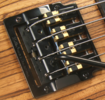
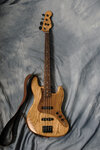
I did what you describe... Here's the result:
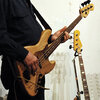
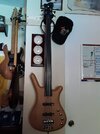
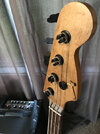
Swamp ash body, maple neck, rosewood fretless fingerboard, all black hardware...
I stained the ash body lightly with walnut stain and sealed it with tung oil, which
works great. I put multiple coats of tung oil on the body, over a period of a couple
weeks. One or two thin coats a day. As thin as I could do them, spreading it with
my fingers.
A cabinet maker friend gave me a board of walnut that he couldn't use... it had
a burl in it that maybe would look out of place in a fancy cabinet, but was just
the thing for my bass. I used a belt sander to take it down to about 1/8" (3 mm)
and sealed that with tung oil too. no stain needed on that.
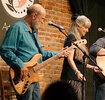
I played fretted bass for decades on a Fender J-bass, so I used the same neck
to learn fretless on, and the transition wasn't too hard. Warmoth parts are pricey, but
excellent. My favorite part of this project was when I fitted the neck to the body. It
was a little tight, so I sanded it just a few strokes. Then it fit right in. I put the screw
through the body and felt it go right into the hole in the neck.
That's actually priceless IMHO. Precision parts are a pleasure to work with.
once I got the neck fitted to the body, I mounted the bridge and tied some
twine around the E and G saddles. I mounted the corresponding tuners and
ran the twine up and wound it about the posts. Then I looked critically at the
whole thing, to make sure one side wasn't too close to the edge.
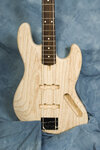
This is fine, and has given great service since 2009.
I bought Fender "Vintage" J-Bass pickups, although I think the
PB & J layout is an excellent choice.
I actually didn't agonize too much over the parts... I just bought the
ones I could afford. The prices can get crazy. But I knew ash body was
a good choice, and I liked the grain I saw in the one above. I knew maple
neck was a good choice, and Rosewood fingerboard also.
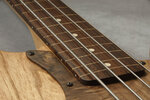
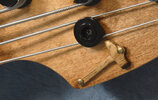
Here's a closeup, showing the burl in the walnut that led my friend to give it to me,
as well as the ash body close, and the rosewood neck with maple inlays instead
of frets. My bass turned into a thing of beauty, with my minimal wood working skills.
All I did was draw around the pick guard on my old Fender J-Bass, mark the holes
for the screws and pickups, and then cut it out with a small sharp hand saw, very carefully
so as not to split anything. Then I finished the edges with Dremel tool and a six inch
mill file, sanded it down to 600 grit and rubbed it with tung oil.
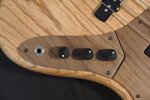
I did use some care and forethought to line up the grain of the wood for both the
pick guard and the control cover. But I sanded the control cover a little too thin,
so I strengthened it with a normal chome piece, and grounded this, for shielding.
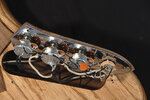
I bought a black Gotoh "high mass" bridge, which sounds witchy I know.
I bought Schaller tuners also black, and used black screws and neck plate.
Women have come up after shows to tell me that my bass looks yummy, like
a caramel sundae. That's the response we always hope for, isn't it?
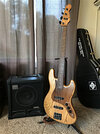
Looking at the specs for your excellent project, I'm thinking ebony would have been
a fine choice for my bass, along with the black hardware. But I have no regrets, and
it's possible that ebony wasn't available in 2009, due to political considerations
which Gibson learned about the hard way. *shrugs... I'm looking fwd to seeing photos
of your build, as it progresses. A year ago, I owned three basses, but have since
sold the other two and decided this one does everything I need.