Favorite body and neck wood for custom bass?

Cadorman

Ambassador of the Catocaster
Country flag
I have pretty much decided that I want to build a Warmoth bass versus buying production. I am planning on doing a 4 string with a Jazz style neck and a P/J pickup combination with no active circuitry. Being a guitar player I really don't know what makes great wood for a bass. Kind of thinking about a quarter sawn maple neck with a rosewood fretboard, but what about ebony? Body wise I am wide open. I will be going with a rear control cavity and no pickguard. What do you guys like for wood when you have a choice?
 
I have pretty much decided that I want to build a Warmoth bass versus buying production. I am planning on doing a 4 string with a Jazz style neck and a P/J pickup combination with no active circuitry. Being a guitar player I really don't know what makes great wood for a bass. Kind of thinking about a quarter sawn maple neck with a rosewood fretboard, but what about ebony? Body wise I am wide open. I will be going with a rear control cavity and no pickguard. What do you guys like for wood when you have a choice?

Quarter-sawn maple neck.
Ebony, or rosewood fretboard.
Ash, or maple body...maybe walnut.
That’s my list for looking at a parts build.
Love a good, solid, passive bass.
I have two active basses too(one does passive as well)...nothing wrong with them either.
But I find my passive basses to be a bit more flexible tone wise.
 
EBONY--- GOBS of it--- can I make a GUITAR from EBONY!?!?!?!?!?
THis :)
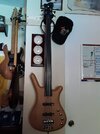
warwick.jpg

BUWAHAHAHAHAHAHAHA


I am very intrigued (I to have thought of the Warmouth route--- but--- never took the leap---I did build a RICKENBASTARD ---)
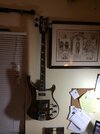
Kraken1.jpg

I would say ----- my favorite BASS wood --- is SWAMPASH --- MAPLE/MAPLE neck and the HEAVIEST hardware you can handle---
T-40.jpg

If you cant beat a DUMB A$$ to death with it and it hold tune------ you did something wrong -----

I agree with Passive being more versatile---I have had FOOL active basses -- they dont stay long no matter how much I love them --
Passive --- or passive with a little "boost" is my preference---

post links of the items your considering---

cant wait to follow the build!!!
Popcorn 2.gif
 
Then I think I am going quarter sawn neck with an ebony board with swamp ash body. I will matte clear the back of the neck with nitro and probably use Formby's tongue oil finish on the body. That way it will match my Strat. Selling some bicycle parts on fleabay to fund the project.
 
I did what you describe... Here's the result:
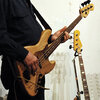
Luretta 6 Lansing 2010.jpg
Swamp ash body, maple neck, rosewood fretless fingerboard, all black hardware...
I stained the ash body lightly with walnut stain and sealed it with tung oil, which
works great. I put multiple coats of tung oil on the body, over a period of a couple
weeks. One or two thin coats a day. As thin as I could do them, spreading it with
my fingers.

A cabinet maker friend gave me a board of walnut that he couldn't use... it had
a burl in it that maybe would look out of place in a fancy cabinet, but was just
the thing for my bass. I used a belt sander to take it down to about 1/8" (3 mm)
and sealed that with tung oil too. no stain needed on that.
Luretta 18 crop.jpg
I played fretted bass for decades on a Fender J-bass, so I used the same neck
to learn fretless on, and the transition wasn't too hard. Warmoth parts are pricey, but
excellent. My favorite part of this project was when I fitted the neck to the body. It
was a little tight, so I sanded it just a few strokes. Then it fit right in. I put the screw
through the body and felt it go right into the hole in the neck.

That's actually priceless IMHO. Precision parts are a pleasure to work with.
once I got the neck fitted to the body, I mounted the bridge and tied some
twine around the E and G saddles. I mounted the corresponding tuners and
ran the twine up and wound it about the posts. Then I looked critically at the
whole thing, to make sure one side wasn't too close to the edge.
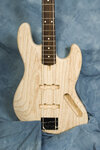
05a Checking alignment.jpg
This is fine, and has given great service since 2009.
I bought Fender "Vintage" J-Bass pickups, although I think the
PB & J layout is an excellent choice.

I actually didn't agonize too much over the parts... I just bought the
ones I could afford. The prices can get crazy. But I knew ash body was
a good choice, and I liked the grain I saw in the one above. I knew maple
neck was a good choice, and Rosewood fingerboard also.
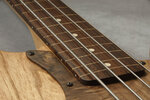
05d Warmoth Fretless Neck 3.jpg
Here's a closeup, showing the burl in the walnut that led my friend to give it to me,
as well as the ash body close, and the rosewood neck with maple inlays instead
of frets. My bass turned into a thing of beauty, with my minimal wood working skills.
All I did was draw around the pick guard on my old Fender J-Bass, mark the holes
for the screws and pickups, and then cut it out with a small sharp hand saw, very carefully
so as not to split anything. Then I finished the edges with Dremel tool and a six inch
mill file, sanded it down to 600 grit and rubbed it with tung oil.
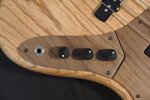
09 Control Plate finished.jpg
I did use some care and forethought to line up the grain of the wood for both the
pick guard and the control cover. But I sanded the control cover a little too thin,
so I strengthened it with a normal chome piece, and grounded this, for shielding.
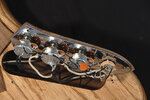
08 wiring.jpg
I bought a black Gotoh "high mass" bridge, which sounds witchy I know.
I bought Schaller tuners also black, and used black screws and neck plate.
Women have come up after shows to tell me that my bass looks yummy, like
a caramel sundae. That's the response we always hope for, isn't it?
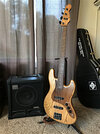
Bass rig vert@100.jpg

Whole bass 7@100.jpg
Looking at the specs for your excellent project, I'm thinking ebony would have been
a fine choice for my bass, along with the black hardware. But I have no regrets, and
it's possible that ebony wasn't available in 2009, due to political considerations
which Gibson learned about the hard way. *shrugs... I'm looking fwd to seeing photos
of your build, as it progresses. A year ago, I owned three basses, but have since
sold the other two and decided this one does everything I need.
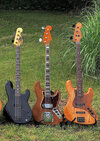
Three basses 5x7@100.jpg
 
Last edited:
20190629_231519.jpg
This is the Strat I remade. 2016 MIM arctic white originally. I stripped the poly and primer with a heat gun and putty knife. It was at least 1/16 of an inch thick in most places. Sanded it smooth and tongue oil finished the body with a Warmoth neck.
 
Now that I've shown you MY project, I'll stick my neck out and say
that I don't think the wood you choose makes much difference to
TONE... only to aesthetics, and to weight.

Wood is like, not magnetic, eh? And if you (like most bassists) stand right
next to an insane drummer and crank up your HiWatt to join the mix like
a bulldozer, then any subtle tones imparted by the wood of the body or the
neck, or the fingerboard would make as much difference as raindrops on
a raging sea.

But oh, the aesthetics of this subject. I looked at some awesome body/neck
combinations, with exotic tropical woods I never knew existed. But then I
came to my senses and picked what I could afford, and I'm very happy with
my choices. Fancy inlays and detailing on an already custom bass seem
to me like racing stripes on a Cadillac. I preferred to keep my project simple
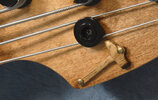
and affordable, and to decorate it in my own way. Here's my headstock
decoration: a Hammer of Thor carved from a piece of an oak tree that was
blown to smithereens by lightning. Definitely witchy, yes it is.
Luretta headstock@100.jpg
Thor Hammer@100.jpg
 
And that's a fine Strat! Sometimes you can go to a lot of work to
remove a paint job, only to find that the reason the factory guys painted it
was that the wood didn't look too great, or that it was made out of several
pieces that didn't match. But yours looks really good.

I did a rescue job on a MIC Precision bass, the black one in my previous post.
So I followed my own wisdom, and left the paint alone, not wanting to open a
can of worms. I replaced all the corroded parts (read that ALL the hardware)
installing good quality components... as soon as my luthier got the neck straight.
And I ended up with an excellent P-bass that could take its place alongside
instruments costing much much more than I had in it, and not give up a thing.
I sold it this year, to a dear friend who gave me too much money, wanting to help
my and my ailing girlfriend. But I know that bass will give great service for a long
time. The Poly is truly a fine and practical guitar finish, however thick.
Raven and me.jpg
For me, this P-Bass is proof of my statement about the wood not mattering much to
the tone. With good. parts and a good amp, this humble ex-squier bass had a fine
and useful tone... and when I plugged my little 60W Roland amp into a P.A.
it sounds HUGE.
 
I have pretty much decided that I want to build a Warmoth bass versus buying production. I am planning on doing a 4 string with a Jazz style neck and a P/J pickup combination with no active circuitry. Being a guitar player I really don't know what makes great wood for a bass. Kind of thinking about a quarter sawn maple neck with a rosewood fretboard, but what about ebony? Body wise I am wide open. I will be going with a rear control cavity and no pickguard. What do you guys like for wood when you have a choice?
Koa Wood for the body and neck, Ebony fingerboard.
Koa is Mahogany.
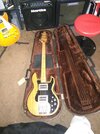
But if you don't build it, try a Travis Bean Longhorn Bass.
 
Koa Wood for the body and neck, Ebony fingerboard.
Koa is Mahogany.
But if you don't build it, try a Travis Bean Longhorn Bass.
AMS, could you possibly elaborate on the statement "koa is mahogany"?

Granted, I don't know much about wood (actual wood, not erections....my offspring proves that much) but I can't seem to identify koa as a species of mahogany, admittedly my research didn't go far beyond what I was able to Google with my phone as I was on the toilet...
 
Back
Top