OP


So, it's been awhile since I talked about this. I figured I'd provide a bit of an update.
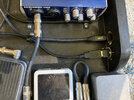
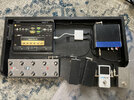
I redid a few things to use my new iPad. It's an iPad Pro, 3rd Generation. I had to change a few things to use the USB-C connections instead of the Lightning connector from my earlier iPad.
I also went back to my original audio interface. I was having some strange, intermittent audio drop-outs with the other (newer) one. I haven't really troubleshot that, yet. I've been too busy to really fuss with that. It may be that the newer audio interface requires more power, given that it can encode up to 96 KHz, whereas this one encodes at a max of 48KHz. I may just need to step up my power supply. But, I haven't confirmed that, yet.
But, this is working quite well.
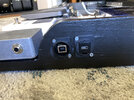
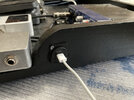
I never really showed this angle before, but it just shows the bulkhead connector I installed where the power supply plugs in to provide power for the interface and iPad.
As for practical, on-stage usage, here are my thoughts....
By far, the biggest Achilles Heel of using this type of a system on stage is direct sunlight. Not only can the direct sunlight make the display difficult to see, but long exposure to direct sunlight in hot weather can damage something like an iPad or iPhone. Consequently, I find that I tend to gravitate more toward my older, but more rugged, Line6 X3 Live. The X3 Live has been rock-solid. It never fails and handles direct sunlight quite well. I have had to replace a few of the internal contact switches as they do wear out over time, but that's a simple soldering job. But, it has been quite reliable and I can get some very decent sounds out of it.
But, sound is where something like the iPad rig does start to show it's advantage. I can't say any particular effect or amp model is necessarily night-and-day better than the X3 Live, but it offers more in the way of flexibility and unique customizations. Newer, dedicated processors like the Helix or Quad Cortex don't have nearly this limitation, however. So, they are probably just as good as this rig for sculpting patches.
What I have been finding is that when playing out with the band where it's a full-on gig, I will use the X3 Live. For smaller, indoor events or when doing music for other situations where I am trying to create some unique, multi-layered sounds, like cascading multiple reverbs, or something, I tend to gravitate toward the iPad rig.
I redid a few things to use my new iPad. It's an iPad Pro, 3rd Generation. I had to change a few things to use the USB-C connections instead of the Lightning connector from my earlier iPad.
I also went back to my original audio interface. I was having some strange, intermittent audio drop-outs with the other (newer) one. I haven't really troubleshot that, yet. I've been too busy to really fuss with that. It may be that the newer audio interface requires more power, given that it can encode up to 96 KHz, whereas this one encodes at a max of 48KHz. I may just need to step up my power supply. But, I haven't confirmed that, yet.
But, this is working quite well.
I never really showed this angle before, but it just shows the bulkhead connector I installed where the power supply plugs in to provide power for the interface and iPad.
As for practical, on-stage usage, here are my thoughts....
By far, the biggest Achilles Heel of using this type of a system on stage is direct sunlight. Not only can the direct sunlight make the display difficult to see, but long exposure to direct sunlight in hot weather can damage something like an iPad or iPhone. Consequently, I find that I tend to gravitate more toward my older, but more rugged, Line6 X3 Live. The X3 Live has been rock-solid. It never fails and handles direct sunlight quite well. I have had to replace a few of the internal contact switches as they do wear out over time, but that's a simple soldering job. But, it has been quite reliable and I can get some very decent sounds out of it.
But, sound is where something like the iPad rig does start to show it's advantage. I can't say any particular effect or amp model is necessarily night-and-day better than the X3 Live, but it offers more in the way of flexibility and unique customizations. Newer, dedicated processors like the Helix or Quad Cortex don't have nearly this limitation, however. So, they are probably just as good as this rig for sculpting patches.
What I have been finding is that when playing out with the band where it's a full-on gig, I will use the X3 Live. For smaller, indoor events or when doing music for other situations where I am trying to create some unique, multi-layered sounds, like cascading multiple reverbs, or something, I tend to gravitate toward the iPad rig.