DIY Pedal build - Rookie Style!!

BYOC discontinued the Silver Pony kit almost 2 years ago. Don't know why. BUT... there is a vendor thru Reverb.com that is offering this BYOC kit, unbuilt and pre-built, currently. I'm very confused with the availability of this kit, but you (or anybody else) might want to jump on this... 4 left in stock. Plus, the following link to the ad offers a 15% discount at checkout:
B.Y.O.C. Silver Pony Overdrive Kit (Build Your Own Clone)

And the video that prompted me to get the BYOC Silver Pony kit, right before it was discontinued:


Built this one, too. Based on the ROSS 5-knobber. Excellent. I'll post pics of mine later.


You're the one that GASsed me up on building this kit, too... :H5:. I'll agree too, that this a great sounding phase shifter.

Thanks sysco. Yes, I've seen reviews of the 5 knob adaptation of the Ross Compressor. I may have to order from the US as I really have been waiting on the Oz distributor for a freaking long time.
RVA, don't think of a kit build as going backwards, rather a different means to an end. Also, just as a badly designed PCB or Point to Point layout can introduce detrimental effects like noise, instability etc, so a well designed one can minimize or eliminate them. They guys at GGG & BYOC really are masters at their game & their effects circuits often have been greatly enhanced or upgraded from the original, or add many optional features, the Phase Royalle (greatly enhanced script phase 90) & 5 Knob Compressor (greatly enhanced Ross Compressor) being two good examples. Sometimes, depending on the effect circuit, it simply makes more sense to do a kit build. Cheers
 
Looking at the layout, there is a 1meg ohm "pull-down" resistor on both the input (lowest "horizontal" resistor on left side of layout) & the output (further-most right vertical resistor on layout) of the circuit. The purpose of these (kinda wrongly named) pull-down resistors is to prevent a DC charge from building up on the input and output capacitors, causing them to make a pop when the effect is switched in. Maybe check those two 1meg ohm resistors for no cold solder joins etc, BUT, I have once madly chase a similar popping sound to no avail. Finally I changed out the footswitch, kinda just hoping, & viola,,, the popping when switching was gone. So it is possible that the footswitch is noisey.
Regarding a Klon build, be warey of buying 1N34A "germanium" diodes off ebay. The 1N34A, most often called a "detector diode" due to their being the best ever type to be used as such in crystal radio, has long been out of production & fakes are rife on the bay. I'll look through my notes this evening & send you a source for genuine, NOS, US made 1N34A diodes. Hope this helps. Cheers
Thanks Ivan. As usual, you set me right on point!
 
I just realized that I reversed the 1N5817 polarized diode with the IC in. I flipped it, but have not had a chance to test it. Is it possible that I fried something? What components are at risk?
 
Last edited:
That 1N5817 is, in this instance being used as a "polarity protection" diode. You see, a diode will only let current flow in one direction & "block" it in the other direction. Its there in case the DC power is applied the wrong way around (opposite polarity). So everything should be fine as the diode, being the wrong way 'round, would not have let the DC power flow through to the circuit. Cheers
 
That 1N5817 is, in this instance being used as a "polarity protection" diode. You see, a diode will only let current flow in one direction & "block" it in the other direction. Its there in case the DC power is applied the wrong way around (opposite polarity). So everything should be fine as the diode, being the wrong way 'round, would not have let the DC power flow through to the circuit. Cheers
Yep, that is what happened. I just tested it and it seen to be working well. Another successful build!

This experience was somewhat easier and a whole lot more clear. Next time I may be able to start making forethoughtful choices.
 
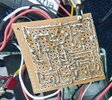
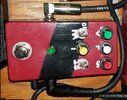
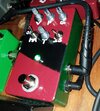
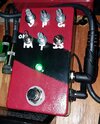
Yes, it is well done, very cool. Board underside looks good too. Congrats. Cheers
 
  • Like
Reactions: RVA
Interesting project, Ray.

Aside from building the occasional switch or other purpose-built doodad, building actual effects pedals never interested me. That’s kind of odd, in a way, given my background and line of work.

But, I enjoy watching projects like these come together.

So, how does the pedal sound for you?
 
  • Like
Reactions: RVA
Interesting project, Ray.

Aside from building the occasional switch or other purpose-built doodad, building actual effects pedals never interested me. That’s kind of odd, in a way, given my background and line of work.

But, I enjoy watching projects like these come together.

So, how does the pedal sound for you?
Thanks Smitty. It makes a really nice light OD/Dist, which suits most of my playing. I am sending the first build to a member today for a second opinion!

You should give it a go. I am sure your builds will be meticulous and it will be fairly easy for you. It is rewarding and addictive in that you now can have any pedal you want for a low price. Big trouble!!
 
I have a question regarding the DIP (toggle for me) switches in the POT. I checked the both for continuity before installing them (for all the regular reasons and because those mini toggles fry pretty easily). I noticed that the lower one in the schematic (connected to diodes 1-4) opens and closes with the switch as you would expect, but the upper one (connected to diodes 1-2) is closed all the time (ie - there is always continuity). I tested this by touching the contacts on the top side of the board (just under the insulation) and at the switch. Despite this, both switches independently have an effect on sound. How can this be if one is always closed?


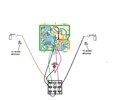
Prince of Tone Footswitch wiring.jpg
 
what language is this thread in? -- whos on first ------ whats a diode? --- can I eat it?

Ivan said there would be snacks and beer------where is the beer???????
 
I have a question regarding the DIP (toggle for me) switches in the POT. I checked the both for continuity before installing them (for all the regular reasons and because those mini toggles fry pretty easily). I noticed that the lower one in the schematic (connected to diodes 1-4) opens and closes with the switch as you would expect, but the upper one (connected to diodes 1-2) is closed all the time (ie - there is always continuity). I tested this by touching the contacts on the top side of the board (just under the insulation) and at the switch. Despite this, both switches independently have an effect on sound. How can this be if one is always closed?


View attachment 17063

Good question RVA. Ok, when switched to the ohms scale or continuity/diode test function, the multimeter puts a small current through the component under test. This current is flowing through the circuit "around" the switch & thus showing continuity. Trying to read components "in situ" will often give false readings, as in this instance. The fact that the switch is having an effect, ei; clipping diodes being switched in/out shows that it is working. Cheers
 
Last edited:
Good question RVA. Ok, when switched to the ohms scale or continuity/diode test function, the multimeter puts a small current through the component under test. This current is flowing through the circuit "around" the switch & thus showing continuity. Trying to read components "in situ" will often give false readings, as in this instance. The fact that the switch is having an effect, ei; clipping diodes being switched in/out shows that it is working. Cheers
Thank goodness. Now I can get some sleep! Thank you!
 
Back
Top