DIY Attenuator project...

syscokid

Ambassador of War & Peace
Country flag
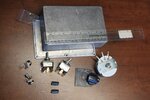
This is what I got right now:

Attenuator.JPG

The caps are for adding brightness under heavy attenuation. Parts added to $43 plus $7 shipping from Parts Express (Ohio).This attenuator should be able to handle amps up to 50 watts of power. I plan to use it for any of my amps that are 30 watts or smaller. The plans I'm copying from, originally allows for the selection of an 8 ohm or 4 ohm impedance. For now, I'll keep it at 8 ohms only. It'll be easy to add an 8 ohm/50 watt resistor and a heavy duty On/Off switch later if I feel I need the 4 ohm feature. Plus the enclosure I selected is larger than the one suggested from the original plans, too.

DIY article:
DIY Workshop: How To Build Your Own Attenuator

Crossing my fingers that all works well... :fingersx:
 
So what is the exact benifit of a rig like this enstead of say the ol Gain up/Volume down to a civilized level ? Ive never had one so dont really know.
 
So what is the exact benifit of a rig like this enstead of say the ol Gain up/Volume down to a civilized level ? Ive never had one so dont really know.
The purpose of an attenuator for guitar amps is to be able to completely drive a tube amp hard, or at least get it into its sweet spot, while reducing the energy and volume to the speaker. Otherwise, known as power tube saturation. Amps with master volumes cuts the signal or volume before it reaches the power tubes. The downside is, since your running the amp harder and sweeter, the power tubes are also taking a beating. This gadget is inserted between the amp and the speaker(s).

Early examples of attenuators was the Tom Scholz Power-Soak and the Marshall Power Break. Then came the Trainwreck/Dr Z Air-Break and Weber's variety of attenuators. In the last ten years or so, many more boutique company's have come out with much more sophisticated versions of an attenuator. Ultimate, Bad Cat, Radial, Tone King, Tube Amp Doctor, Rivera, just to name a few. In fact I have a Rivera Rock Crusher. It can handle 120 watts. But it's also $500. There are others that are more expensive, too.

Using an attenuator is just another chapter in the book of the ultimate tone quest... :dood:
 
I should build a 16 ohm version for my Marshall Class 5. When cranked it sounds pretty decent. But, those little amps can get much louder than their five watt rating would lead you to believe.

Thanks for sharing this link.
 
I should build a 16 ohm version for my Marshall Class 5. When cranked it sounds pretty decent. But, those little amps can get much louder than their five watt rating would lead you to believe...
Exactly... :celebrate:

Fortunately, I live and own my own house. But I also try to be a considerate neighbor. There are times during the week when the wifey and the surrounding neighbors are at work, and I'll take this golden opportunity to unleash the amps. Then there are times where I have to cool it, but yet I get a little frustrated when I have to cut off the "balls" of the amp. I'm sure a little bit of OCD is involved here, too. When I recently stumbled upon this project, I thought to myself: "An attenuator small enough to hide behind, or inside one of my smaller amps". By "smaller", I mean my two 15 to 18 watters.

Later this year, I also plan to build a 6 watt Champ-style amp. One of my friends has an original Silverface era Champ, and it sounds so nice when cranked. But yeah... even a 5 watter can be way too loud in a lot of situations.
 
I've been known to add those parts to my cart more than once but havent pulled the trigger yet.
Good luck, let us know.
The biggest downside I hear is the treble roll off with the volume choked down, much like guitars and amps without treble bleed, and just not letting the gear take nice deep breaths like it should.
 
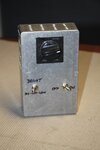
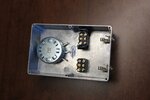
Finished... except for the finish. Guess what? It works... :). The Bright switch is very effective, and I like the 2 values chosen for the bright caps. I tested the attenuator on my Allen Amps Sweet Spot, a semi-clone of an 18 watt Blackface Princeton Reverb. Amp was maxed out for about 30 minutes. The L-Pad on the attenuator did get pretty warm, but that was to be expected. I drilled plenty venting holes thru the enclosure around the L-Pad, plus I also removed the cover to the L-Pad to enhance cooling.
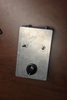
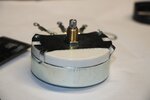
Anyways, here's my $50 attenuator:

Attenuator (1).JPG

Attenuator (2).JPG

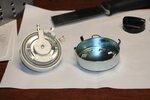
Pull back the 4 tabs that clamp the cover to the L-Pad...
Attenuator (3).JPG

Attenuator (4).JPG

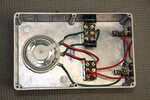
It's this simple...
Attenuator (5).JPG

Ha-ha... precision drilling:
Attenuator (6).JPG

Attenuator (7).JPG

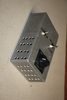
Finally...
Attenuator (8).JPG
 
BTW, that's 16 gauge wire that's in there... plenty beefy!

clear.gif
Parts Express Order List:

027-324_HR_0.jpg

2.2uF 100V Electrolytic Non-Polarized Crossover Capacitor
Part # 027-324

027-332_HR_0.jpg

4.7uF 100V Electrolytic Non-Polarized Crossover Capacitor
Part # 027-332

260-262_HR_0.jpg

Parts Express Speaker L-Pad Attenuator 100W Mono 3/8" Shaft 8 Ohm
Part # 260-262

060-450_HR_0.jpg

DPDT Heavy Duty Toggle Switch Center Off - Spade Connectors (On-Off-On)
Part # 060-450

060-452_HR_0.jpg

DPDT Heavy Duty Toggle Switch - Spade Connectors (On-On)
Part # 060-452

093-104_HR_0.jpg

Switchcraft 11 1/4" Mono Jack with Nut & Washer
Part # 093-104

320-750_HR_0.jpg

Hammond 1590D Aluminum Diecast Case 7.4" x 4.75" x 2.2"
Part # 320-750
 
Very cool! So I assume the point is to surpass the amp's headroom and get natural breakup. Did you achieve this?
 
So I assume the point is to surpass the amp's headroom and get natural breakup.
Yes, but not just natural preamp tube breakup, but the natural breakup of the power circuit too, which includes the phase inverter tube and the power tubes.

Did you achieve this?
Yes, but I can bring the volume down to a more friendly level, and still get that power tube saturation.

Oh yeah.... I forgot to mention another very popular attenuator from about 10 to 15 years ago: the THD Hot Plates.
 
  • Like
Reactions: RVA
Very nice syscokid! Excellent work! I really like how small it is.
I have a Weber Mini MASS that I use on my 18W Plexi clone. Works very well but cost about 3 times what yours did.
 
I had a Tom Sholz Power Soak in the early 80s. I didn't think anyone knew what those were.
 
Syscokid, I think I might have to build one for myself. Thanks for the motivation and idea........I think. I need another little project like I need another hole in my head!!:rolf:
 
Looks like my next project once I finish sew the Melody Maker case back together. Very sweet indeed.
 
Be careful how much wattage you stick into the L pad. Ideally you wouldn't stick more than half its rated wattage to it for long. Their intended use is in hifi woofer/horn systems. Horns & horn type tweeters are much more efficient than speakers (woofers) so an L pad is used to adjust the power going to the mid & high end horns to lower their volume. I know people use them as attenuators successfully, just be aware that it cant handle the abuse of dissipating its full rated wattage. Hope this helps. Cheers
 
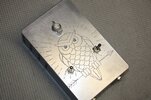
A couple days ago, I added some graphics to my gadget. Downloaded and printed out a simple Owl sketch. Taped it over the enclosure. With an electric engraver, I traced over the sketch. The clear chicken head knob was borrowed from another pedal. I've got a slightly different chicken head knob coming in:

Attenuator (9).JPG
 
Back
Top