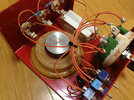
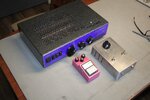
DIY Attenuator project...

Be careful how much wattage you stick into the L pad. Ideally you wouldn't stick more than half its rated wattage to it for long. Their intended use is in hifi woofer/horn systems. Horns & horn type tweeters are much more efficient than speakers (woofers) so an L pad is used to adjust the power going to the mid & high end horns to lower their volume. I know people use them as attenuators successfully, just be aware that it cant handle the abuse of dissipating its full rated wattage. Hope this helps. Cheers
Thanks Ivan, and that's a very good point. In that tutorial I downloaded and posted, that fact is briefly mentioned, but not articulated as you have. Personally, and for a little extra safety margin, I wouldn't use this DIY attenuator as designed for even my 50 watters. It should be OK for my one 30 watt amp, my two 15 & 18 watters, and my future 6 to 10 watter.

I have a Weber Mini MASS that I use on my 18W Plexi clone. Works very well but cost about 3 times what yours did.
Those are worth every penny. More features, better design, and solid.

Why an owl, syscokid? Any particular reason other than it looks cool?
It is cool, isn't it... :H5:

I like Owls. It's their silent nature of catching their prey that had me envisioning an Owl for a graphic. If I'm not mistaken, the Owl flight is almost completely noisless, even when flapping their wings.
 
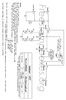
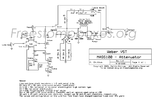
Here's a schematic for the Weber Mini MASS attenuator noting the differences between the older & later models.C__Data_Users_DefApps_AppData_INTERNETEXPLORER_Temp_Saved Images_WeberMiniMASS.gif
Weber used to supply speaker motors to the general public but I don't think they do any more. I suppose it'd be pretty easy to obtain one from a speaker with cone damage or something. Cheers
 
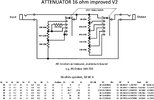
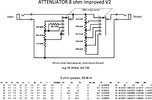
Here's a couple of purely resistive DIY attenuator schematics, both 50 watt, an 8 ohm & a 16 ohm version. Included is all info showing how they load the amp output, power out in watts at various settings & also db of attenuationC__Data_Users_DefApps_AppData_INTERNETEXPLORER_Temp_Saved Images_5941894727_c65865cd74_b.jpg C__Data_Users_DefApps_AppData_INTERNETEXPLORER_Temp_Saved Images_5941911953_d8275b03b1_b.jpg
Cheers
 
The volume pot is a large (50 ohm/50 watt) wire wound rheostat (wire element in ceramic housing). Cheers
 
Last edited:
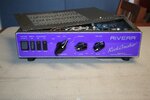
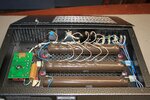
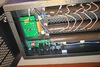
Here's what a $500 Rivera Rock Crusher looks like:

Rivera Rock Crusher (1).JPG

Rivera Rock Crusher (2).JPG

Rivera Rock Crusher (3).JPG

Rivera Rock Crusher (4).JPG

To put the "size" thing in perspective:

Rivera Rock Crusher (5).JPG
 
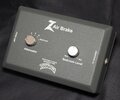
I used to have a Dr Z Air Break. Bought it used for $200... had for 2 years... sold it for $250. New: $350 plus!
Here's a couple of old pics of it:

Dr Z Air Break (1).JPG

Dr Z Air Break (2).JPG
 
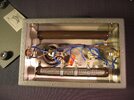
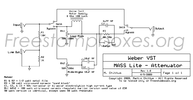
The Dr Z air brake is one that many people DIY. In your pic you can see the coilled element & wiper of the rheostat. IIRC I have a schematic somewhere for the Rivera Rock Crusher, I'll see if ai can dig it up for you. Here's the Weber Mass Lite (100W) attenuator schematic. Cheers
 
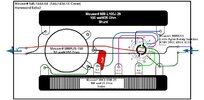
This is the Dr Z airbrake layout, including Mouser part No.s for all componentsC__Data_Users_DefApps_AppData_INTERNETEXPLORER_Temp_Saved Images_images80FAKH39.jpg
This would make construction of really easy for those not so good at reading schematic diagrams. Cheers

Edit: I looked up all components for this last night (out of curiosity) at Mouser Australia, all are readily available but the large series resistor, part No. 588-D 100K-25 only comes with one of the moveable tags so you would either need to order another two or make two yourself, which would be quite simple. Cheers
 
Last edited:
Back
Top