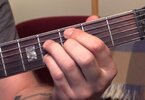
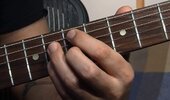
Okay...this is gonna get a little hairy.
Part of the issue you're seeing here is due to the actual, theoretical chord construction versus what you are able to play, or choose to play, on the guitar. There are certain notes that are often omitted on the guitar which are not strictly necessary to capture the essential harmony at a given point.
One of the first notes to omit is the fifth. Now, a power chord consists of the first and the fifth, so if you're playing rock and bashing out power chords ad infinitum...yeah...you need the fifth. But, it is one of the least important notes required to establish the harmony of a chord.
Aside from rock and metal, the 3rd is one of the most important notes as it is the only note that establishes if a chord is major or minor. The other additional notes of an altered chord may be omitted or used depending on how easily you can play the chord and depending on what tonality you want.
In the case of your comparison of a C9 to a Em7b5, there are similarities. First, let me address a "9" chord. Without omitting any notes, a 9 chord consists of the 1, 3, 5, b7 and 9 scale degrees. In the case of a C9 these would be notes C, E, G, Bb, and D. A m7b5 chord consists of the 1, b3, b5, and b7. In the case of an Em7b5 chord these would be notes E, G, Bb, and D. So, yes, there are several notes that are the same between the two. The C9 has the additional note, C, which is not a part of the Em7b5.
Now, getting to the C9 he is playing above at 5:05 and in the screen capture, he does say the root is on the 6th string BUT he is NOT playing it. He actually is using it for reference. Thus, he begins the chord with the 3rd (E) in the bass, which means he is effectively playing the chord in a 1st inversion. Also, he is only playing four notes of the C9 - C, E, G, and D. These would be scale degrees 1, 3, 5, and 9. He is omitting the b7 scale degree. Often you'll see this type of chord referred to as an "add 9" chord or a "2" chord, i.e., "C add9" or "C2".
I have several guitar anthologies by various artists. It's not unusual to see a notation above a staff of music stating something like, "Chords indicated are only meant to show overall tonality". It's not unusual for a chord to be shown on a piece of music, yet the chord, as played, will omit notes from the chord's theoretical construction.