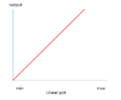
OK. Linear taper is easy. The output level from the pot is exactly proportional to the degree of rotation. Turn it to the halfway point, and the signal coming out is exactly half what is going in. In deciibels that is -6dB. That's a bit quieter, but no a lot. It takes about -10dB to halve the volume. So you keep turning the pot down and not a great deal happens until you get almost to the end, then it all happens at once - that's the problem you describe.
The audio, or log taper deals with that by not trying for that proportionality. You turn down from max, and initially quite a lot is happening, the signal drops a long way. Then as you get lower on the scale, it all levels out a bit so the volume is not dropping so fast. Every manufacturer has his own version of this, so you need to try a few to see what you like.
The ideal pot would follow a logarithmic relation between input and output, but nobody can make a pot like that. What they actually do is approximate it with two straight lines.
View attachment 7695
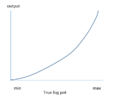
A true log pot would exactly match (well, oppose, really) the human hearing curve
View attachment 7696
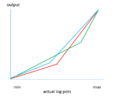
But these can't be made, so manufacturers make up their own approximations. Here is how three different manufacturers might choose to do it
View attachment 7698
And that is where a preference for different manufacturers comes from. The green one would have better sensitivity at high volume and the red one would be more controllable at low volume. You pays yer money and ye takes yer pick!
Maybe some day I will examine a bunch and produce those curves.