Best Mini Pots:

Inspector #20

Ambassador of Tone
Fallen Star
Country flag
Working in a small control cavity. Mini pots are likely the only option, but these turn a long time with very little change and then drop suddenly near the end of their travel.

Any recommendations for a better mini pot in terms of taper and still retain the 8mm mounting posts????
 
Working in a small control cavity. Mini pots are likely the only option, but these turn a long time with very little change and then drop suddenly near the end of their travel.

Any recommendations for a better mini pot in terms of taper and still retain the 8mm mounting posts????

I like the Bourns PDB181-GTR01. It's small and comes in both linear and audio taper, so you shouldn't have to live with the all-or-nothing effect.
 
I like the Bourns PDB181-GTR01. It's small and comes in both linear and audio taper, so you shouldn't have to live with the all-or-nothing effect.

I have used the Bourns minis. They are very good. I've them in my Washburn and I like the feel and taper.
 
per Tom Anderson - excepts from the Tom Anderson Forum:

500k audio taper is what we use. we use alpha.
----
different brands of pots have different sounding audio tapers. i like the alphas best. cts are usually stiffer feeling if you like that. cts seem to have more end resistance so they sometimes do not turn all the way off. we use a 6mm solid shaft with a 3/8" long bushing. the small, 16mm alphas have a easier turning feel. the full size alphas have a smooth feel but are stiffer to turn.

----------
we use 16mm pots because the manufacturer can control the torque on the turning ratio really well with them and on the bigger pots they can't make them spin nicely. pot size has nothing to do with noise. the lube used to make them smooth feeling has to be non conductive so if you are turning the pot while not be grounded to the guitar by touching anything else metal(like strings or bridge), you will be making an intermittent ground connection. for me personally this is not an issue when i play guitar as i'm never not touching the guitar when the volume is up. the alternative is stiff pots with uncontrolable end resistance which is unacceptable for me.
-----------
we used the cts for years, but they could never deliver two batches in a row that felt good. end resistance was a big problem with them too. in their and all other pot makers defense, we ask a lot of their product. we input a tiny little amount of voltage and then amplify it 3 zillion times(maybe not quite that much, but quite a bit) and expect no rotational noise. then we want it to withstand dust and getting soaked by nasty sweat, maybe even a beer soaking. when was the last time you turned you home stereo volume from zero to max? nobody makes a totally great high end pot for guitars. over the last 30 years i have tried all the "premium" and "scientific" grade pots and they don't survive long at all if they even are turnable with normal human fingers. so we use the best we can find, and replace them when they fail.
we can sell ours, but w do only have them with solid 6mm shafts since that's all we use. we do get a slightly different log taper, but the resister and cap do more to help with the taper than it does.
 
Another vote for the Bourns audio taper mini pots.
I use the 500k in everything except piezo applications.
The taper and resistance to movement is close to perfect.
 
I am yet to find a good explanation on the differences between them. Can you expound???

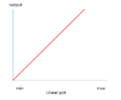
OK. Linear taper is easy. The output level from the pot is exactly proportional to the degree of rotation. Turn it to the halfway point, and the signal coming out is exactly half what is going in. In deciibels that is -6dB. That's a bit quieter, but no a lot. It takes about -10dB to halve the volume. So you keep turning the pot down and not a great deal happens until you get almost to the end, then it all happens at once - that's the problem you describe.

The audio, or log taper deals with that by not trying for that proportionality. You turn down from max, and initially quite a lot is happening, the signal drops a long way. Then as you get lower on the scale, it all levels out a bit so the volume is not dropping so fast. Every manufacturer has his own version of this, so you need to try a few to see what you like.

The ideal pot would follow a logarithmic relation between input and output, but nobody can make a pot like that. What they actually do is approximate it with two straight lines.

upload_2017-8-18_6-46-30.png


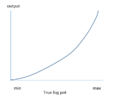
A true log pot would exactly match (well, oppose, really) the human hearing curve

upload_2017-8-18_6-48-44.png

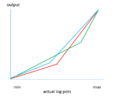
But these can't be made, so manufacturers make up their own approximations. Here is how three different manufacturers might choose to do it


upload_2017-8-18_6-54-20.png


And that is where a preference for different manufacturers comes from. The green one would have better sensitivity at high volume and the red one would be more controllable at low volume. You pays yer money and ye takes yer pick!

Maybe some day I will examine a bunch and produce those curves.
 
OK. Linear taper is easy. The output level from the pot is exactly proportional to the degree of rotation. Turn it to the halfway point, and the signal coming out is exactly half what is going in. In deciibels that is -6dB. That's a bit quieter, but no a lot. It takes about -10dB to halve the volume. So you keep turning the pot down and not a great deal happens until you get almost to the end, then it all happens at once - that's the problem you describe.

The audio, or log taper deals with that by not trying for that proportionality. You turn down from max, and initially quite a lot is happening, the signal drops a long way. Then as you get lower on the scale, it all levels out a bit so the volume is not dropping so fast. Every manufacturer has his own version of this, so you need to try a few to see what you like.

The ideal pot would follow a logarithmic relation between input and output, but nobody can make a pot like that. What they actually do is approximate it with two straight lines.

View attachment 7695


A true log pot would exactly match (well, oppose, really) the human hearing curve

View attachment 7696

But these can't be made, so manufacturers make up their own approximations. Here is how three different manufacturers might choose to do it


View attachment 7698


And that is where a preference for different manufacturers comes from. The green one would have better sensitivity at high volume and the red one would be more controllable at low volume. You pays yer money and ye takes yer pick!

Maybe some day I will examine a bunch and produce those curves.
Always such a concise and thorough explanation!
 
OK. Linear taper is easy. The output level from the pot is exactly proportional to the degree of rotation. Turn it to the halfway point, and the signal coming out is exactly half what is going in. In deciibels that is -6dB. That's a bit quieter, but no a lot. It takes about -10dB to halve the volume. So you keep turning the pot down and not a great deal happens until you get almost to the end, then it all happens at once - that's the problem you describe.

The audio, or log taper deals with that by not trying for that proportionality. You turn down from max, and initially quite a lot is happening, the signal drops a long way. Then as you get lower on the scale, it all levels out a bit so the volume is not dropping so fast. Every manufacturer has his own version of this, so you need to try a few to see what you like.

The ideal pot would follow a logarithmic relation between input and output, but nobody can make a pot like that. What they actually do is approximate it with two straight lines.

View attachment 7695


A true log pot would exactly match (well, oppose, really) the human hearing curve

View attachment 7696

But these can't be made, so manufacturers make up their own approximations. Here is how three different manufacturers might choose to do it


View attachment 7698


And that is where a preference for different manufacturers comes from. The green one would have better sensitivity at high volume and the red one would be more controllable at low volume. You pays yer money and ye takes yer pick!

Maybe some day I will examine a bunch and produce those curves.

Excellent description. Now it makes sense. I hate that immediate drop off I am currently experiencing....
 
Back
Top