Attenuators?

Yes. The passive tone control network operates by bleeding signal (mid & low frequencies) off to ground, so there is a lot of loss. A plate driven (high impedance source) tone network suffers even more loss than a cathode driven (low impedance source) tone network. This is why plate driven tone networks usually have another gain stage (or more than one) following the tone network (to make up for the loss) & cathode driven tone networks get away without the following gain stage. But all passive tone networks suffer loss. Cheers
So Fender amp tonestacks, like the Bassman or Princeton Reverb, are plate driven? Marshalls, like the JCMs, are cathode driven?
 
So, here are some thoughts about attenuators. Admittedly, I've never had or used one.

But, since a speaker's impedance isn't a constant value, but is a reactive value, it seems to me an attenuator with just resistors can't account for or duplicate that.

I mean, take an 8 ohm speaker...it's nominal value is 8 ohms. Usually that impedance is measured at something like 400 Hz. It's physical, DC resistance is less...usually around 6 ohms. At higher frequencies, the instantaneous impedance of a speaker can be much greater than it's nominal rating.

The point being, although a speaker may be rated for 8 ohms (or some other value) the actual impedance presented to the amplifier at any point may be higher or lower than that, depending on frequency.

So, I don't know what impact it may have on tone, but it seems that a purely resistive attenuator isn't going to be able to reproduce a reactive impedance, like a speaker will.
 
Last edited:
So, here are some thoughts about attenuators. Admittedly, I've never had or used one.

But, since a speaker's impedance isn't a constant value, but is a reactive value, it seems to me an attenuator with just resistors can't account for or duplicate that.

I mean, take an 8 ohm speaker...it's nominal value is 8 ohms. Usually that impedance is measured at something like 400 Hz. It's physical, DC resistance is less...usually around 6 ohms. At higher frequencies, the instantaneous impedance of a speaker can be much greater than it's nominal rating.

The point being, although a speaker may be rated for 8 ohms (or some other value) the actual impedance presented to the amplifier at any point may be higher or lower than that, depending on frequency.

So, I don't know what impact it may have on tone, but it seems that a purely resistive attenuator isn't going to be able to reproduce a reactive impedance, like a speaker will.
Primitive attenuators are just a massive resistor(s).

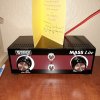
The Weber MASS attenuators are advertised as: "The MASS employs an actual speaker motor for the load to yield a realistic interaction between the attenuator and the output circuit of the amp."

Rivera Rock Crusher: "We built into the RockCrusher a reactive load network for proper speaker-amplifier interaction. Rather than a purely resistive load like many of the other power attenuators on the market, the Rock Crusher ensures that the amplifier and speaker see each other in a proper relationship of impedance and inductive/capacitive reactance."

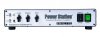
Fryette Power Station: "Our Integrated Reactance Amplifier® is an easy to use, tunable reactive load coupled to a vacuum tube power amplifier that fine tunes your amplifier response which then drives your speaker cabinet."
 
Primitive attenuators are just a massive resistor(s).

The Weber MASS attenuators are advertised as: "The MASS employs an actual speaker motor for the load to yield a realistic interaction between the attenuator and the output circuit of the amp."

Rivera Rock Crusher: "We built into the RockCrusher a reactive load network for proper speaker-amplifier interaction. Rather than a purely resistive load like many of the other power attenuators on the market, the Rock Crusher ensures that the amplifier and speaker see each other in a proper relationship of impedance and inductive/capacitive reactance."

Fryette Power Station: "Our Integrated Reactance Amplifier® is an easy to use, tunable reactive load coupled to a vacuum tube power amplifier that fine tunes your amplifier response which then drives your speaker cabinet."

Okay. That makes sense. Thanks, Sysco. Like I said, I've never used attenuators, as I've tended toward low-wattage amps. But, the reactive piece just made me curious.

It's cool to see builders accounting for this.
 
Last edited:
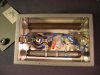
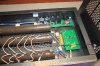
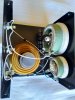
Gutshots of the Weber Mass 200IMG_20190531_121800.jpg
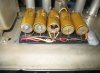
The speaker motor can be clearly seen.
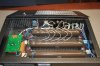
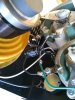
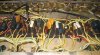
The large rheostat is for "speaker volume" or level of attenuation. The smaller rheostat is for treble correction.IMG_20190531_121938.jpg
The pot mounted under the treble correction rheostat is the line out level control. Cheers
 
So, here are some thoughts about attenuators. Admittedly, I've never had or used one.

But, since a speaker's impedance isn't a constant value, but is a reactive value, it seems to me an attenuator with just resistors can't account for or duplicate that.

I mean, take an 8 ohm speaker...it's nominal value is 8 ohms. Usually that impedance is measured at something like 400 Hz. It's physical, DC resistance is less...usually around 6 ohms. At higher frequencies, the instantaneous impedance of a speaker can be much greater than it's nominal rating.

The point being, although a speaker may be rated for 8 ohms (or some other value) the actual impedance presented to the amplifier at any point may be higher or lower than that, depending on frequency.

So, I don't know what impact it may have on tone, but it seems that a purely resistive attenuator isn't going to be able to reproduce a reactive impedance, like a speaker will.

Weber's use a speaker coil to produce impedance.
 
Weber's use a speaker coil to produce impedance.
Yes. You can also see the magnet assembly in the pics, so that the impedance load is dynamic (or reactive) like an actual speaker load. The voice coil also is mounted on a spring (between the speaker motor & chassis base) to simulate the load of the speaker cone moving air. Cheers
 
Yes. You can also see the magnet assembly in the pics, so that the impedance load is dynamic (or reactive) like an actual speaker load. The voice coil also is mounted on a spring (between the speaker motor & chassis base) to simulate the load of the speaker cone moving air. Cheers
Thanks for sharing some cool info. All these recent revelations at Room Eleven is gassing me up to build or rearrange something... :hmmm:
 
OK all my smart electronics whizzes. I scanned through pages 2 and 3 regarding MV and Attenuators and circuits, resistors, mods to amps for the desired effect of attenuation or output control.

SO, one question I have is when an attenuator ( internal speaker feature of this style unit) is used, does the use of it need to be accounted for in regards to impedance setting of the amp, such as 4,8,16?
I know it sounds stupid, but the way I think makes me have to ask.
 
OK all my smart electronics whizzes. I scanned through pages 2 and 3 regarding MV and Attenuators and circuits, resistors, mods to amps for the desired effect of attenuation or output control.

SO, one question I have is when an attenuator ( internal speaker feature of this style unit) is used, does the use of it need to be accounted for in regards to impedance setting of the amp, such as 4,8,16?
I know it sounds stupid, but the way I think makes me have to ask.

You set the amps impedance selector to match the nominal impedance of the cabinet or speaker you are using, just as you would without an attenuator.
As to the attenuator itself, different types have different features. The Scumback (formerly Alex) attenuators for example come in either 8 ohm or 16 ohm models, so you need the correct one to suit your needs. I believe some attenuators have selectable impedance (maybe Sysco's Rivera Rock Crusher???).
The Webers are "impedance swamped" so can safely be used with 4, 8 or 16 ohm amp/speaker configurations without needing to select the correct impedance on the attenuator. Hope this helps. Cheers
 
Happy 1st Birthday, Precious (or Pretty) Bear... :love::love::love:

That's my wife and 14 year old daughter. :)

I'm 6'3" and my wife is 5'4" so, when we met, she started calling me 'Oso' which later became Oso Precioso...which is how I got the CMONOSO custom license plate. We have the Line app and we all communicate as a family with situational emoji's of 'Brown & Cony,' a rabbit and bear couple...which have become our cartoon counterparts

Here's our 'family photo' of our crew:

31421808_2044566245799020_3280556644148183040_n.jpg


And some random situational emoji's we use.

This one means "let's watch a movie tonight."


22eb71ac2942d33dd8888a61ac1cda47.jpg


When she misses me, I get this one:

3138051_orig.jpg


Or this one...

images


When our daughter asks where we are, instead of texting back "Grocery Shopping," we just send this one:

4004.png;compress=true


When I am bugging my wife at work - and she wants to be left alone - she just send this one:

line-emoticon-brown-bear-working.png


If she wants us to go to dinner later, I get this one:

upload_2019-6-1_8-9-36.jpeg

If she asks why I am not ready to leave the house yet, I send this:

87-875604_brown-drying-fur-with-hairdryer-line-cony-cony.png


When she sends me these emojis, I know it's going to be a long night.. :)

tenor.gif


18bcc1f18e73f974e401a0fab1eae869.jpg


It's our own little code system...
 
I got a strange duck in yesterday January 11th 1972 Fender Twin Reverb with a master volume. Fender did not have a Master volume until 1973.
All the date codes on the Oxford speakers and transformers match and ink stamped inside of the chassis.
My guess it's a prototype the component values match a pre master volume Twin.
And it was owned by the Vegas brothers the band Redbone and Tony Bellamy then Archie the top five hit Come and get you Love was recorded on this amp.
I played this amp in 2005 it sounded like crap Archie died last year his wife sold it. I checked it out every capacitor is leaking it's a 100% rebuild.
I put in a bid Keith will let me know. The blue book $850.00 for a master volume Twin. The Mallory filter capacitors are blown up I will not power it up.

Twin 001.JPG
 
I like the fried bacon main board I wounder if the green corrosion is living underneath it.
And the blue molded capacitors are notorious for absorbing moisture.

Twin 003.JPG
 
Back
Top