Attention Vette Lovers

The new engines today break in rather quickly due to the materials they now use.

I don't see a significant change in engine behavior with the newer parts. I still support some circle track guys now and then. I think it was more about finish and fit than materials.

We had our own method of finishing cylinders way back then - polishing a bored cylinder with Scotch-Brite on a hone with WD-40 as a coolant.

We built my 429 Ford, drove it 45 miles to Bakersfield and raced it all night long. We put over 100,000 street miles on that 429 with a 4.30 gear. Never burned oil. Never had it apart...
 
Robert, I know of SA, but for brevity, What is it and why not good for high temp?

Also, why do the dragsters not have those water jackets you spoke of? They have to cool them somehow that I don't understand. How do Top Fuelers cool their motors?

'SA' is a non detergent oil rating without anti wear additives. These oils will coke in turbos, lack ZDDP protection and will collect/char on the back of the piston crowns and in other high heat areas.

Water jackets on Top Fuel engines - Like Donovan and Keith Black - have no water jackets to increase block/head strength.

Engines don't produce much heat at idle. A typical Top Fueler isn't started until its in the chute. The aluminum does a good job of pulling away heat, as does the very wide clearances.

Total engine run time - including a sub 6 second, 300 mph run is isually less than a minute.

Almost all the Childs & Albert pistons for Top Fuel application use teflon buttons on the skirts for lubrication and stability.

The SAE 70 oils, like Kendall Nitro 70, are also a key factor in controlling heat production....
 
Thanks for the "breakdown" on the oil info.
I suspected I had the right answer about the dragster cooling and low run time startup to end of run.

I sure can't believe all you have crammed into 50 years of living, Robert. I would have been happy as a kid to have gotten good at one of your endeavors, Cars, Guitars, etc. Instead, I just scratch the surface as a hack mechanic and axe man.
 
Thanks for the "breakdown" on the oil info.
I suspected I had the right answer about the dragster cooling and low run time startup to end of run.

I sure can't believe all you have crammed into 50 years of living, Robert. I would have been happy as a kid to have gotten good at one of your endeavors, Cars, Guitars, etc. Instead, I just scratch the surface as a hack mechanic and axe man.

Don't sell yourself short!!!

I owe it all to Mom & Pop...

I grew up in Dad's hot rod shop and worked as his apprentice. he also restored vintage aircraft (A&P) and I got into that. A friend of his taught me to fly his Stearman Fabric Covered Crop Dusters. I then was allowed to fly some of the warbirds we restored, even though I wasn't licensed. I managed our family's race team and worked as a fill-in crew chief for other teams. Plus, I was always being asked to help others out with something odd that nobody else could - or would - work on....
 
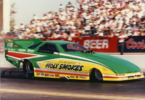
Jim Murphy's car 'Holy Smokes.' This is the current color scheme:

1578596823794.png

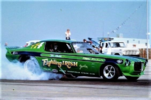
Tim Beebe's 'Fighting Irish' Top Fuel Funny car:

1578596915852.png

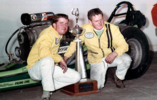
Tim Beebe (Right) - My friend and mentor. Tim also was a local clay track crew chief...

1578596954567.png

Tim used to let me use his parts washer tank and bead blaster cabinet whenever I had an oddball project going on....Great guy!!!!
 
Here's a snapshot from the recorder on your average (modern) funny car:

Donovan 417 Snapshot.jpg

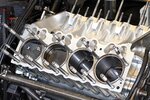
Here's the current breed of top fuel Hemi blocks's - Rules limit displacement to 500CID. The absence of water passages is evident here. Kidney-bean shaped holes
are for the roller tappets. No conventional style head gasket is used. Copper 'O' rings are placed in the grooved section of the cylinder liners:

Keith Black.jpg

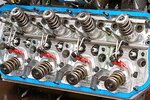
Here's a shot of a modern hemi head. Overall there are 34 fuel-injection nozzles on a Top Fuel engine - 16 in the head, 8 in the manifold and 10 in the blower hat.

Top Fuel Head.jpg

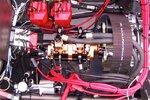
Here's a shot of the massive, belt-driven mechanical fuel pump and parts of the car's ignition system...

Top Fuel Pump & Ignition Systems.jpg
 
Last edited:
HOLY CAMOLY, That engine probably cost more than everything I own

Around $60,000 for a complete engine. But, honestly, there's more in the drivetrain....Transmissions are no longer used. The engine is connected to the differential via a multi-stage, centrifugal clutch. The clutch 'slips' at different rates and eventually locks up once the car gets moving.... :)
 
Last edited:
Back
Top