
You are using an out of date browser. It may not display this or other websites correctly.
You should upgrade or use an alternative browser.
You should upgrade or use an alternative browser.
Anyone here play a Gretsch?
- Thread starter Ghostwolf
- Start date


Can you describe your seven angle nut cut?
Yes
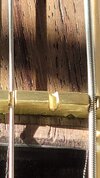
Each slot is cut like an hourglass and each 'edge' is rounded and polished. When using a non-locking tremolo, the low E and g strings unwind from the post and move laterally in the nut slot, so the corner radius is critical.
The floor of the nut also needs to "fall away" from the strings as they descend towards the tuners. The string should only have contact with the nut floor about 2/3rds of the way through the slot.
The next critical angle is the nut floor. It needs to be rounded - not flat - and it needs to be .004" larger than string gauge - no less and no more.
The walls of the slot also need to be at least .006" and not more than .008" over string gauge.
Lastly, I polish the slot with gauged abrasive cord to ensure smoothness.

Yes
Each slot is cut like an hourglass and each 'edge' is rounded and polished. When using a non-locking tremolo, the low E and g strings unwind from the post and move laterally in the nut slot, so the corner radius is critical.
The floor of the nut also needs to "fall away" from the strings as they descend towards the tuners. The string should only have contact with the nut floor about 2/3rds of the way through the slot.
The next critical angle is the nut floor. It needs to be rounded - not flat - and it needs to be .004" larger than string gauge - no less and no more.
The walls of the slot also need to be at least .006" and not more than .008" over string gauge.
Lastly, I polish the slot with gauged abrasive cord to ensure smoothness.
Okay, thanks. I already do a lot of that.
I appreciate it.
Okay, thanks. I already do a lot of that.
I appreciate it.
The polish is critical, but you must maintain the filed profile.
So, I've been checking Gretsch out more lately and perusing the various Gretsch forums.
The perpetual discussion in Gretsch land seems to be whether to get a 5420 model, such as some form of the Electromatic, or to spend three to four times more money to get some variety of the 6120 model in the Professional lines.
As expected, it is a never-ending discussion and has much of the same back-and-forth as we engage in with Epiphone vs. Gibson or Squier vs. Fender USA.
However, I've run across a pretty interesting detail as I was doing some digging on the Gretsch website and other places. The situation has to to with bracing in the various models. Sound post type bracing is the bracing style used by Gretsch from the beginning and is used on most of their guitars. However, in 1958, to get more sustain and reduce feedback, they came up with the Trestle bracing system. Oddly, Gretsch still calls this "new" on their website. More recently, Gretsch developed the ML bracing system.
What is interesting is that the trestle bracing system is most rigid and provides the best resistance to feedback. It is not a solid center block, but it adds more stiffness and rigidity to the top and has four points of contact with the back. The ML is somewhat of a hybrid approach and is found on some of the higher-end Gretsch guitars. The ML system has two points of contact with the back.
What all this indicates is that, although there may be models that look almost exactly the same, there are some real structural differences between the guitars that one should consider...I know I am. To me, I like the idea of the trestle system since it seems this is the most rigid, which is a good thing, not only for feedback resistance, but also vibrato use. The other point of interest is that the trestle system is currently only used in certain models of the 5420 line and there is a "traditional trestle" used in some of the most expensive pro-line models. It is not employed across the board in all models.
So, when it comes to hollow-bodies, Gretsch is my current front runner, and I'm deliberately leaning toward 5420 models with the trestle bracing system.
The perpetual discussion in Gretsch land seems to be whether to get a 5420 model, such as some form of the Electromatic, or to spend three to four times more money to get some variety of the 6120 model in the Professional lines.
As expected, it is a never-ending discussion and has much of the same back-and-forth as we engage in with Epiphone vs. Gibson or Squier vs. Fender USA.
However, I've run across a pretty interesting detail as I was doing some digging on the Gretsch website and other places. The situation has to to with bracing in the various models. Sound post type bracing is the bracing style used by Gretsch from the beginning and is used on most of their guitars. However, in 1958, to get more sustain and reduce feedback, they came up with the Trestle bracing system. Oddly, Gretsch still calls this "new" on their website. More recently, Gretsch developed the ML bracing system.
What is interesting is that the trestle bracing system is most rigid and provides the best resistance to feedback. It is not a solid center block, but it adds more stiffness and rigidity to the top and has four points of contact with the back. The ML is somewhat of a hybrid approach and is found on some of the higher-end Gretsch guitars. The ML system has two points of contact with the back.
What all this indicates is that, although there may be models that look almost exactly the same, there are some real structural differences between the guitars that one should consider...I know I am. To me, I like the idea of the trestle system since it seems this is the most rigid, which is a good thing, not only for feedback resistance, but also vibrato use. The other point of interest is that the trestle system is currently only used in certain models of the 5420 line and there is a "traditional trestle" used in some of the most expensive pro-line models. It is not employed across the board in all models.
So, when it comes to hollow-bodies, Gretsch is my current front runner, and I'm deliberately leaning toward 5420 models with the trestle bracing system.
So, I've been checking Gretsch out more lately and perusing the various Gretsch forums.
The perpetual discussion in Gretsch land seems to be whether to get a 5420 model, such as some form of the Electromatic, or to spend three to four times more money to get some variety of the 6120 model in the Professional lines.
As expected, it is a never-ending discussion and has much of the same back-and-forth as we engage in with Epiphone vs. Gibson or Squier vs. Fender USA.
However, I've run across a pretty interesting detail as I was doing some digging on the Gretsch website and other places. The situation has to to with bracing in the various models Sound post type bracing is the bracing style used by Gretsch from the beginning and is used on most of their guitars. However, in 1958, to get more sustain and reduce feedback, they came up with the Trestle bracing system. Oddly, Gretsch still calls this "new" on their website. More recently, Gretsch developed the ML bracing system.
What is interesting is that the trestle bracing system is most rigid and provides the best resistance to feedback. It is not a solid center block, but it adds more stiffness and rigidity to the top and has four points of contact with the back. The ML is somewhat of a hybrid approach and is found on some of the higher-end Gretsch guitars. The ML system has two points of contact with the back.
What all this indicates is that, although there may be models that look almost exactly the same, there are some real structural differences between the guitars that one should consider...I know I am. To me, I like the idea of the trestle system since it seems this is the most rigid, which is a good thing, not only for feedback resistance, but also vibrato use. The other point of interest is that the trestle system is currently only used in certain models of the 5420 line.
So, when it comes to hollow-bodies, Gretsch is my current front runner, and I'm deliberately leaning toward 5420 models with the trestle bracing system.
The Japanese Gretsch models are quite good in terms of build quality and finish, but the guitars themselves are nothing unique, other than the strange knob arrangement.
I developed this opinion playing the USA models from the 1960's, many years ago.
I took this photo for @smitty_p today...
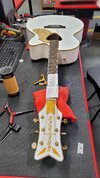
The Japanese Gretsch models are quite good in terms of build quality and finish, but the guitars themselves are nothing unique, other than the strange knob arrangement.
I developed this opinion playing the USA models from the 1960's, many years ago.
Actually, I do like the knob arrangement. The quintessential 5420 and 6120 models with three knobs on the lower rear bout use two volumes and a master tone. But, the master volume in the front lower bout is pretty cool to have.
That is somewhat different from the typical concept behind most other two pickup guitars. Most guitars will have either individual volumes or a single master volume. The Gretsch gives you both.
I realize you’re not a fan and they don’t do anything for you. No problem.
Actually, I do like the knob arrangement. The quintessential 5420 and 6120 models with three knobs on the lower rear bout use two volumes and a master tone. But, the master volume in the front lower bout is pretty cool to have.
That is somewhat different from the typical concept behind most other two pickup guitars. Most guitars will have either individual volumes or a single master volume. The Gretsch gives you both.
I realize you’re not a fan and they don’t do anything for you. No problem.
If only I didn't have to work on them so often

Session 5
Ambassador of Strings & Wings

Actually, I do like the knob arrangement. The quintessential 5420 and 6120 models with three knobs on the lower rear bout use two volumes and a master tone. But, the master volume in the front lower bout is pretty cool to have.
That is somewhat different from the typical concept behind most other two pickup guitars. Most guitars will have either individual volumes or a single master volume. The Gretsch gives you both.
I realize you’re not a fan and they don’t do anything for you. No problem.
Yes the master volume is a nice feature. I have to say the Quality of Gretsch is fantastic! my made in China is excellent flawless, intonation spot on, a great guitar for the money, its a lot of guitar for what i paid for it. I read an article how Gretsch really pushes the quality control for their guitars, it definately shows. The quality is high like Godin guitars, I am impressed. Nothing sounds like a Gretsch, they have their own sounds, tones.
Yes the master volume is a nice feature. I have to say the Quality of Gretsch is fantastic! my made in China is excellent flawless, intonation spot on, a great guitar for the money, its a lot of guitar for what i paid for it. I read an article how Gretsch really pushes the quality control for their guitars, it definately shows. The quality is high like Godin guitars, I am impressed. Nothing sounds like a Gretsch, they have their own sounds, tones.
I gotta say, I'm strongly, strongly leaning in a Gretsch direction. I know I started with Godin..which I still think is a terrific instrument, then I ran into the Guild Starfire, but the Gretsch really has my attention at the moment.
Yes the master volume is a nice feature. I have to say the Quality of Gretsch is fantastic! my made in China is excellent flawless, intonation spot on, a great guitar for the money, its a lot of guitar for what i paid for it. I read an article how Gretsch really pushes the quality control for their guitars, it definately shows. The quality is high like Godin guitars, I am impressed. Nothing sounds like a Gretsch, they have their own sounds, tones.
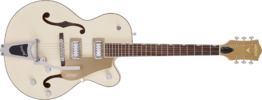
Setup, intonation and polishing is done here in SoCal....
You would not want to see them as they leave the factory.
Session 5
Ambassador of Strings & Wings
I gotta say, I'm strongly, strongly leaning in a Gretsch direction. I know I started with Godin..which I still think is a terrific instrument, then I ran into the Guild Starfire, but the Gretsch really has my attention at the moment.
You need both... Godin and Gretsch...



SG John
Ambassador of Cool Guitars and Amps.
I forget what the arrangement of knobs was like on my friend's Jet when he loaned it to me, but it didn't bother me at all. It was the Classic Jet set up with master volume, and as mine is wired. Just a different placement.The Japanese Gretsch models are quite good in terms of build quality and finish, but the guitars themselves are nothing unique, other than the strange knob arrangement.
I developed this opinion playing the USA models from the 1960's, many years ago.
I took this photo for @smitty_p today...
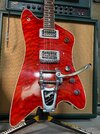
What I really like about mine is the master volume option. Instead of going with the two switches, I went the single switch option with master volume, neck and bridge volume knobs, then a master tone. Since I like changing my overall sound with the guitar instead of pedals, this combination works very well. Mine is true to Bo Diddley's wiring, and early Gretsches in general.
Last edited:

eSGEe
Ferengi Ambassador of Trade
YA'll givin me gas!

 www.jimmysvintagemusic.com
2017 Gretsch Electromatic cool color – Jimmy's Vintage Music
www.jimmysvintagemusic.com