
syscokid
Ambassador of War & Peace

Did you get your new fuses yet?I checked both sides of the sockets, they look brand new. No burning or damage that I can see.

Did you get your new fuses yet?I checked both sides of the sockets, they look brand new. No burning or damage that I can see.
Cool info! I saw the same pic you posted a couple days ago, while I was trying to find out what all the fuss is about regarding "BR3". WTF is BR3??? It's a rectifier for the amp's heater circuit that converts the AC filament voltage to DC for the first 3 preamp tubes. Apparently the rectifier was speced with a 1 amp rating. Three 12AX7's will draw about 900 mA of current. Initial power surge at startup was too much for a rectifier rated for 1 amp. Part of the fix is to replace the puny stock rectifier with a more robust rectifier. Most pics of this mod usually shows a new rectifier occupying the same location on the board where the old rectifier was. But going back to the Marshall Amp Forum where I saw the above pic, there's another pic of the same amp that shows the new rectifier was chassis mounted! Which I think is a good method to do this mod, especially if the board and its traces got toasted and crusty:Ok, firstly I'll explain why you need to use "timed" (= Slo-Blo) fuses here;
When cold, the tube filaments have notably higher resistance than they do when hot. So at initial power-up the filament current draw surges briefly. Ever seen that nice bright flash the old production Mullard 12AX7's exhibit at power-up, this is what causes it.
So with that out of the way, I'd best go back & read through the thread properly so I can give correct advice.
So, here i the JCM900 SLX2500 Power Supply Unit's schematic
View attachment 86295
From this, it appears that the power amp tubes (PI included) are AC heater'd, while the pre-amp tubes are DC heater'd. Further, it shows the power amp filament supply is applied to the PI (V4) tube socket & from there connects to the power tube sockets (V5 then V6). Being that I'm not familiar with "post JCM800" amps, I checked a few 2500 SLX gutshots to confirm this, & here's a gutshot where this can be seen.
View attachment 86297
So we can see the red & black filament leads coming from the 'board to the PI (V4), from there on to the first power tube socket (V5) & then the next power tube socket (V6), in the normal "twisted leads" daisy chain fashion.
So V5 is the socket reading 1VAC, while the V4 PI socket & the V6 socket have 7VAC(?) & their tubes light up.
The thing is, for the filament current to get from V4 to V6, it has to come via the V5 socket, as their filament leads are linked there (at V5).
So there's a few possibilities as to what the problem may be, but, you say you previously created a short that blew the filament fuses,,, can you take a close look at the V5 socket (well lit & possibly using something like a jewelers loupe or similar magnifier). Look say, between pins 2 & 1, or pins 7 & 8, looking for "carbon tracking" between them. I'll wait to hear the results. Cheers
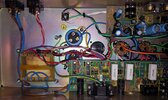


While in bad cases burning etc might be visible, carbon tracking can also resemble a light, barely visible pencil line drawn between the pins.I checked both sides of the sockets, they look brand new. No burning or damage that I can see.

Yep! I'm sure I got a picture of this amp floating back over there too over this same issue somewhere lol. Those original rectifiers were abysmally small and mounted flush against the board. Most toasted the the boards as a result and damaged the traces but others were way luckier and just burned out the rectifier itself.Cool info! I saw the same pic you posted a couple days ago, while I was trying to find out what all the fuss is about regarding "BR3". WTF is BR3??? It's a rectifier for the amp's heater circuit that converts the AC filament voltage to DC for the first 3 preamp tubes. Apparently the rectifier was speced with a 1 amp rating. Three 12AX7's will draw about 900 mA of current. Initial power surge at startup was too much for a rectifier rated for 1 amp. Part of the fix is to replace the puny stock rectifier with a more robust rectifier. Most pics of this mod usually shows a new rectifier occupying the same location on the board where the old rectifier was. But going back to the Marshall Amp Forum where I saw the above pic, there's another pic of the same amp that shows the new rectifier was chassis mounted! Which I think is a good method to do this mod, especially if the board and its traces got tasted and crusty:
View attachment 86359


Do you want to do some tests?Good news and bad news.
I replaced the fuses with the proper ones, and now all tubes are lighting up nicely.
Bad news is the bias is all wacky. Only showing 13ma, and turning the trimmer pot does nothing. Yet, with no tubes, I see -41 to -48 v at pin 5 on both sockets.
More bad news, now that V5 tube is dark again, and so are all the preamp tubes, and the fuses are fine.
Off to a tech it will go!
Worst Marshall design ever! My '98 DSL was more reliable, and didn't burn up traces on the board.
BR3Cool info! I saw the same pic you posted a couple days ago, while I was trying to find out what all the fuss is about regarding "BR3". WTF is BR3??? It's a rectifier for the amp's heater circuit that converts the AC filament voltage to DC for the first 3 preamp tubes. Apparently the rectifier was speced with a 1 amp rating. Three 12AX7's will draw about 900 mA of current. Initial power surge at startup was too much for a rectifier rated for 1 amp. Part of the fix is to replace the puny stock rectifier with a more robust rectifier. Most pics of this mod usually shows a new rectifier occupying the same location on the board where the old rectifier was. But going back to the Marshall Amp Forum where I saw the above pic, there's another pic of the same amp that shows the new rectifier was chassis mounted! Which I think is a good method to do this mod, especially if the board and its traces got toasted and crusty:
View attachment 86359
Is it a chicken or the egg thing? I've read how closely spec'd the BR3 is and that it can't handle spikes over it's value - so it fails. But if the caps are replaced first, the BR3 issue wouldn't happen?BR3
the actual problem is the filter caps for the DC filament voltage.
The filter caps get old, short out, and BR3 overheats from too much load current.
BR3 does not need to be upgraded, or mounted externally.
The stock rectifier has no problem.
The filter caps should be changed and that will solve the rectifier from overheating.
I see lots people try to modify BR 3 for no reason; and it's pointless.
The people who tell you BR3 needs to be modified:Is it a chicken or the egg thing? I've read how closely spec'd the BR3 is and that it can't handle spikes over it's value - so it fails. But if the caps are replaced first, the BR3 issue wouldn't happen?
The people who tell you BR3 needs to be modified:
do not realize why it overheats.
BR3 will last if the filter caps are good.
"can't handle spikes..."
Then how did it keep working for the previous 25 years?
It has nothing to do with "spikes,"
everything to do with underrated filter capacitors....they get old and short out.
Replace the filament filter caps with a higher voltage rating, higher current, higher temperature rating, longer life rating.
10,000 hour life rating minimum, 105C temp rating minimum, 16 volt (not 6 volt)!
Replace the filter caps for the plus/minus 16 volt low voltage supplies also.
The factory used under rated caps.
We can make these amps sound quite killer when the caps are good...
This info would be very interesting to discuss with Andy Fuchs...Is it a chicken or the egg thing? I've read how closely spec'd the BR3 is and that it can't handle spikes over it's value - so it fails. But if the caps are replaced first, the BR3 issue wouldn't happen?

I see people racing to modify what they don't understand....This info would be very interesting to discuss with Andy Fuchs...
Are you referring to the C8 10,000 uF/15 vdc filter capacitor? You don't think that the BR3 mini rectifier can heat up enough to affect the circuit tracks, even if the stock filament rectifier fails on its own.But circuit tracks have been over heated due to shorted filter capacitors...
They damn well oughta lol it was a common issue in this amp like the bias drift was from the 100w JCM2000 DSL/TSL amps ( 50watters SOMEHOW dodged this and rarely caught it, yet to this day I dunno why or how).Are you referring to the C8 10,000 uF/15 vdc filter capacitor? You don't think that the BR3 mini rectifier can heat up enough to affect the circuit tracks, even if the stock filament rectifier fails on its own.
Do you know if Marshall ever offered a service bulletin for what seems to be a common with these JCM900's?
BINGO!It's going to be a bad solder connection at the socket or the socket itself is bad.
Not the tranny...
The problems crop up in older units.Are you referring to the C8 10,000 uF/15 vdc filter capacitor? You don't think that the BR3 mini rectifier can heat up enough to affect the circuit tracks, even if the stock filament rectifier fails on its own.
Do you know if Marshall ever offered a service bulletin for what seems to be a common with these JCM900's?
As I previously said, I'm unfamiliar with these amps, but this here makes perfect sense. As electrolytic capacitors age, the electrolyte dries out, ESR, leakage current etc goes up, so that bridge rectifier has to work harder. Spikes aren't the problem, it's a 1A rectifier so has been surge tested at about twice that. It can safely supply 1A, so supplying 900mA for the filaments isn't a problem. The extra current continuously drawn by an old, out of spec electrolytic capacitor would be a problem. CheersI see people racing to modify what they don't understand....
The rectifier (BR3) gets hot for a reason...what is the real reason?
Why does the original part (un modified) work for 25 years with no problem?
Do you really think Marshall made a mistake in the design?
I think the fact is:
after replacing the filter caps, original BR3 is usually still good.
But circuit tracks have been over heated due to shorted filter capacitors...
