Ok, firstly I'll explain why you need to use "timed" (= Slo-Blo) fuses here;
When cold, the tube filaments have notably higher resistance than they do when hot. So at initial power-up the filament current draw surges briefly. Ever seen that nice bright flash the old production Mullard 12AX7's exhibit at power-up, this is what causes it.
So with that out of the way, I'd best go back & read through the thread properly so I can give correct advice.
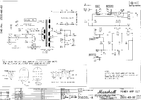
So, here i the JCM900 SLX2500 Power Supply Unit's schematic
View attachment 86295
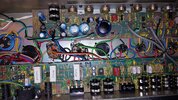
From this, it appears that the power amp tubes (PI included) are AC heater'd, while the pre-amp tubes are DC heater'd. Further, it shows the power amp filament supply is applied to the PI (V4) tube socket & from there connects to the power tube sockets (V5 then V6). Being that I'm not familiar with "post JCM800" amps, I checked a few 2500 SLX gutshots to confirm this, & here's a gutshot where this can be seen.
View attachment 86297
So we can see the red & black filament leads coming from the 'board to the PI (V4), from there on to the first power tube socket (V5) & then the next power tube socket (V6), in the normal "twisted leads" daisy chain fashion.
So V5 is the socket reading 1VAC, while the V4 PI socket & the V6 socket have 7VAC(?) & their tubes light up.
The thing is, for the filament current to get from V4 to V6, it has to come via the V5 socket, as their filament leads are linked there (at V5).
So there's a few possibilities as to what the problem may be, but, you say you previously created a short that blew the filament fuses,,, can you take a close look at the V5 socket (well lit & possibly using something like a jewelers loupe or similar magnifier). Look say, between pins 2 & 1, or pins 7 & 8, looking for "carbon tracking" between them. I'll wait to hear the results. Cheers