Kept getting "wolftones" on the neck, even when screwed down pretty close to flush. I ran an intonation check with my Korg Pitchblack in strobe mode and things were pretty close.
I have huge hands and I tend to clamp down really hard, so I go ever-so-slightly flat on the fretted notes so they pull into pitch.
If I dropped the pickup to kill the overtone anomaly, I lost tons of output and threw off my overall balance.
While working on this project, I broke the high "e" string. Rather than throw on another set, I grabbed some spare singles from my supply bag...
Now, a few months ago, a colleague influenced me to switch from a lifetime of using Ernie Ball (lime green) .010's to their hybrid .009's. But, all I had was a set of .017"/.013"/.010's" singles, so I threw them on.
I have to admit I was floored at the difference in tone with a mere .001" in string diameter and the "wolftones" were now gone. True, the additional .001" feels like I strung it with bass strings, but the tone on the G/B/E is so much fuller and with more clarity.
So, essentially, my Stratocaster is now back to 1988 specifications...even the stock pots and wiring....go figure.
The copper shielding was a big factor in noise reduction, but the full aluminum pickguard shield (.010") and strategic use of 3M Spec 33 electrical tape (1 layer insulates 100 VDC) totally isolated the electronics from EMI/RFI. The Tremolo spring cover is shielded on the back with aluminum tape.
Anywhere a hot and a ground wire were in close proximity, I applied the black tape. I saw the inside of one of Yngwie's Stratocaster's a few years ago and the backs of the pickup's were lined with copper tape. I used 3M black tape here too as I thought it was a better choice, especially since the wirr bundle crosses the back of each pickup.
I created a copper tunnel for the wiring to cross from input rout to main cavity, then joined them redundantly with a ground wire.
Where the "hot" tip of the input jack gets close to the copper shielded wall of the input jack rout, I applied a piece of black tape here too, which totally killed a very slight background "hum" that appeared when the jack was seated.
I also taped off the unused lugs on the pots and ran a super heavy gauge wire from input jack to volume pot with a dielectric shrink wrap covering. The ground wire from the input jack was also enlarged and shielded with the braided RFI stainless mess from a stripped out oxygen sensor and dielectric shrink wrapped into place at both ends.
When plugged into my 40 watt tube Marshall, you immediately think the guitar volume is turned off...its that quiet. Sitting in front of the computer no longer has any effect on the guitar and no more radio stations playing either.
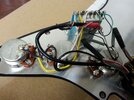
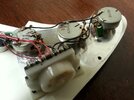
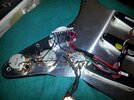
Now, the wiring/pots/switch/tone cap are all the originals that came in the guitar in 1987. Only the main input wires were replaced. The pickup wire bundles are pretty ugly, due to the 4 conductor wiring, but its well soldered and quiet.
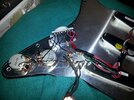
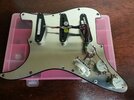
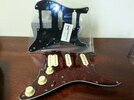
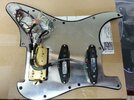
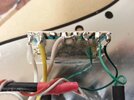
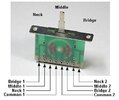
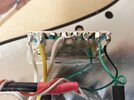
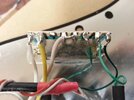
The images below show the post-modification wiring (top) and the pre-modification wiring (bottom) this switch had a really crazy wiring scheme, so I had to verify all connections with noise continuity. I couldn't go by any diagrams.
I need to get some recordings posted. You guys need to hear this!!!