Accidental Peter Green Modification Unmasked - Calling Gahr!!!!

Well then... The factory defect makes it extra special, and more valuable. You can probably resell the pup for 3x what you paid for it!

Ok... I just had some pancakes, and I'm definitely full of it. Maybe not more valuable, but it's still special... :dance:

The tone - with a lot of gain - has an almost chainsaw quality to it, and in the middle position, there is no muddiness whatsoever. I can just play there the entire set...it has a sore of snarl like what you used to hear on Randy Rhoad's rhythms...The bassist noticed it right away!!!!
 
If you closely examine this modification, it really doesn't appear to require rewiring or even swapping the magnets position.

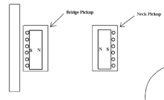
When normally orientated - as shown below - the north pole on both pickups face each other. If you pull the magnet out and turn it 180 degrees, the south and north will face each other.

magnetor-71.gif

However, if you simply rotate the neck pickup 180 degrees, you have also caused the south pole to face the bridge pickup's north pole....

So why pull the cover and move the magnet???
 
If you closely examine this modification, it really doesn't appear to require rewiring or even swapping the magnets position.

When normally orientated - as shown below - the north pole on both pickups face each other. If you pull the magnet out and turn it 180 degrees, the south and north will face each other.

View attachment 18128

However, if you simply rotate the neck pickup 180 degrees, you have also caused the south pole to face the bridge pickup's north pole....

So why pull the cover and move the magnet???

Because you have turned the magnet round - which swaps the phase - and also turned the coil round, which swaps it back again. Net result zero change. You must turn EITHER the magnet or the coil, not both.
 
Because you have turned the magnet round - which swaps the phase - and also turned the coil round, which swaps it back again. Net result zero change. You must turn EITHER the magnet or the coil, not both.

But the coil is passive until energized....and humbucker pole pieces are not magnets like single coils, so I can't see where the coil has anything to do with it...????
 
If you closely examine this modification, it really doesn't appear to require rewiring or even swapping the magnets position.

When normally orientated - as shown below - the north pole on both pickups face each other. If you pull the magnet out and turn it 180 degrees, the south and north will face each other.

View attachment 18128

However, if you simply rotate the neck pickup 180 degrees, you have also caused the south pole to face the bridge pickup's north pole....

So why pull the cover and move the magnet???
OK... Pretty much what Mr. DonP has stated.

I'm not sure I'm explaining this right, but...
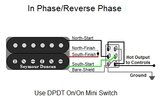
What you're suggesting has nothing to do with the out of phase result. It all depends on the polarity of the magnet facing the last coil that the signal exits from. If both pups have the magnet's north polarity facing the coil with the screw poles, and the signal leaves after those coils , the signal is in phase with each other. But with the magic of 4 conductor wiring, you can change the signal to exit from the other coil that has a south polarity instead. Operate both pups together, and now you have an out of phase signal.

In_Phase_Reverse_Phase__40362.1471991208.500.400.jpg
 
But the coil is passive until energized....and humbucker pole pieces are not magnets like single coils, so I can't see where the coil has anything to do with it...????

The pole pieces are magnets - they are energised by the slab magnet underneath them. The slab puts a south pole under one coil and a north under the other. The respective tops of the pole pieces take on those polarities. It doesn't matter what way the entire assembly faces, it just responds to the string's velocity. You need to change the direction of the field through the coil to change the phase, and that requires you to flip the magnet.
 
The pole pieces are magnets - they are energised by the slab magnet underneath them. The slab puts a south pole under one coil and a north under the other. The respective tops of the pole pieces take on those polarities. It doesn't matter what way the entire assembly faces, it just responds to the string's velocity. You need to change the direction of the field through the coil to change the phase, and that requires you to flip the magnet.

Ok..so the effect is only present when the field is energized.
 
Not sure what you mean. The field is always energized. The magnet sees to that.

Well...let me see...as I still find this a bit confusing. Yes, the magnet is always energized (charged) but does not the entire pickup become an electro magnet once power is applied, thereby increasing its magnetic properties many times over???
 
No power applied to the Guitar circuit other than the magnet(unless active electronic circuitry added...eg:EMG active set up)
Essentially the guitar pickups are like an SM 57/58 mic...no power needed, just need to amplify the signal.
 
These last few posts have me thinking... :hmmm:
Pickups do generate their own voltages (right?). Their output voltages can be measured in millivolts. With this in mind, I wish there was a standardized testing method observed by all pickup manufacturers, that will produce these voltage specs much like horsepower specs.

Dimarzio sort of does this, but I have no idea how they set up their testing.
 
Well...let me see...as I still find this a bit confusing. Yes, the magnet is always energized (charged) but does not the entire pickup become an electro magnet once power is applied, thereby increasing its magnetic properties many times over???

No. Power doesn't get applied to a pickup - it is entirely passive, like a microphone. All the magnetism it has is what is there from the bar magnet. Let me explain a bit how this works.

A magnetic field alone won't produce any output voltage. You only get an induced voltage when the magnetic field changes. That change is brought about by the steel or nickel string moving close to the pole piece. So the magnet provides the field which gets changed by the moving string, which then induces a small current in the coil. That appears as the signal which goes to the amplifier, causing women's underwear to fall of (so I'm told).
 
No. Power doesn't get applied to a pickup - it is entirely passive, like a microphone. All the magnetism it has is what is there from the bar magnet. Let me explain a bit how this works.

A magnetic field alone won't produce any output voltage. You only get an induced voltage when the magnetic field changes. That change is brought about by the steel or nickel string moving close to the pole piece. So the magnet provides the field which gets changed by the moving string, which then induces a small current in the coil. That appears as the signal which goes to the amplifier, causing women's underwear to fall of (so I'm told).

LOL!!!

Ok...This part keeps puzzling me though. In a single coil, the pole pieces are actually magnets...which is why they pull on the strings as opposed to a humbucker, ehich can be placed much closer to the strings without creating a Wolftone.

In a humbucker - from my study - it appears the pole pieces are just metal and are not - in and of themselves - magnetic in nature until place here the magnet. So, if we rotate the pickup itself 180° we have now changed the North/South arrangement of the pickups from this diagram:

magnetor-71-gif.18128


But as Gahr said, doing that doesn't change anything. However, both coils are essentially the same, are non-magnetic and cannot (in my mind) influence or change the magnet's polarity. So the 'out-of-phase' effect seems to be from the N & S sides of the pickups facing each other - opposite of the diagram shown above - which can be induced by moving the pickup physically 180° of rotation.

But, if what Gahr says is correct, that if you rotate the pickup the pole will switch back to its regular orientation, I cannot see how a passive set of coils and pole pieces can - in any way - influence a switch in the magnet's N & S orientation.

So, let me further postulate...are you saying that when you alter the magnet's N/S position, it causes the path of electrons through the coils to actually change direction, effectively reversing the phase electronically rather than magnetically???
 
Back
Top