In another thread, I made the comment on just how little movement there is across the nut when using a vibrato. So, I decided to see if I could evaluate it. Well, all it takes is a Sharpie!
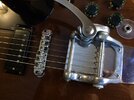
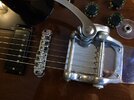
For starters, here's the system under evaluation. This is my 1974 Gibson SG with a B5-style vibrato. The bridge is a Wilkinson roller bridge (okay...I know it technically is not a "roller" bridge as there is no roller-bearing. But, the saddles are wheels and they do turn about the axle, so it makes it easy to observe what is happening).
You can see I used a red Sharpie to make a mark on the string. I'll use this to observe the amount the string moves during vibrato use.
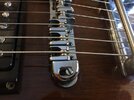
Here is a close up of the string at the bridge, prior to using the bar. The mark is centered on the roller.
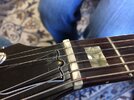
And here is a shot of the string at the nut, prior to using the bar. I put a red mark on it, too.
The nut is a delrin nut and I lubricate the nut with a mixture of graphite and teflon oil. In fact, you can still see some gray smudges from the graphite on the surface of the nut. I gotta clean that off!
So far, so good. Here is where it gets interesting. I had my son push the vibrato arm all the way to the pickguard and hold it there while I took the remaining pictures. This is well beyond what we would normally do in actual use of a vibrato.
So, here is how much the string moved across the bridge with the bar fully depressed.
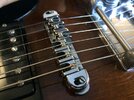
You can see the mark is shifted very slightly forward. While the bar is being dropped, you can see the string move and the roller turn. But, this is all it moves! Maybe a millimeter.
This is the really fascinating part. At the nut end, there is essentially no movement across the nut! In this pic, the vibrato arm is fully depressed all the way to the pickguard.
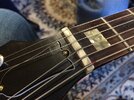
While the bar is being pushed down, you can see the string relax in the nut slot and edge very slightly toward the peg head, but not even the thickness of a single winding. Once the string is relaxed, it more or less just lays in the slot. We often have this vision of a string sawing back and forth in the nut as a vibrato is used. But, it doesn't really happen that way.
For starters, here's the system under evaluation. This is my 1974 Gibson SG with a B5-style vibrato. The bridge is a Wilkinson roller bridge (okay...I know it technically is not a "roller" bridge as there is no roller-bearing. But, the saddles are wheels and they do turn about the axle, so it makes it easy to observe what is happening).
You can see I used a red Sharpie to make a mark on the string. I'll use this to observe the amount the string moves during vibrato use.
Here is a close up of the string at the bridge, prior to using the bar. The mark is centered on the roller.
And here is a shot of the string at the nut, prior to using the bar. I put a red mark on it, too.
The nut is a delrin nut and I lubricate the nut with a mixture of graphite and teflon oil. In fact, you can still see some gray smudges from the graphite on the surface of the nut. I gotta clean that off!
So far, so good. Here is where it gets interesting. I had my son push the vibrato arm all the way to the pickguard and hold it there while I took the remaining pictures. This is well beyond what we would normally do in actual use of a vibrato.
So, here is how much the string moved across the bridge with the bar fully depressed.
You can see the mark is shifted very slightly forward. While the bar is being dropped, you can see the string move and the roller turn. But, this is all it moves! Maybe a millimeter.
This is the really fascinating part. At the nut end, there is essentially no movement across the nut! In this pic, the vibrato arm is fully depressed all the way to the pickguard.
While the bar is being pushed down, you can see the string relax in the nut slot and edge very slightly toward the peg head, but not even the thickness of a single winding. Once the string is relaxed, it more or less just lays in the slot. We often have this vision of a string sawing back and forth in the nut as a vibrato is used. But, it doesn't really happen that way.
Last edited: