2021 Gibson Les Paul Standard 50's Gold Top:

Parallel...
So it comes out to a hair less than .1uF. Might try that on a neck pickup one day.

I get a little bemused when thinking about caps in line; I'm so used to thinking about them in tone control applications, where low values roll of higher frequencies.

Roy Buchanan's old Tele "Nancy" has a .1uF cap wired in between the switch and the volume pot. Over the years people kept trying to test the DCR of its great pickups and got no reading. A few figured it for broken windings, which (so I'm told) in rare cases can still allow a coil to produce signal. But it was just the cap at work, refusing to pass DC.

Don Mare posted on the Tele forum about his long quest to duplicate Nancy's tone, and the eureka moment when he stumbled onto the secret while working with an entirely different Tele.
 
I have a pair of those Epi "mudbuckers".
I think I will have a look under the covers and melt off some of the wax if they are encased.
Worth a look. Same have claimed a tone improvement from shaving & melting off as much wax as they could. They also had treble-deadening brass covers, which accounts for some of it. Very often simply taking the covers off can make for a big improvement with those.
Is "mudbucker"a real designation???
Nah. Just a nickname they picked up up in the 90s when they were really bad. I've never been able to verify this, but I believe something got better around 2010. Not a formal change of specs, but maybe a different factory making them? Perhaps something as simple as less wax, or better covers? Not sure of the details. Either way, the 2010-and-later Alnico Classics seemed better, while the ones from before that often seemed dull & lifeless to me.

The term "mudbucker" was first used talking about Gibson's giant bass humbucker in the 60s, as used on the EB-0 and in neck position on the EB-3 and a few other basses of the time. It's super wide because of a sidewinder design where their fat coils are horizontal, with magnets at the outer edges and a keeper bar in the center. Definitely not a bright pickup.
s-l300.jpg


I think it is the Alnico Classic set.
There is a newer Alnico Pro Classic that is 4 wire I think.
The 4-wire Alnico Classic Pro set are a lighter wind ostensibly based on Gibson's 57 Classics. They're said to be pretty good, though Epi is pretty cagey about sharing the specs. Quite a different animal from the Alnico Classics, though, despite a confusingly similar name.

The regular Alnico Classics have a bridge wound to around 14K (officially called the Alnico Classic Plus). They were standard in a lot of Epi models until a few years ago.

To be even more confusing, sometimes Alnico Classic Pros are referred to as Pros, making it easy to confuse them with the more recent (and more PAF-like) Probuckers, which have earned a reputation as Epiphone's best humbuckers so far.
 
Worth a look. Same have claimed a tone improvement from shaving & melting off as much wax as they could. They also had treble-deadening brass covers, which accounts for some of it. Very often simply taking the covers off can make for a big improvement with those.

Nah. Just a nickname they picked up up in the 90s when they were really bad. I've never been able to verify this, but I believe something got better around 2010. Not a formal change of specs, but maybe a different factory making them? Perhaps something as simple as less wax, or better covers? Not sure of the details. Either way, the 2010-and-later Alnico Classics seemed better, while the ones from before that often seemed dull & lifeless to me.

The term "mudbucker" was first used talking about Gibson's giant bass humbucker in the 60s, as used on the EB-0 and in neck position on the EB-3 and a few other basses of the time. It's super wide because of a sidewinder design where their fat coils are horizontal, with magnets at the outer edges and a keeper bar in the center. Definitely not a bright pickup.
s-l300.jpg


The 4-wire Alnico Classic Pro set are a lighter wind ostensibly based on Gibson's 57 Classics. They're said to be pretty good, though Epi is pretty cagey about sharing the specs. Quite a different animal from the Alnico Classics, though, despite a confusingly similar name.

The regular Alnico Classics have a bridge wound to around 14K (officially called the Alnico Classic Plus). They were standard in a lot of Epi models until a few years ago.

To be even more confusing, sometimes Alnico Classic Pros are referred to as Pros, making it easy to confuse them with the more recent (and more PAF-like) Probuckers, which have earned a reputation as Epiphone's best humbuckers so far.

Tone wise, what are you looking for???
 
I've altered quite a few pickup 'voices' with capacitance. It helps a lot when you have deep, wooly low end frequency response.

In the case of overtly bright, thin pickups, I'll generally add a 220k resistor in line with the pickups signal wire to trim high frequency. I have also had great success combining resistors and capacitors in line to such a degree that I could alter the pickup's voicing to give me exactly what a client was looking for.

It's not often this technique is needed, but in cases where a client has tried different pickups and/or pots without success, then I'll start changing the voicing.

On my DoubleNeck, we experimented with the placement of the bridge pickup. I though that maybe, if we shifted it a bit more towards the nut - around .500" or so - we might be able to achieve a 'hybrid tone' similar the the middle pickup on a black beauty.

Well, this was a mistake. The shift away from the bridge made everything muddy, undefined and unusable with any type of gain.

In this case, I went through a set of Thro-Bak's, Lollar Imperials, Virgil Arlo's 59's, Mojotone 59 Clones, and a bunch of garden variety take-outs, all with negative results.

Here's what I ended up doing to fix it.

I used a 550k volume pot with a 1Mg tone pot on the 6 string side. I used a PIO K47 tone capacitor on the bridge with a 0.01uf value. I then soldered (2) .047uf capacitors together and placed them in line with the bridge pickup signal lead. I lastly constructed a special treble bleed from a PIO K47 .015uf capacitor and a 220k resistor.

I also use a flipped magnet in the bridge to give me that "honky" solo tone, but this has no effect except in the middle position.

Listen to the solo tone of the DoubleNeck in this clip. Solo starts at 2:52

Listen to FALL TO PIECES - COVER VERSION by Von Herndon on #SoundCloud

On that clip, the rhythm guitar (in the chorus) is actually played overdriven on the 12 string neck through a pair of Thro-Bak's.
 
Tone wise, what are you looking for???
Tighter lows, a little thinner overall, less mids if possible, and lower output.
It's a bridge P90 wound to 10K, going in neck position.

I've considered taking a couple of hundred turns of wire off the coil. Probably the best solution.
But I hesitate to try that because I haven't unwound a coil before.
 
Tighter lows, a little thinner overall, less mids if possible, and lower output.
It's a bridge P90 wound to 10K, going in neck position.

I've considered taking a couple of hundred turns of wire off the coil. Probably the best solution.
But I hesitate to try that because I haven't unwound a coil before.

What maker???

10k is a lot of pickup for a neck position.
 
Can I offer a suggestion???

Look at the P90 options from GFS.
I like some of the GFS pickups I've tried. I have a Surf 90 - not really very P90ish despite the name, but I liked it enough to give my son one for neck position on his Ibanez. (He's mostly an acoustic player when it comes to guitar, and he found the neck humbucker too dark & round for his tastes.) Also have a VEH bridge hum that's quite decent, though there are others in the hotter-than-vintage category that I like better. I know the GFS P90s have a very good reputation, and their Mean 90 hum-sized P90 is well regarded too.

The thing is, I already have this Sentell P90 and it's kind of an unusual one: a clear bobbin which shows the copper wire underneath. I like that look; bought it years ago to use in another guitar whose pickup rout is unusually close to the bridge. That guitar didn't work out.
Jerry wound me two other P90s too, a 9.7K A5 bridge and an 8.3K neck using one A5 and one A2 (That was before I turned on to UA5.)

Anyway, I've had this one sitting unused for too long, and the only slot I have available is neck position.
Originally my idea was to use a cap to cut some bass and just keep its volume knob turned about halfway down.
Figured full volume could be used like a boost for solos once in a while.
But that isn't ideal.

I guess I ought to just bite the bullet and try taking some winds off rather than attempt a quick fix that's less than ideal.
Haven't ever done that. Is it as simple as just unwinding the coil wire manually, checking the DCR occasionally?
Shouldn't need to keep tension on it when unwinding, right?
 
I like some of the GFS pickups I've tried. I have a Surf 90 - not really very P90ish despite the name, but I liked it enough to give my son one for neck position on his Ibanez. (He's mostly an acoustic player when it comes to guitar, and he found the neck humbucker too dark & round for his tastes.) Also have a VEH bridge hum that's quite decent, though there are others in the hotter-than-vintage category that I like better. I know the GFS P90s have a very good reputation, and their Mean 90 hum-sized P90 is well regarded too.

The thing is, I already have this Sentell P90 and it's kind of an unusual one: a clear bobbin which shows the copper wire underneath. I like that look; bought it years ago to use in another guitar whose pickup rout is unusually close to the bridge. That guitar didn't work out.
Jerry wound me two other P90s too, a 9.7K A5 bridge and an 8.3K neck using one A5 and one A2 (That was before I turned on to UA5.)

Anyway, I've had this one sitting unused for too long, and the only slot I have available is neck position.
Originally my idea was to use a cap to cut some bass and just keep its volume knob turned about halfway down.
Figured full volume could be used like a boost for solos once in a while.
But that isn't ideal.

I guess I ought to just bite the bullet and try taking some winds off rather than attempt a quick fix that's less than ideal.
Haven't ever done that. Is it as simple as just unwinding the coil wire manually, checking the DCR occasionally?
Shouldn't need to keep tension on it when unwinding, right?

Yes, you would need to keep the wire tensioned and its a very delicate process.
 
Here's what I would do...

First, lower the pickup down to a out 12/64" from the top of the bobbin to the underneath of the strings, when fretted at the last fret.

If that doesn't give you what you want, you could make up a simple divider, from two fixed value resistors, to divide and reduce the output. A 2:1 ratio ought to do it.

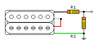
For example, let's say that you're using a 500k pot. So R2 would be 500k, and R1 would be 250k. The 500k in parallel with the 500k pot will look like 250k. Add the 250k on top of that and the pickup is still "seeing" a 500k load. But now, the output (voltage) is divided by half, which is approximately a -3db drop in volume/output.

image_50156.jpg
 
Last edited:
Here's what I would do...

First, lower the pickup down to a out 12/64" from the top of the bobbin to the underneath of the strings, when fretted at the last fret.

If that doesn't give you what you want, you could make up a simple divider, from two fixed value resistors, to divide and reduce the output. A 2:1 ratio ought to do it.

For example, let's say that you're using a 500k pot. So R2 would be 500k, and R1 would be 250k. The 500k in parallel with the 500k pot will look like 250k. Add the 250k on top of that and the pickup is still "seeing" a 500k load. But now, the output (voltage) is divided by half, which is approximately a -6db drop in volume/output.

View attachment 76330
Robert, half power would be -3dB.
 
Here's what I would do...

First, lower the pickup down to a out 12/64" from the top of the bobbin to the underneath of the strings, when fretted at the last fret.

If that doesn't give you what you want, you could make up a simple divider, from two fixed value resistors, to divide and reduce the output. A 2:1 ratio ought to do it.

For example, let's say that you're using a 500k pot. So R2 would be 500k, and R1 would be 250k. The 500k in parallel with the 500k pot will look like 250k. Add the 250k on top of that and the pickup is still "seeing" a 500k load. But now, the output (voltage) is divided by half, which is approximately a -6db drop in volume/output.

View attachment 76330
Thanks - that's exactly what I was looking for!
I can always add a cap inline later to thin it out some.
But I suspect I won't need it.

I was not eager to try unwinding a couple of hundred turns.
 
So, we are around the 30 day mark now with the new Gold Top. I still haven't pulled the control cover plates or truss rod cover off. The guitar has already been used on at least a dozen recordings.

The guitar came setup exactly to my 'SOP' specs, which mirror that of Gibson's published specs (which I adopted years ago)

1st fret action height .030"

12 fret action height. 070"

7th fret relief height .015"

The pickups were set to the published Gibson spec (current) of 1.6mm (1/16") bridge and 2.4mm (3/32") neck. Pickup balance on the old, analog VU meter was dead-on the money, so no changes were made.

I have made only two adjustments to this guitar.

1. I adjusted the individual string pole pieces to balance string to string volumes. Wax came out from around the screws when this adjustment was made, proving what Gibson's Nicolas Chemsak said about "all factory installed Burstbuckers are potted and no over-the-counter Burstbuckers are potted..."
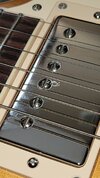
20211118_183758.jpg

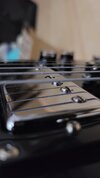
The image below is a close up look at the Gibson 490's (from @ChasFred) on my Custom DoubleNeck, shown as a reference point.
20211119_220527.jpg

2. I found the intonation was biased towards the lower frets (close at lower frets with a large deviation up around the 12th) and had a tendency to go sharp when I played it.

I adjusted the intonation to balance the pitch and bias everything ever so slightly flat, so that when watching a tuner while playing, every note of a chord plays in tune.

I also 'temper' the intonation values to get the best average between the 12th and lower frets.

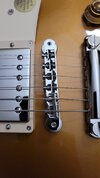
Here is a shot of the Gold Top's ABR-1 as delivered:
20211122_220548.jpg

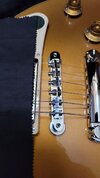
Here's a shot after I made minor adjustments:
20211124_074002.jpg

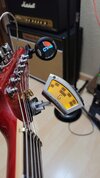
For reference, here's how I evaluate tuning using two tuners:
20211127_215906.jpg

While I'm no expert on the subject of setup, I often setup 25-40 guitars a week, including warranty service as an 'extra help,' so using the guitar builder's published specs makes setup super fast and provides a consistent benchmark.

Some will argue that every guitar should be setup by ear and feel. That's great for a bedroom player with their own guitar. It doesn't work when you have 20+ guitars to setup, or when you are working on "the line" at Fender and you have seven minutes per guitar for setup and adjustments to maintain daily productivity quotas.

So, the Gold Top has really exceeded all of my expectations and it continues to be used daily...
 
Back
Top