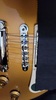
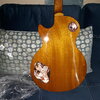
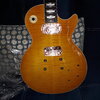
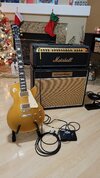
2021 Gibson Les Paul Standard 50's Gold Top:

81 days of ownership thus far and the new Les Paul is still wearing its original .010" x .046" strings. I've been playing it daily since I brought it home on November 17, 2021.

20211229_214925.jpg


Red pick dust from yesterday's rehearsal.

20220205_140803.jpg


The only adjustments I made were to the pickup pole pieces to balance string to string volumes.

Every measurement on this guitar is consistent with Gibson's published specs, which I've used as a setup guide on everything that goes out of my shop.

Both Fender and Gibson published specs are very similar.

Neck relief is .010", first fret height is .022" and 12th fret action height is .070" respectively. (Same specs we use on the Fender and Jackson lines)

Gibson actually specifies checking action at the 17th fret with a capo on the first fret, but if you use this method and get the spec of 4/64" to 5/64", it will be .070" at the 12th unfretted, so you can check it either way.

Nut and saddle slots are also right on the money at + .004" above string gauge.

This guitar literally came right out of the case and onto the stage with zero modifications.
 
Last edited:
Super sweet that you finally found the right LP. I've been eyeballing an ebony LP Classic up at the shop. I know I said I didn't have any money, but when has that ever stopped a poor guitarist before?

They don't have it listed on their website yet but it looks like this one


View attachment 79933


I must say I've been smitten since I saw it last week.....:facepalm:

That one looks pretty good!
 
So, the nut slot for a .010 string should be a .014?

Correct.

Out of trust and respect, I have been asked not to publish the actual documents because they are considered a "trade secret" and the service specification sheets are marked both "Confidential" and "Do Not Duplicate/Distribute."

As a side note, Gibson guitars are ALL fitted with "Gibson Brite Wire" strings and those are made exclusively by D'Addario.

Prior to the 2015 General Revisions of their specs, Gibson was using +.004" across the board as a target specification on all models. (whether you agree or not, this is what the guitars were being set-up to on the bench).

For 2015, Gibson revised their assembly line/warranty specifications and, as you can see, they changed the slots in the nut from the previous (2015-Earlier) specification of + .004" to as high as .012" above string gauge on the low 'E' string and "tightened" the spec to only +002" on the 'A' and 'D' strings.

Gibson's specification department did not give a reason for the change, only noting that the build process is continuously evaluated and changes are made to improve functionality.

This specification is the same regardless of nut material. Brass, Titanium or Tek-Toid all adhere to the same chart specifications.


Gibson Assembly Speciations - String Gauge All Les Paul Models
E:0.046"
A:0.036"
D:0.026"
G:0.016"
B:0.011"
e:0.009"

Gibson Assembly Speciations - Dimensions of String Slots
E:0.058"
A:0.048"
D:0.038"
G:0.028"
B:0.019''
e:0.014"

In my opinion, +.004" (which is the current Fender Blueprint Specification for USA models) is the best overall setting and it is what I use when setting up nuts from scratch as SOP. However, say for example, a client complained about the nut slot being too wide in his Gibson Les Paul. The warranty tech would compare the actual nut slot measurement to the chart specification and no authorization for changing out the nut would be authorized.

2013 was the last year Gibson used Corian for nuts. They switched to Tek-Toid for all 2014 Models.

In 2017, the Les Paul Standards received the Aluminum Bridge and Tailpiece and that continued through 2021 on the Standard models:


In 2018, Gibson began using a cryogenically hardened nickel silver fret material.

In 2019 for the 2020 model year, Gibson switch to a "proprietary spec" Graph-Tech nut on all Les Paul Models.

In 2020, Gibson made a published switch from .009" x .046" to .010/.013/.017/.026/.026/.046 Strings on Les Paul Models

In 2021, Gibson switched to a "proprietary spec" .090" x .055" fretwire from Jescar.
 
This continues to be a great guitar. If I had one complaint about this guitar, it would be the fact that the "traditional" method of Gibson's construction avoidsd any kind of shielding for EMI/RFI and under certain conditions, it can be overwhelming.

I was playing a live performance last night with a friend's band, just a single, 60 minute set at a very old bar. I got pulled in to cover a missing player.

The electrical interference in that place was off the hook. I mean, they had at least 40-50 wireless Roku TV's around the bar, all playing the same videos, plus Neon lights, strobes, black lights, you name it.

The Gibson literally sounded like an arc welder under these conditions. If I rotated my body, the noise would change. I swapped cabled to no avail and I was playing straight into the Ivanberg without a gate. It was also transmitting garbled cell phone conversations.

Lucky, I brought my YelloStrat, which is fully shielded. I plugged it in and it was dead quiet no matter where I stood.

There's nothing at all wrong with my Gibson, it's just simply that the traditional build methodology that worked in the 1950's, is not well suited to our current signal-rich environment.

Just have to remember the unshielded guitars can really freak put in certain situations.
 
And you discover and experience things playing out in public, live, that you would never encounter in a million years of playing at home.

One night, we were performing and a girl on the dance floor was having a Bluetooth phone conversation while dancing and I could hear it coming through my amp during the break between songs.

Only my unshielded guitars do this, and it's simply nature of the beast and there is nothing at all wrong with the guitar.

Plug in one of my shielded guitars and absolutely zero noise or RFI.
 
Last edited:
This continues to be a great guitar. If I had one complaint about this guitar, it would be the fact that the "traditional" method of Gibson's construction avoidsd any kind of shielding for EMI/RFI and under certain conditions, it can be overwhelming.

I was playing a live performance last night with a friend's band, just a single, 60 minute set at a very old bar. I got pulled in to cover a missing player.

The electrical interference in that place was off the hook. I mean, they had at least 40-50 wireless Roku TV's around the bar, all playing the same videos, plus Neon lights, strobes, black lights, you name it.

The Gibson literally sounded like an arc welder under these conditions. If I rotated my body, the noise would change. I swapped cabled to no avail and I was playing straight into the Ivanberg without a gate. It was also transmitting garbled cell phone conversations.

Lucky, I brought my YelloStrat, which is fully shielded. I plugged it in and it was dead quiet no matter where I stood.

There's nothing at all wrong with my Gibson, it's just simply that the traditional build methodology that worked in the 1950's, is not well suited to our current signal-rich environment.

Just have to remember the unshielded guitars can really freak put in certain situations.
Rob, can you expand a bit more on what the shielding impeding factor in the gibson design would be? Maybe there is a way to solve it up to a certain degree.
 
Last edited:
Rob, can you expand a bit more on what the shielding impeding factor in the gibson design would be? Maybe there is a way to solve it up to a certain degree.

As @gball can attest, Gibson used to have a shield, a two piece metal cover, that encapsulated the controls and what looked like an aluminum ashtray around the switch.

These guitars are more EMI/RFI resistant than a model such as my 2021 Gibson Les Paul 50's Standard Gold Top, which has zero shielding of any kind.

The best solution is full copper shielding.
 
As @gball can attest, Gibson used to have a shield, a two piece metal cover, that encapsulated the controls and what looked like an aluminum ashtray around the switch.

These guitars are more EMI/RFI resistant than a model such as my 2021 Gibson Les Paul 50's Standard Gold Top, which has zero shielding of any kind.

The best solution is full copper shielding.

Exactly. The Norlin-era Les Pauls with the Faraday cage are the most dead-quiet guitars of any kind I have ever played, in every environment. Such a great idea that got poop-canned when the "everything was better in the 1950s" nazis made us go back to playing granddads guitars.
 
I keep gravitating to this 2021 for some reason, despite how heavy it is...

Shot from Saturday/Sunday marathon sessions...

Screenshot_20220508-101154_Messenger.jpg

I never play it without a strap as a safety consideration. I don't want any more practice fixing broken headstocks!!!!
 
Back
Top