1957 Fender Princeton (Amp Porn) Completely 100% Original / UNtouched.

It's not mine, belongs to a customer of Grand Central Music.
He wants to gig with it.
That may be a tad unrealistic.
I think that amp is like 3 watts, isn't it? It's like a champ amp. I can't see any difference between a Champ and this amp, is there any difference?

I thought those 5F2 and 5F2A Princeton’s were in the 8-12 watt range. The 5F2A that I recently built is pretty loud. I tried my best to source the correct parts for the Tweed sound, and not end up with a black face Princeton.
 
Gotcha..... but it’s still way cooler. As far as gigging with it. Put a mic in front of it and run it thru the board.

Ever take note on what Neil Young has been using as his go to amp since the 70s. Something like a Fender Reverb Twin. Aren’t they like 15 amps stock? Just mics it and runs it thru the house speakers.

Edit: just looked it up. 1959 Tweed Fender Deluxe. But I did get the 15w correct.
I gotta agree it is the coolest.
Too bad it's not 50 watts...even 15 would work.
 
Yes it does have a death cap, but not the kind I like.
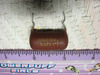
I like the brown drop ones.
View attachment 56209
Hey AMS... I'm sure it has crossed your mind but you haven't discussed it here at this thread yet:
This amp is very pristine. You said it yourself that it shows evidence of it barely ever been used. The filter caps and coupling caps are 63 to 64 years old. The amp's components and circuit was designed with the old days of 110vac at the wall sockets. Have you fired up this amp yet? Perhaps bring it up slowly with a variac? Reform the old filter caps? Check the old speaker's cone for dry rot?

If the owner wants to gig with it, I would suggest replacing the old AC cord with a 3-pronger (ground wire to chassis), possibly new filter caps, possibly new coupling caps, possibly new speaker, and remove Death cap. Any original parts removed would need to be preserved properly of course.
 
Hey AMS... I'm sure it has crossed your mind but you haven't discussed it here at this thread yet:
This amp is very pristine. You said it yourself that it shows evidence of it barely ever been used. The filter caps and coupling caps are 63 to 64 years old. The amp's components and circuit was designed with the old days of 110vac at the wall sockets. Have you fired up this amp yet? Perhaps bring it up slowly with a variac? Reform the old filter caps? Check the old speaker's cone for dry rot?

If the owner wants to gig with it, I would suggest replacing the old AC cord with a 3-pronger (ground wire to chassis), possibly new filter caps, possibly new coupling caps, possibly new speaker, and remove Death cap. Any original parts removed would need to be preserved properly of course.

That's what we planned on doing but,
the coupling caps may still be good, and I like to leave them in if possible because they sound "old."

IMHO coupling caps can last for 100 years maybe more. Depending on the circuit, the stress of insulation maybe be very low...
so I can measure leakage and if it's not leaking I can leave it.

The high voltage filter caps have a high insulation stress. The insulation breaks down easier and faster.
After 63 years you could probably expect changing the filter caps.

We have not powered it up...
I don't put a lot of faith into reforming filter caps especially if they are 63 years old.
It can reform, but it can also suddenly short out too I think.

I would remove the death cap, and install the grounded 3 prong power lead for certain.
That's pretty much a given.

The voltage difference of about 8% higher than normal is something to consider.
The filaments could be over-voltage....that's got to be addressed somehow.
If the filter caps are rated 500 volt (stock was 450 volt), then I'm not too worried about the B+ being too high.
A tube amp usually doesn't react to 8% higher plate volts in a bad way too often, but the filament might turn out to be the real problem.
You would not want to run 6 volt filaments on 7 volts....I think + - 5% is what you should keep within range.
 
The filaments could be over-voltage....that's got to be addressed somehow...
... A tube amp usually doesn't react to 8% higher plate volts in a bad way too often, but the filament might turn out to be the real problem.
You would not want to run 6 volt filaments on 7 volts....I think + - 5% is what you should keep within range.
You probably already know all this, but from Rob Robinette's website I learned to succesfully lower the filament voltage to one of my amps at:
Scroll down to: Lower Your 6.3V Heater Voltage

My JCM800/2204 clone build has a ClassicTone PT and was pushing about 6.9vac at the filaments. I need to check my notes, but I think I got the voltage down to a perfect 6.3vac. I have some pics of the mod if you're interested!
 
Oh goofy me! I just realized I did a thread on reducing the filament voltages:
(3) Reducing an Amp's Heater AC Voltage Supply | The Tone Rooms
So you are using small value high wattage resistors just to drop a little voltage (?)
That would be the classic method probably...
Unless you wanted adjustable sliders on the resistors...
Old radio transmitters would have a big variac to adjust the filament.

They just start lowering the filament voltage very slowly, until the amp output just starts to drop off.
Then they raise it 5% or so, to maintain the rated amp output.
But they don't run it any higher then they need to. Just enough that's all.
 
Damn, what a great find. Someone got very lucky indeed. Ive been wanting the Doc or Marty McFly to grab me a few things like this for ages, just can't get them to play.
Wouldn't be surprising for the coupling caps to still be good.
Might I ask "how" you reform electrolytic capacitors?
I use a "current limiting" method with good success & have yet to have a failure (no "voltage limiting" variac method please).
Thanks for posting pics of such an original & pristine old amp.
Once insuring it's serviceable, I'd be powering it with the 110VAC it wants to see, rather than todays 120VAC. Cheers
Edit:
The "insulation" layer in electrolytic capacitors is a thin layer of aluminium oxide. This layer deteriorates & is what must be reformed (with the capacitors removed from the chassis, especially when this old).
The electrolyte can be re-distributed if necessary by slowly warming the capacitors in an oven, though take care to not exceed it's maximum operating temperature rating.
Cheers
 
Last edited:
Damn, what a great find. Someone got very lucky indeed. Ive been wanting the Doc or Marty McFly to grab me a few things like this for ages, just can't get them to play.
Wouldn't be surprising for the coupling caps to still be good.
Might I ask "how" you reform electrolytic capacitors?
I use a "current limiting" method with good success & have yet to have a failure (no "voltage limiting" variac method please).
Thanks for posting pics of such an original & pristine old amp.
Once insuring it's serviceable, I'd be powering it with the 110VAC it wants to see, rather than todays 120VAC. Cheers
Edit:
The "insulation" layer in electrolytic capacitors is a thin layer of aluminium oxide. This layer deteriorates & is what must be reformed (with the capacitors removed from the chassis, especially when this old).
The electrolyte can be re-distributed if necessary by slowly warming the capacitors in an oven, though take care to not exceed it's maximum operating temperature rating.
Cheers
Supposedly (starting low) raising the current higher and higher over many hours of time causes the self-healing insulation to fill in any faults...

I have never bought into that.
I have always felt that "re-forming" was basically a joke.
I have always installed new capacitors. I don't trust "re-forming."
 
  • Like
Reactions: RVA
Supposedly (starting low) raising the current higher and higher over many hours of time causes the self-healing insulation to fill in any faults...

I have never bought into that.
I have always felt that "re-forming" was basically a joke.
I have always installed new capacitors. I don't trust "re-forming."
Placing a resistance (100k will suffice) in series with the (positive) supply limits the current & drops the voltage, allowing the insulation layer to form at its own rate. As progressively less current is drawn by the capacitor forming, so the voltage drop across the resistor lessens.
The insulation layer is formed in much the same "limiting" manner to start with.
Cheers
 
Back
Top