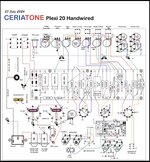
A retired truck driver’s version:
Looking at the layout, this Fat switch adds a .68 cap that parallels V2A’s 820 ohm cathode resistor. IMO, a .68 cap at this location adds a bunch of gain to the mids and highs, and barely any increase to the lows. I’m actually surprised it’s labeled as a Fat switch instead of a Gain switch.
Split/Shared V1 Cathode switch: I think that when V1 shares its cathode circuit with both inputs, that both volume controls are interactive with each other even with only a single input being plugged into. When V1’s cathode circuit is split, that interactivity is eliminated unless jumper cables are used.
3-way NFB switch: The higher the resistance value is, the less negative feedback is in the output circuit. The three selectable values accordingly to the layout is 49K, 95K, and 127K. More NFB makes the amp sound smoother, cleaner, quieter, and tamer. Less NFB makes the amp more aggressive, gainier, and wilder. Plexi’s generally are loaded up with 47K’s, which is like middle-of-the-road for NFB control. JCM800 2204’s use a 100k NFB resistor. Some amps have no NFB, like some Fender Tweeds and Vox AC’s.