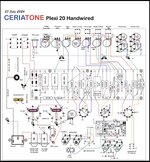
Ceriatone British Style Plexi 20

Can anyone explain to me what these features actually do? These are 3 of the features this amp has that I have no idea what they are or what they are doing. I've watched the video several times and about 5 minutes in he tries to explain the switches on the back, but he fumbles around so much I don't really think he knows what they do. He was saying something about one of these switches make the amp go from 68 plexi/JTM type low gain to louder higher gain and saturation, but that's all I got out of it and I'm not even sure which switch he was talking about.

– Fat switch (V2A cathode capacitor)
– Split/Shared V1 Cathode Switch
– 3 way Negative Feedback switch


There's no manual on the website for this amp, just a layout. I don't know if these amps ship with a manual, I bought my King Kong used so it didn't have one, but there was a download for it on the website.
I bet a schematic could give you some clues. Also, tap the brain trust here. Lots of amp building experience.
 
Can anyone explain to me what these features actually do? These are 3 of the features this amp has that I have no idea what they are or what they are doing. I've watched the video several times and about 5 minutes in he tries to explain the switches on the back, but he fumbles around so much I don't really think he knows what they do. He was saying something about one of these switches make the amp go from 68 plexi/JTM type low gain to louder higher gain and saturation, but that's all I got out of it and I'm not even sure which switch he was talking about.

– Fat switch (V2A cathode capacitor)
– Split/Shared V1 Cathode Switch
– 3 way Negative Feedback switch


There's no manual on the website for this amp, just a layout. I don't know if these amps ship with a manual, I bought my King Kong used so it didn't have one, but there was a download for it on the website.
Other than “they do what they say” I couldn’t tell you how they actually work. I have had the Fat switch which worked well, the Cathode switch I have never had. The NFB on a couple different amps I have had might as well been a sticker, it did nothing. My first couple amps from Nik came with paper manuals, same as on the site just printed out. However none have come with any since. I told him last time we talked to up his game on the manuals and info, he agreed he needs to.
 
Other than “they do what they say” I couldn’t tell you how they actually work. I have had the Fat switch which worked well, the Cathode switch I have never had. The NFB on a couple different amps I have had might as well been a sticker, it did nothing. My first couple amps from Nik came with paper manuals, same as on the site just printed out. However none have come with any since. I told him last time we talked to up his game on the manuals and info, he agreed he needs to.

I guess I'll just have to wait until I get it and see for myself, lol.
 
Can anyone explain to me what these features actually do? These are 3 of the features this amp has that I have no idea what they are or what they are doing. I've watched the video several times and about 5 minutes in he tries to explain the switches on the back, but he fumbles around so much I don't really think he knows what they do. He was saying something about one of these switches make the amp go from 68 plexi/JTM type low gain to louder higher gain and saturation, but that's all I got out of it and I'm not even sure which switch he was talking about.

– Fat switch (V2A cathode capacitor)
– Split/Shared V1 Cathode Switch
– 3 way Negative Feedback switch


There's no manual on the website for this amp, just a layout. I don't know if these amps ship with a manual, I bought my King Kong used so it didn't have one, but there was a download for it on the website.
They make an "All Access" version of the JTM45 now that has a bunch of those circuit change switches. I've looked over the layout diagram and considered adding them to my stock version. My main hesitation is that with the MV and buffered loop, I can already get some amazing tone versatility with the 31 band EQ and a couple of pedals.

Subtle little changes to this or that probably wouldn't be be worth the effort. It'd be nice to try the options and just make some permanent mods for anything that's appealing.
Since yours is coming with, I'd guess you'll try flipping the switches a few times and then just leave them one way or another.

The tone explosion running stereo with the O20H will blow away anything those little switches can do. :coffee2:
 
Last edited:
Fat switch (V2A cathode capacitor)
– Split/Shared V1 Cathode Switch
– 3 way Negative Feedback switch
A retired truck driver’s version:

Looking at the layout, this Fat switch adds a .68 cap that parallels V2A’s 820 ohm cathode resistor. IMO, a .68 cap at this location adds a bunch of gain to the mids and highs, and barely any increase to the lows. I’m actually surprised it’s labeled as a Fat switch instead of a Gain switch.

Split/Shared V1 Cathode switch: I think that when V1 shares its cathode circuit with both inputs, that both volume controls are interactive with each other even with only a single input being plugged into. When V1’s cathode circuit is split, that interactivity is eliminated unless jumper cables are used.

3-way NFB switch: The higher the resistance value is, the less negative feedback is in the output circuit. The three selectable values accordingly to the layout is 49K, 95K, and 127K. More NFB makes the amp sound smoother, cleaner, quieter, and tamer. Less NFB makes the amp more aggressive, gainier, and wilder. Plexi’s generally are loaded up with 47K’s, which is like middle-of-the-road for NFB control. JCM800 2204’s use a 100k NFB resistor. Some amps have no NFB, like some Fender Tweeds and Vox AC’s.
 
A retired truck driver’s version:

Looking at the layout, this Fat switch adds a .68 cap that parallels V2A’s 820 ohm cathode resistor. IMO, a .68 cap at this location adds a bunch of gain to the mids and highs, and barely any increase to the lows. I’m actually surprised it’s labeled as a Fat switch instead of a Gain switch.

Split/Shared V1 Cathode switch: I think that when V1 shares its cathode circuit with both inputs, that both volume controls are interactive with each other even with only a single input being plugged into. When V1’s cathode circuit is split, that interactivity is eliminated unless jumper cables are used.

3-way NFB switch: The higher the resistance value is, the less negative feedback is in the output circuit. The three selectable values accordingly to the layout is 49K, 95K, and 127K. More NFB makes the amp sound smoother, cleaner, quieter, and tamer. Less NFB makes the amp more aggressive, gainier, and wilder. Plexi’s generally are loaded up with 47K’s, which is like middle-of-the-road for NFB control. JCM800 2204’s use a 100k NFB resistor. Some amps have no NFB, like some Fender Tweeds and Vox AC’s.

Thank you very much! :cheers:

Now what the guy in the video said makes more sense. :yesway:
 
Dammit Steve! Now you've gone and done it. You gave me GAS to order the kit version of this. :BH:

Sorry..
ZFrfMx5.gif
 
Back
Top