Gibson Bashing or good review, What say you?

I went to a 3 day school, put on by Floyd Rose at Fender. I have never worked with anything other than a standard Floyd Rose and have had absolutely zero issues with retirn to pitch, when properly set up.
Yep. I’m very familiar with the standard Floyd Rose through body models(I actively gigged with them for many years). They have their advantages and disadvantages, and it’s up to the individual end users to weigh and form their opinions on them.
Until I saw the previously posted video of the top mount Floyd Rose unit, showing the stabilizer feature in action, I had no idea that it was an integrated component of that particular model, and functionality of that model is affected(as illustrated in the video) by removing/disabling it. I had hoped that it would behave in a similar manner to traditional Floyd systems(flutter available/smooth return to pitch/shimmer easily available). I am familiar with other, similar in effect, add on components available for Floyd and other traditional through body trem systems. But he was pretty clear in illustrating how it functions…
 
Yep. I’m very familiar with the standard Floyd Rose through body models(I actively gigged with them for many years). They have their advantages and disadvantages, and it’s up to the individual end users to weigh and form their opinions on them.
Until I saw the previously posted video of the top mount Floyd Rose unit, showing the stabilizer feature in action, I had no idea that it was an integrated component of that particular model, and functionality of that model is affected(as illustrated in the video) by removing/disabling it. I had hoped that it would behave in a similar manner to traditional Floyd systems(flutter available/smooth return to pitch/shimmer easily available). I am familiar with other, similar in effect, add on components available for Floyd and other traditional through body trem systems. But he was pretty clear in illustrating how it functions…

They never mentioned this system in my training course. What's it called exactly???
 
I went to a 3 day school, put on by Floyd Rose at Fender. I have never worked with anything other than a standard Floyd Rose and have had absolutely zero issues with retirn to pitch, when properly set up.
Pretty sure that is the whole idea and successful reason the Floyd was invented and developed as we know it today.
Dive Bomb and Tuning Stability from a properly set up and used Trem.
 
Ok,

A couple of things. Lock nut behind the nut is a poor design. Ibanez did this with the DT555 in 1983.

Watch old Hendrix videos at how badly his guitar woukd come out of tune. This tells me that very, very few people know how to properly profile a nut, and this is one area that i think is an issue.

The poster mentioned the guitar was a "Tribute," or what is often called a "T-Series."

Gibson skips all the aging processes on these guitars Something Nick Chemsak told me was one of their cost cutting measures, including, lower quality woods) and its one reason for them having a real lack of stability. After several years of seasoning, they will likely settle down, but when new, they are very troublseome.

I think this trem system is called the FRX???
 
They never mentioned this system in my training course. What's it called exactly???

1685979860278.jpeg
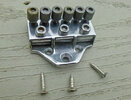
Created for stop tail guitars, tune o matic bridge and tailpiece equipped guitars including Gibson SG/LP/ES etc. Meant to have a low impact installation that is easily reversible. The only modification necessary being holes to be drilled for the nut lock plate.
Much like the Stetsbar, it uses the existing tailpiece mounts to install the main bridge system. Gibson released a SG model equipped with one installed at the factory. The 2016 Gibson SG CM limited edition…


View attachment 93438
Created for stop tail guitars, tune o matic bridge and tailpiece equipped guitars including Gibson SG/LP/ES etc. Meant to have a low impact installation that is easily reversible. The only modification necessary being holes to be drilled for the nut lock plate.
Much like the Stetsbar, it uses the existing tailpiece mounts to install the main bridge system. Gibson released a SG model equipped with one installed at the factory. The 2016 Gibson SG CM limited edition…


Wow, that's something!
 
Ok,

A couple of things. Lock nut behind the nut is a poor design. Ibanez did this with the DT555 in 1983.

Watch old Hendrix videos at how badly his guitar woukd come out of tune. This tells me that very, very few people know how to properly profile a nut, and this is one area that i think is an issue.

The poster mentioned the guitar was a "Tribute," or what is often called a "T-Series."

Gibson skips all the aging processes on these guitars Something Nick Chemsak told me was one of their cost cutting measures, including, lower quality woods) and its one reason for them having a real lack of stability. After several years of seasoning, they will likely settle down, but when new, they are very troublseome.

I think this trem system is called the FRX???
The video maker had no tuning stability issues at all. He pointed out a functional anomaly that I had never heard mentioned about the FRX model. They(Floyd Rose and numerous “reviewers”) did tout the stabilizer in the marketing and review materials as being advantageous, but never pointed out the difference in behavior from a traditional Floyd system. That was what I found interesting.
 
The video maker had no tuning stability issues at all. He pointed out a functional anomaly that I had never heard mentioned about the FRX model. They(Floyd Rose and numerous “reviewers”) did tout the stabilizer in the marketing and review materials as being advantageous, but never pointed out the difference in behavior from a traditional Floyd system. That was what I found interesting.

Just my observations with behind the nut lock nuts in general.
 

View attachment 93438
Created for stop tail guitars, tune o matic bridge and tailpiece equipped guitars including Gibson SG/LP/ES etc. Meant to have a low impact installation that is easily reversible. The only modification necessary being holes to be drilled for the nut lock plate.
Much like the Stetsbar, it uses the existing tailpiece mounts to install the main bridge system. Gibson released a SG model equipped with one installed at the factory. The 2016 Gibson SG CM limited edition…

Very interesting idea! I, too, question the lock behind the nut if there are nut issues. Sorta defeats the purpose. That said with a proper nut it would prevent any slippage behind nut on tuners.
Very cool.
 
Very interesting idea! I, too, question the lock behind the nut if there are nut issues. Sorta defeats the purpose. That said with a proper nut it would prevent any slippage behind nut on tuners.
Very cool.

Yep. Trouble is, nobody seems to "get" nut slotting. Its multiple angles, not straight cuts.

My stock Fender tremolo 11 semitone divebomb YouTube video got me hired at Fender.

Even if the nut slots are right, the behind the nut lock can put a lot of stress on an already weak section of the neck.
 
Very interesting idea! I, too, question the lock behind the nut if there are nut issues. Sorta defeats the purpose. That said with a proper nut it would prevent any slippage behind nut on tuners.
Very cool.

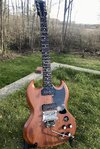
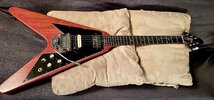
I never really liked the idea, but some do. As Robert has said, a properly setup nut is paramount. My SG performs pretty well with its setup…locking tuners, and a Tusq nut tailored to taste. It took me a while to dial it in to the way it performs today, but it was a learning experience. I do a lot of back and forth between drop tuning, and standard tuning, so I’m happier without a full locking system. Drop only setting on a trem system worked well for me when I was gigging regularly. Now that I’ve stepped away from that scene, I find that my setups float pretty well too…although this SG does perform better than my V for full float setup. The V hangs up on the D string occasionally when set to float, but not at all when set to drop only. I’m guessing that it has something to do with the slight difference in the nut geometry for the D & G strings. But, as I stated, it’s rock solid when set to “drop pitch only”. Perhaps that will change in the future, but I’m happy with that one as it is now, and have no compulsion to alter or change out the nut as it stands now.
IMG_2888.jpeg
IMG_5125.jpeg
 
So...let me get this straight...

Guy has sample size of 1
Said sample is an entry level/beginner model
Sample comes stock with frets unsuited to his style
Dude then slaps aftermarket trem on sample
My man then makes sweeping generalization about the company as a whole.

This, my friends, is what we call logical fallacy.
 
Last edited:
Ok,

A couple of things. Lock nut behind the nut is a poor design. Ibanez did this with the DT555 in 1983.

Watch old Hendrix videos at how badly his guitar woukd come out of tune. This tells me that very, very few people know how to properly profile a nut, and this is one area that i think is an issue.

The poster mentioned the guitar was a "Tribute," or what is often called a "T-Series."

Gibson skips all the aging processes on these guitars Something Nick Chemsak told me was one of their cost cutting measures, including, lower quality woods) and its one reason for them having a real lack of stability. After several years of seasoning, they will likely settle down, but when new, they are very troublseome.

I think this trem system is called the FRX???
YES FRX Top Mount Tremelo System
 
So...let me get this straight...

Guy has sample size of 1
Said sample is an entry level/beginner model
Sample comes stock with frets unsuited to his style
Dude then slaps aftermarket trem on sample
My man then makes sweeping generalization about the company as a whole.

This, my friends, is what we call logical fallacy.

gball, are you saying that if I am 7'3 inches tall and Volkwagen builds a compact car that is too small for me to fit in, it is to their credit that their cars don't suck just because I am a giant? Obviously Joking HAHA
 
Last edited:
Back
Top