Guitar Frequencies:

My experience has been & i never used EQ, or even boost with the Plexi, 800 & Dsl's, they seem to have the best filter naturally built in for mid range pop. 2 Marshalls in aband have to carve separate EQ's kinda why i always record marshall-mesa its like a natural EQ love affair when they get together.. disclaimer i always play at band level practic-studio -live , the amps tone circuits are designed for that for optimim use..just my observance & into set it & forget & use the TONE knob on me g-tar
 
One thing I learned about running a JCM at high volume is it will turn to mud quick if you don't back off the bass when you slam the front end using the high sensitivity input.
but dangit if the old "everything at 7" rule doesn't seem to work every time with a JCM.
You know your JCM’s very well, my friend… :dood:.

For the very reasons you posted, is why I have both of my 2204/4104/50watt JCM-Whatever’s modded with the following:
1) The first gain stage, that is only activated by plugging into the high sensitivity input, has its .022 coupling cap reduced to .015 for my 6CA7/EL34 amp, and .0022 for my 6550 amp.

2) Resonance/Depth/Beef control circuits added to fine tune a cleaner bass produced from the power stage. From very low to mid volume levels this control is cranked up a bit, but at high volumes (master at 7-ish) the control is at minimum. The bass from the resonance control is much cleaner than the bass control that’s before the tone stack into a very overdriven amp.

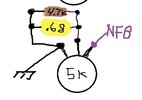
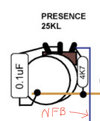
3) And greatly inspired by Ivan H, the stock presence circuit has been modded too. Stock presence circuit:
IMG_0577.jpeg

Modded presence circuit adds midrange grind and less high end spiky-ness when maxed out:
IMG_0576.jpeg

4) Scumback M75-LD speakers. These are Scumback’s enhanced version of the Celestion G12-65 which were Marshall’s original choice of speaker in the first years of the JCM combo amps. IMO, this is the perfect speaker for this type of amp.
 
You know your JCM’s very well, my friend… :dood:.

For the very reasons you posted, is why I have both of my 2204/4104/50watt JCM-Whatever’s modded with the following:
1) The first gain stage, that is only activated by plugging into the high sensitivity input, has its .022 coupling cap reduced to .015 for my 6CA7/EL34 amp, and .0022 for my 6550 amp.

2) Resonance/Depth/Beef control circuits added to fine tune a cleaner bass produced from the power stage. From very low to mid volume levels this control is cranked up a bit, but at high volumes (master at 7-ish) the control is at minimum. The bass from the resonance control is much cleaner than the bass control that’s before the tone stack into a very overdriven amp.

3) And greatly inspired by Ivan H, the stock presence circuit has been modded too. Stock presence circuit:
View attachment 92725

Modded presence circuit adds midrange grind and less high end spiky-ness when maxed out:
View attachment 92726

4) Scumback M75-LD speakers. These are Scumback’s enhanced version of the Celestion G12-65 which were Marshall’s original choice of speaker in the first years of the JCM combo amps. IMO, this is the perfect speaker for this type of amp.

Spoken like a true Amp God!!!!
 
Last night's gig was an example of how important eq is. We were outside with a cement wall behind us. The E string on my bass had a serious boom to the tone. The jazz bass has limited tone controls. I moved my amp towards the end of the wall and played with the eq on my DI/preamp pedal and the amp itself but I couldn't get rid of the boom. I switched to my Yamaha bass with active controls and was able to minimize the boom. You never know what sound problems a venue will have. You need multiple eq options. I'm going to be looking for a pedal that has a high pass filter option. The bass, mid, treble options on my DI and amp couldn't cut it in this case.
 
Last night's gig was an example of how important eq is. We were outside with a cement wall behind us. The E string on my bass had a serious boom to the tone. The jazz bass has limited tone controls. I moved my amp towards the end of the wall and played with the eq on my DI/preamp pedal and the amp itself but I couldn't get rid of the boom. I switched to my Yamaha bass with active controls and was able to minimize the boom. You never know what sound problems a venue will have. You need multiple eq options. I'm going to be looking for a pedal that has a high pass filter option. The bass, mid, treble options on my DI and amp couldn't cut it in this case.

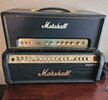
Interesting, because ive never experienced an EQ issue (requiring bass/mid/treble adjustment) from any venue, ive only needed more or less volume, depending on the size of the venue, but bass is a very unique instrument, so i can totally understand your issue.
 
@Kerry Brown - Let me also say that the style of music creates different challenges.

In my current assignment, we are playing really chuggy heavy metal. My EQ's on the amp are perfectly adequate, as far as tone goes, but i cannot get enough grit to get a good chug out of my 50 watt Marshall Origin. (None of my Origin tone controls ever have to be maxxed out)

But the gain or "grit" from the Origin was perfect for my last band, playing 70's and 80's Rock, so in that arena, its a great amp.

Even switching from my 50 watt Origin, to my 100 watt Valvestate, my 100 watt Marshall Ss to my 75 watt Line 6 SS, and adjusting only by ear, all my tone controls are exactly the same between all 4 of these amps,)with respect to bass, middle and treble settings,) and its only the gain control that is set differently between these 4 amps.

Even the primary EQ on my board stays in the same "frown" even when switching amps.

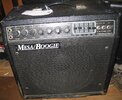
Here are three amps, all set by ear in a rehesrsal studio, through the same 2x12 cabinet with Celestion Copperback 250's and all are set pretty much identical.

20230514_105059.jpg

Screenshot_20230514_105401_Gallery.jpg

This is why i typically set my amps from a data sheet, because its faster and its how i would set it by ear anyways....
 
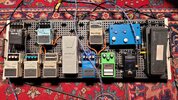
And the board...

20230510_095748.jpg

The blue pedal is only used for running a second amp and that is only done when performing Hotel California or Stairway To Heaven...
 
Well,

I took all these amps up to the music academy's soundstage and blasted them at full volume (118db peak) for evaluation.

The 50 watt Origin has always had fairly loud transformer hum, but its manageable, but i just can't het a chug out of it.

The 100 watt Marshall Solid-State has a tendency to squeal really bad at very high volumes.

The 100 Watt 1993 Valvestate has good crunch and behaves well at high volumes, but its super noisy.

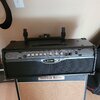
The star of the show was the 75 watt Line 6. Dead quiet and more useable gain at 11am than any of the other amps could produce, even when boosted.

The Line 6 has what i would describe as a really tight, percussive gain structure, even tighter than my other amps have when boosted. There's no need to boost the Line 6 and this would allow me to ditch the pedalboard for the June 24th live show.
 
This is a Stratocaster into a 1969 Marshall modified by Dumble just guitar and amp
sounds correct to me no hiss or hum notice how the notes flip bloom and sustain

Login • Instagram
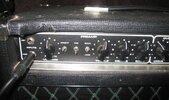
That's a very respectable noise floor. Good toone.

For this "Halford-Fight" project, we are runnung insane amounts of gain to get the right "chug" for the songs, so that's a huge factor.

The picking techniques are also very intricate.
 
June of 1980 I ran the sound system for Judas Priest at the Seattle center the guitar amps used back stage
were two early metal face Marshall Super Lead 100 1/2 stack 4 x 12 all the amps on stage were fake
I did not pay attention what effects were used they had a guy back stage switching them on and off
dog meat Dave ran the monitor system back stage I ran the main house system at that show.
same year AC/DC back in black no fake amps way loud that was a good side job the pay was good the fringe benefits
all the girls going through me to get at the bands
 
Back
Top