More Mods for my JCM800: New Grounding Scheme, Rework the Bright Cap Switch, Add a Switchable Clipping Circuit!!!

Both of what you circled are shielded wires to V1's grid pins. The first circled one includes a grid resistor. The second circle is a straight-shot connection from the preamp volume pot to the other grid pin. They are far as possible from the heaters.


But modern trends have the first stage grid resistors at the socket. I can't remember what the reasoning is.... :unsure:
If you look at all amplifiers with low noise...
the grid resistors are always mounted at the input jacks.
As far away from the filament wires as possible.

If you look at amplifiers with grid resistors at the sockets...
you will be hearing a lot more buzzing noise.

Then they try to compensate by making the filaments elevated...trying to get rid of all the buzzing.
But it never really works all the way. It still buzzes some.

The key to low noise is the layout.
Keep components and wires out of / away from --- the filament wires magnetic field.
The further away the better.
 
Looks like you added some more cool info after I went beddy-bye. I'll definitely try the removal of the preamp tubes with the amp on approach.

And since I'll definitely be implementing a new ground scheme, and if after this is done and there is still some questionable noise, I will experiment with moving the V1b grid resistor from the socket to the input jack. The amp's original circuit board had this grid resistor on the board.
The grid resistor on the board is to increase capacitance between plate and grid.
This decreases oscillation and instability...

Many Fender amps were laid out in a similar way.

But if you notice:
the filament wires are run in one direction-------------------------------
The audio components and wires are 90 degrees from the filament wires l l l l l
This is quite intentional.
The filament and the audio do not run in parallel directions, but are separated by 90 degrees in position.

This prevents the AC magnetic field of the filament from entering the audio path.
Keep all the filament wires running left to right across the chassis...
Keep all the audio running front to back.
 
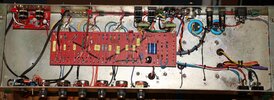
I've been thinking of rewiring and relocating the ground circuits on my heavily Frankenstein-ed '82 JCM800. I think I can reduce the background noise that this amp has always had. In the last few years I've picked up a little more knowledge on proper grounding, and I want to finally apply it to this old beast.

In the following illustration you should see basically six different colors in regards to the grounds only. Red, blue, green, yellow, orange, and grey represent different grounding points for different parts of the circuit.

View attachment 42400

Example: Ground point #1 in red, will connect to the input jack's ground, 1st preamp stage cathode ground, the preamp filter cap's ground, and the PT's heater center-tap.

Ground point #6 in grey is the AC's earth ground that will connect at the AC's receptacle mounting bolt.

Grounding points #7 & #8 in parenthesis, will be grounded separately at the mounting bolts of its tube sockets.

So, before I start yanking a bunch of spaghetti in the amp, does anybody see something wrong?
The background noise comes from V2 filament mainly and changing the ground won't stop the noise.
Changing the filament layout especially at V2 is what stops the buzzing noise.
 
The background noise comes from V2 filament mainly and changing the ground won't stop the noise.
Changing the filament layout especially at V2 is what stops the buzzing noise.
You should have said something 2 1/2 years ago, ha ha! That's how old this thread is! The amp has changed again since then. I ditched all of the silver mica caps for dogbone ceramics. New filament wiring with a slightly different layout. Corrected a small error with the resonance control mod. I guess now I need to update this thread with current pics... :hmmm:

Isn't this essentially what we did to the Origin 50 Head????
No. Did not alter the ground scheme, nor the heater filament scheme.
 
You should have said something 2 1/2 years ago, ha ha! That's how old this thread is! The amp has changed again since then. I ditched all of the silver mica caps for dogbone ceramics. New filament wiring with a slightly different layout. Corrected a small error with the resonance control mod. I guess now I need to update this thread with current pics... :hmmm:


No. Did not alter the ground scheme, nor the heater filament scheme.

Ahhhhhh!!!!
 
I can show you guys how to stop the buzzing noise just by moving a couple wires...cancels it out entirely.
Never need a DC filament supply...
never need to elevate the filaments. It will work better than either of those methods.

I guess the trouble is
People don't realize where the noise is coming from....Many people think that the noise is "RF."
there's almost nothing written about it, information wise...
 
Last edited:
I can show you guys how to stop the buzzing noise just by moving a couple wires...cancels it out entirely.
Never need a DC filament supply...
never need to elevate the filaments. It will work better than either of those methods.

I guess the trouble is
People don't realize where the noise is coming from....Many people think that the noise is "RF."
there's almost nothing written about it, information wise...
Hey AMS... What's up buddy!! Just letting you know that this guinea-pig of an amp is much quieter than it ever was. There's no DC filaments and no DC elevated heaters on this amp. But a big advantage to DC elevated heaters on amps with "cathode followers" is to take some of the stress off the preamp tubes with high voltages at their cathodes. 30v to 60v of DC elevation does wonders for a 12AX7 that is seeing close to 200v at its cathode.
 
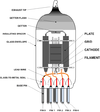
Regarding the placement of grid stopper resistors, I will say again, they are best placed as close to the valve socket as possible. If we look to any of the old valve/tube text books & manuals you will find that this is what they recommend. Belncowe, Aiken etc also recommend they be placed as close to the socket as possible, as this is where they are most affective. If we think about it, the tube itself is where the control grid lead-out is closest to the filament's lead-outs, see this 12AX7 diagram
16674582796195502997030054109999.png
(or take a 12AX7, 12AY7, 12AT7, 12AU7 etc & examine the element lead-outs to the pins to see this).
Here's an article on grid stoppers, why we use them & where to place them in relation to the socket by Mr Aiken Grid Resistors - Why Are They Used?
Again, amp manufacturers placed the grid stoppers on the input jacks for convenience & as a cost cutting measure (saves the cost of a tag strip or two per amp). When all the old valve/tube text books & application manuals etc, & the very knowledgeable people like Blencowe, Kevin O'Connor, Aiken etc tell us to place the grid stopper resistors right at the valve socket, I think we can take it on good authority that this is where we should place them for them to be most affective. Cheers
 
Last edited:
Back
Top