More Mods for my JCM800: New Grounding Scheme, Rework the Bright Cap Switch, Add a Switchable Clipping Circuit!!!

syscokid

Ambassador of War & Peace
Country flag
I've been thinking of rewiring and relocating the ground circuits on my heavily Frankenstein-ed '82 JCM800. I think I can reduce the background noise that this amp has always had. In the last few years I've picked up a little more knowledge on proper grounding, and I want to finally apply it to this old beast.

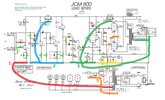
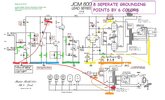
In the following illustration you should see basically six different colors in regards to the grounds only. Red, blue, green, yellow, orange, and grey represent different grounding points for different parts of the circuit.
JCM800 2204 2020-4-23 New Grounding Notes.jpg

Example: Ground point #1 in red, will connect to the input jack's ground, 1st preamp stage cathode ground, the preamp filter cap's ground, and the PT's heater center-tap.

Ground point #6 in grey is the AC's earth ground that will connect at the AC's receptacle mounting bolt.

Grounding points #7 & #8 in parenthesis, will be grounded separately at the mounting bolts of its tube sockets.

So, before I start yanking a bunch of spaghetti in the amp, does anybody see something wrong?
 
I've been thinking of rewiring and relocating the ground circuits on my heavily Frankenstein-ed '82 JCM800. I think I can reduce the background noise that this amp has always had. In the last few years I've picked up a little more knowledge on proper grounding, and I want to finally apply it to this old beast.

In the following illustration you should see basically six different colors in regards to the grounds only. Red, blue, green, yellow, orange, and grey represent different grounding points for different parts of the circuit.

View attachment 42400

Example: Ground point #1 in red, will connect to the input jack's ground, 1st preamp stage cathode ground, the preamp filter cap's ground, and the PT's heater center-tap.

Ground point #6 in grey is the AC's earth ground that will connect at the AC's receptacle mounting bolt.

Grounding points #7 & #8 in parenthesis, will be grounded separately at the mounting bolts of its tube sockets.

So, before I start yanking a bunch of spaghetti in the amp, does anybody see something wrong?
The background noise is caused by the magnetic field of the filament wires, not the grounding locations.
There is procedures for tuning out the noise by moving the layout of the filament wires.
Also: FYI this noise is not caused by capacitors (although most of the time the capacitors are blamed...etc as usual)

Specifically the grid wires pins 2 and 7 must be moved away from the filament wires pins 4/5 and 9.
This is done one tube at a time to optimize the noise level of each stage in the preamp.

So here yo go:

the first thing is to remove V1 V2 preamp tubes.
Leave the phase inverter installed.
Turn the amp on, turn the master to 10.
Now there should be no buzzing noise (basically) there will be a small amount of low frequency hum and that is normal.

Step 2 is install the V2 preamp tube and the phase inverter.
Leave V1 preamp tube out.
Turn gain knob to zero, and turn master to 10.
now turn the amp on, and you will hear the filament noise of V2.

At this point arrange the wires of V2 preamp socket to cancel as much of the buzzing noise as possible.
Use a wooden chopstick to move the V2 wires while listening to the amp noise.
Separate pins 2 and 7 wires (grids) from filament wires pins 4/5 and 9.

If possible arrange the grid wires vertical up and away from the socket.
Arrange the filament wires horizontal away from the socket against the chassis.
Try to establish a 90 degree difference between the grid wires and the filament wires.
 
Last edited:
The background noise is caused by the magnetic field of the filament wires, not the grounding locations.
There is procedures for tuning out the noise by moving the layout of the filament wires.
Also: FYI this noise is not caused by capacitors (although most of the time the capacitors are blamed...etc as usual)


Specifically the grid wires pins 2 and 7 must be moved away from the filament wires pins 4/5 and 9.
This is done one tube at a time to optimize the noise level of each stage in the preamp.
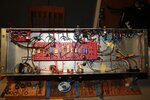
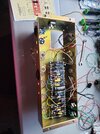
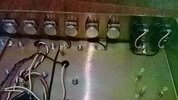
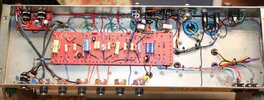
Agree. This pic of this guinea pig is over two years old. Some minor changes of a couple components, but the wiring is the same. Preamp wiring is located pretty well. I think I need to address the area where the speaker jack is sandwiched between the added PPIMV to the left and the impedance selector to the right.

GUTS 1-22-18 (1).JPG

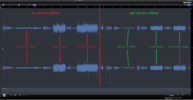
All the grounding points with the exception of the AC cable's earth ground, will be at a level horizontal plane between the pots and the circuit board. I will not ground to any of the tranny bolts. I'm also planning to record some audio on this, and compare and post the results.
 
Agree. This pic of this guinea pig is over two years old. Some minor changes of a couple components, but the wiring is the same. Preamp wiring is located pretty well. I think I need to address the area where the speaker jack is sandwiched between the added PPIMV to the left and the impedance selector to the right.

View attachment 42402

All the grounding points with the exception of the AC cable's earth ground, will be at a level horizontal plane between the pots and the circuit board. I will not ground to any of the tranny bolts. I'm also planning to record some audio on this, and compare and post the results.

Marshall V1.jpg
 
I've been thinking of rewiring and relocating the ground circuits on my heavily Frankenstein-ed '82 JCM800. I think I can reduce the background noise that this amp has always had. In the last few years I've picked up a little more knowledge on proper grounding, and I want to finally apply it to this old beast.

In the following illustration you should see basically six different colors in regards to the grounds only. Red, blue, green, yellow, orange, and grey represent different grounding points for different parts of

So, before I start yanking a bunch of spaghetti in the amp, does anybody see something wrong?
The reason you see all those old amps with the resistor mounted at the input jack:
They are trying to keep the AC buzzing noise of the filament out of the audio path.
The closer the resistor is to the filament wires, the more noise will be picked up.

The AC current travels through the filament wires.
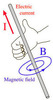
The more current that the wire carries, the larger the magnetic field around the wire will become.
When this magnetic field crosses another wire, or crosses a component (like the resistor), the AC noise enters the audio path.
Then the AC noise is amplified just like the guitar is amplified.

1587706755887.png
 
Last edited:
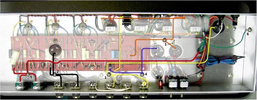
Both of what you circled are shielded wires to V1's grid pins. The first circled one includes a grid resistor. The second circle is a straight-shot connection from the preamp volume pot to the other grid pin. They are far as possible from the heaters.

The reason you see all those old amps with the resistor mounted at the input jack:
They are trying to keep the AC buzzing noise of the filament out of the audio path.
The closer the resistor is to the filament wires, the more noise will be picked up.

The AC current travels through the filament wires.
The more current that the wire carries, the larger the magnetic field around the wire will become.
When this magnetic field crosses another wire, or crosses a component (like the resistor), the AC noise enters the audio path.
Then the AC noise is amplified just like the guitar is amplified.

View attachment 42404
But modern trends have the first stage grid resistors at the socket. I can't remember what the reasoning is.... :unsure:
 
So here yo go:

the first thing is to remove V1 V2 preamp tubes.
Leave the phase inverter installed.
Turn the amp on, turn the master to 10.
Now there should be no buzzing noise (basically) there will be a small amount of low frequency hum and that is normal.

Step 2 is install the V2 preamp tube and the phase inverter.
Leave V1 preamp tube out.
Turn gain knob to zero, and turn master to 10.
now turn the amp on, and you will hear the filament noise of V2.

At this point arrange the wires of V2 preamp socket to cancel as much of the buzzing noise as possible.
Use a wooden chopstick to move the V2 wires while listening to the amp noise.
Separate pins 2 and 7 wires (grids) from filament wires pins 4/5 and 9.

If possible arrange the grid wires vertical up and away from the socket.
Arrange the filament wires horizontal away from the socket against the chassis.
Try to establish a 90 degree difference between the grid wires and the filament wires.
Looks like you added some more cool info after I went beddy-bye. I'll definitely try the removal of the preamp tubes with the amp on approach.

And since I'll definitely be implementing a new ground scheme, and if after this is done and there is still some questionable noise, I will experiment with moving the V1b grid resistor from the socket to the input jack. The amp's original circuit board had this grid resistor on the board.
 
The resistors that Sysco has mounted at the socket are "grid stopper" resistors & the best place to mount them is most definitely right at the socket pins. Best to use non magnetic, non inductive resistors here to avoid picking up interference noise. The reason we see them mounted on the input jacks in old amps is because it made construction more convenient.
There can be many sources of noise in amps, & yes, filament wiring is among them. The grounding scheme in Marshall's is definitely not ideal & it will benefit from proper localised grounding. Use this pic as a reference
15539805918482472706276637288979.png
Note the grounding points along the front, control pot edge of the chassis. Moving from the input jack side towards the PT side, here is what you want to ground at each point. (Ignore actual wining in pic, just use the grounding points along front edge of chassis).

Point 1: Input jacks, V1 cathodes, Heater CT.

Point 2: Volume pot (pre-amp), V2 cathodes, Pre-amp filter cap dual can.

Point 3: Master volume, Presence control pot, PI filter cap, Output jack, Middle control pot.

Point 4: Bias supply.

The following to points will be on the back side of the chassis.

Point 5 ( use main filter cap clamp mounting bolt to mount solder lug): PT's HT CT, Screen filter, Main filter, V4 & V5 cathodes.

Point 6: (mount solder lug near where power inputs the amp & well away from point 5): Power Cord Earth.

Going by the thread title, I believe this is what you're after. Cheers
Edit:
In a 50 watt amp the screen filter & PI filter will be a shared dual cap can, less than ideal. Ground at point 3. Cheers
 
Last edited:
Like this? Or should I ground the V1a cathode 10k resistor at point 1?
View attachment 42436
You could try the V1a 10k cathode at point 1 or point 2, see if you notice a difference. Theoretically, if they each had their own separate HT supply node & filter cap you would ground it & the filter at point 2, but because they share the HT node & filter we have to compromise, just like we do with the PI/screen grid dual cap can filter.
Here is how I grounded my (footswitchable) 2204/Caswell #39 amp

Point 1: input, heater CT, V1a & V1b cathodes.

Point 2: Volume control, Pre-amp filter dual cap can, added stage cathode, added volume control, added filter cap.

Point 3: middle control, master volume control, presence control, output jack, screen grid/PI dual cap can filter.

The rest is all the same as previously shown. The amp is very quiet with no hum/noise problems. How this helps. Cheers
 
View attachment 42438View attachment 42438
The grounds go where? Sometimes I hate you guys....
Haha, you can see the first 4 point here in this pic of my partially wired JTM50 chassis. WP_20190310_00_13_40_Smart.jpg
The ground points are arranged in a straight line along the control side of the chassis. You have to drill these yourself.
Point 1: is between the input jack sockets.
Point 2: is between the two volume pots.
Point 3: is between the treble & middle control pots.
Point 4: is below the presence control pot. This one could be moved to the other side of the OT mounting bolt to move it away from the PT, but it creates no hum/noise problems where it is.
Point 5: you've already got this, on the dual cap can clamp bolt (seen in your pic).
Point 6: Mount this solder lug on the chassis sidewall (near where the rectifier is mounted. Cheers
 
Funny thing as I take a moment to think about what or why I'm doing this... :unsure:. The amp does not suffer from unwanted excessive noise like hum, hiss, and/or buzzing. There's a tiny bit of this stuff happening, but nothing crazy. I just want to implement new knowledge from the last few years and hopefully upgrade the performance of this killer amp.

And as usual, this project's initial purpose is leading me to rethink many other points about in how I have modded this amp through the years. But first, I must complete a solid foundation for the grounding circuit and then continue Into the Void..

 
Next... Rework the Bright Cap Switch:
For years, I've been all over the map with either trying different bright cap values or no cap at all. IMO, removing the 1000 pF bright cap neuters the soul of the JCM800 too much at lower preamp volume settings. A couple years ago, I went extreme and bumped up the bright cap to 2200 pF and connected it to an on/off switch.

Recently I've come to inevitable conclusion that a 2200 pF bright cap adds way too much boost to lower preamp volume stages in the high and low input jack circuits. And it really screws-up the beautiful clean tones of the amp at the low input jack.

Therefore, I have ditched the 2200p cap in favor of the stock value of a 1000p cap and added an alternate value of 350p on the same switch. This combination sounds much better and makes more sense as the amp is operated towards its sweet spot... which means: LOUD!


Gratuitous pic coming very soon...
 
Greg, You may want to try a polystyrene capacitor on my #183 ODS build used silver mica first the polystyrene smoothed things out
got rid of the top end hash used a on/off/on switch 250pf and 500pf center off. #183 used a 160pf and a 220pf ceramic stock for the bright switch
on/on switch. The 250pf and 500pf to my ears off position Jimmy Page 250pf Jimmi Hendrix 500pf Angus Young what more could you want.
One more thought try a 7 position rotary switch I did that with my EF86 build that gives you seven value options.
 
Greg, You may want to try a polystyrene capacitor on my #183 ODS build used silver mica first the polystyrene smoothed things out
got rid of the top end hash used a on/off/on switch 250pf and 500pf center off.
Very cool, and I'm going to look into those polystyrenes in those values, including a 1000pF. What works well, is another little trick I picked up from the Grapevine to subtly mellow out very high frequencies, is to add a 100pF bypass cap to the NFB 100k resistor, like I did on my other homebuilt JCM800/2204.

One more thought try a 7 position rotary switch I did that with my EF86 build that gives you seven value options.
Wow! For a bright switch? Now that's wild!
 
Last edited:
Back
Top