TTR tube amp gurus: please help!

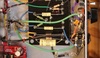
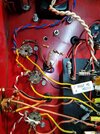
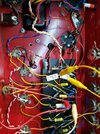
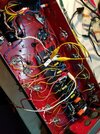
Happy New Year, jtcnj! I'm assuming your build is still in a heavy prototyping stage, but I like to see shielded cabling to both grids of V1. Your recent pic shows only a partial stretch of shielded cable to the V1 pin-2 grid only. Grid resistor should be soldered directly to pin-2 with a shielded cable running full length from the grid resistor to the jack, with the shield grounded to the jack. Also, a piece of heatshrink tubing long enough to overlap the end of the shielded cable, covering the whole resistor, and overlapping the pin-2 lug.

Same thing for the V1 pin-7 grid too, that does not have a resistor. Ground this second shielded cable to the pre amp/volume pot's ground lug.

Kinda like this, except the heatshrink tubing needs to cover the lugs of the grids too for added rigidity:
IMG_2815.JPG
 
It was complete, as per the Rob Robinette model, I just have not been happy with it.
Yeah, it seems that all of Rob Robinette's JCM800 layouts follow what you have described. I think its a shortcoming on this part of his layouts.

Once you get this build to where you like it, you might want to reconsider this different approach with the shielded cables. However, if the amp's background noise and hiss is not a problem, then there's no point for these shielded cables.
 
Good catch, Greg!!
Yes, that was from when was I experimenting with the SLP/JCM mode switch / jumpering out the cold clipper stage.
I still have that in the works, but reconnected the wire for now.

I am also going to try moving the feed to the Presence pot to the OT side of NFB resistor. This may give the presence control more effect.
I read that somewhere, probably on robrobinette.

For now, at least for a week or so anyway, I put the chassis back in the cab to keep me from futzing with it and focus on PLAYING.
 
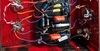
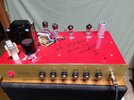
I added impedance switch to RR JCM800 MICRO so I can play through the Silkyn Super 50 Celestion 16Ω speaker.
At first the way the taps worked out I got positive feedback squeal in 1 of 2 the positions - but not both.

I should have realized that would happen, and realize it I did when I heard the familiar squeal.
Picked another wire combination that puts both switch positions on the same "side" of the coil wind with respect to the lead used as common.

20220207_181345-2.jpg20220207_181401-2.jpg

I'm still tinkering with the circuit. Right now I am back to clip leading in resistors on the voltage divider into the power tube triodes grids.
Looking to drive the power tube harder / sooner compared with the pre-amp gain vol pot level into the PI.

I plan to try adding a dropping resistor on the B+1 node to the OT / power tube plates to bring the voltage down to around or under 300v. I think it is at 329v now. I want to keep the preamp nodes where they are. I will likely need to adjust the cathode resistor value / plate dissipation again.

I also re-arranged the Presence tap to before the NFB resistor, not much change in the Presence response.
I will try clip leading in a resistor parallel to the NFB resistor to increase the NFB signal and see how it all sounds.

Lastly, I may convert the output to 2 ef80, if I am satisfied getting the plate voltage down to 300v
 
Last edited:
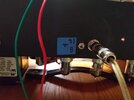
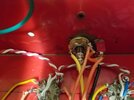
I finally decided to convert the power section to EF80 from 12au7.
I got the B+ down to @305v.
I will clean up the screen resistors; I just wanted to get it working first.
I end up with 94% plate dissipation with the 250Ω cathode resistor (measures @260Ω), factoring in 5% for the screen current.
The pic shows a clip lead shunting out the 470Ω that was in series; I have since removed it.

First impressions are good.
After playing around with the NFB resistor value, I added a 10K in parallel with the existing 10K.

I'm still planning on adding the SLP / JCM mode switch which bypasses the cold clipper stage.

20220418_195455-2.jpg20220418_195501-2.jpg20220418_195503-2.jpg20220424_190540-2.jpg
 
I havent finalized it yet but I'm happy with the results so far.

You know, for me personally....I found that my "monkey see - monkey do" approach to using Creambacks, Greenbacks and Vintage 30's was a huge part of my dislike of how my amp's sounded.

My first "outside the Celestion box" speaker experiment was the cheap, imported Electro-Harmonix 12VR75.

I couldn't believe how much better my DSL40C's sounded with this speaker.

With the Cream/Green/Vintage speakers, (aside from the fact I blew them all apart in my pair of DSL40C's) I always struggled to get a bright enough EQ to give me an edge in a live mix with un-mic'd amps on a larger stage.
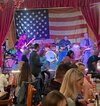
FB_IMG_1620082161405.jpg

The 12VR75 changed the entire character of my amps and it became my go-to speaker.

After blowing the voice coils off the cones on my Creambacks, Greenbacks and Vintage 30's, and discovering that there is no guarantee on speakers from Sweetwater, I started looking for a lighter weight speaker.

My first experiment with lighter weight speakers was a Celestion Creamback Neo, but I blew the voice coil and cone apart on that one too.

It was at this point I just stopped doing what everyone else was doing and I started looking elsewhere.

My first success with a Neodymium speaker was with Jensen's Jet 100 watt. It was less than half the weight of a ceramic magnet speaker and it didn't suffer a cone/coil separation at elevated resonance/volume levels.

For the last part of my two years in our band, I was running the Jensen Jet 100 alongside a Jensen Stealth 80 watt Neodymium in my custom 2x12 cabinet. These Italian made speakers were able to handle my extreme resonance and volume levels and kept total weight ofy 2x12 mahogany cabinet less that 30 pounds.

Not long ago, a musical friend told me about a special project that Celestion engineers embarked on to create a speaker that could handle Blackmore's 200 watt Marshall Majors. The project was hush-hush, because they didn't want anyone to know that the average Creambacks and Greenbacks were being blown apart by Blackmore's rig.

(There's a post about this project where my source names name's from Celestion's secret project)

The 250 watt Copperback Neodymium speaker is based on those early experiments and it is by far the best sounding, most neutral speaker I've used to date.

They are not cheap. With tax and shipping, expect to pay $500.00 fir a pair of them. They are ONLY available as a Made In U.K model. There is no Chinese counterpart.

Another speaker in this arena is the 200 watt Eminence EM12-N. Yes, they retail for $269.00 each, but there is nothing that I have found that has the clarity and tenacity of these high quality speakers.

Update: some have said that Sweetwater recently started covering speakers under their in-house, 2 year warranty, but that has not yet been confirmed by Sweetwater.

Back in 2019 and 2021, when i blew these Celestions up, i was told that I would have to go through Celestion to warranty my blown speakers.

I started the warranty process with Celestion and shipped the speakers to Celestion, Claydon Business Park, Great Blakenham, Ipswich, IP6 0NL United Kingdom for examination.

They shipped them back to me saying the warranty doesn't cover "abuse," which is understandable.

I gave all the blown Celestions away to a local fellow who said he could recone/repair them.
 
Last edited:
You know, for me personally....I found that my "monkey see - monkey do" approach to using Creambacks, Greenbacks and Vintage 30's was a huge part of my dislike of how my amp's sounded.

There's no need to be self-deprecating. Those speakers have been used for decades and have been recorded on an untold number of songs and professional recordings. You aren't to be faulted, nor should you disparage yourself, for initially trying what has been used successfully by many.

But, in the end it turned out not to be a combination you liked and you were willing to step out of that paradigm and you tried something different.

That's called a "growing experience."

Welcome to the human race.
 
There's no need to be self-deprecating. Those speakers have been used for decades and have been recorded on an untold number of songs and professional recordings. You aren't to be faulted, nor should you disparage yourself, for initially trying what has been used successfully by many.

But, in the end it turned out not to be a combination you liked and you were willing to step out of that paradigm and you tried something different.

That's called a "growing experience."

Welcome to the human race.

The sound wasn't great, true enough, but the failure of the speakers was the catalyst to go searching.

It just boggles my mind how this industry is so driven by what other people do.
 
Back
Top