
You are using an out of date browser. It may not display this or other websites correctly.
You should upgrade or use an alternative browser.
You should upgrade or use an alternative browser.
Its Good To Have A Backup:
- Thread starter Inspector #20
- Start date
OP


Had I known, I could have picked up the 8200 when I dropped off the Ivanberg.
I had written it off at the time!
OP
OP
OP
(From Don
"Well I couldn’t wait. So down to the studio I went. Fired up the soldering iron and got the first transistor out of the bag. Damn Newark sent a 2N3906 instead on the VN2410, sh#t. Good news is the second one was a VN2410 !
So I removed TR1 and soldered in the new one from the top side of the board. Used a little isopropyl alcohol to clean off the flux. Fired up the amp and, well no sound. That’s right no more white noise ! Your amp is back to working condition. I’ll mount it back in the cabinet tomorrow.
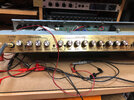
Here’s a few pics and a sound clip. It’s the lack of noise that’s the best part !!!"
"Well I couldn’t wait. So down to the studio I went. Fired up the soldering iron and got the first transistor out of the bag. Damn Newark sent a 2N3906 instead on the VN2410, sh#t. Good news is the second one was a VN2410 !
So I removed TR1 and soldered in the new one from the top side of the board. Used a little isopropyl alcohol to clean off the flux. Fired up the amp and, well no sound. That’s right no more white noise ! Your amp is back to working condition. I’ll mount it back in the cabinet tomorrow.
Here’s a few pics and a sound clip. It’s the lack of noise that’s the best part !!!"

OP

OP
If that happen to me....

@Don O is a swell guy and also has an electrical engineering background.
I would have planted flowers in it..

chilipeppermaniac
Ambassador of Decibels
They make a little blue pill for that, Dono. or in Robert's case, Mrs Herndon!!!!!!ESD damage can occur years earlier and have a delayed failure, if it is indeed ESD damage.
OP
They make a little blue pill for that, Dono. or in Robert's case, Mrs Herndon!!!!!!
I need a pill that would do the opposite. Spontaneous errections can be embarrassing.
chilipeppermaniac
Ambassador of Decibels
Robert,,,,,,,,,,,, see above........ " or in Robert's case, Mrs Herndon"
I didn't figure I needed to add, "No Pill needed."
I didn't figure I needed to add, "No Pill needed."
chilipeppermaniac
Ambassador of Decibels
@Don O, I love schematics, especially clearly notated ones.(From Don
"Well I couldn’t wait. So down to the studio I went. Fired up the soldering iron and got the first transistor out of the bag. Damn Newark sent a 2N3906 instead on the VN2410, sh#t. Good news is the second one was a VN2410 !
So I removed TR1 and soldered in the new one from the top side of the board. Used a little isopropyl alcohol to clean off the flux. Fired up the amp and, well no sound. That’s right no more white noise ! Your amp is back to working condition. I’ll mount it back in the cabinet tomorrow.
Here’s a few pics and a sound clip. It’s the lack of noise that’s the best part !!!"
View attachment 83227
View attachment 83226
View attachment 83224
View attachment 83225
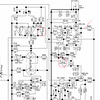
From your circled places, I am seeing a VR1 and VR5 = both Gain pots, correct? Then on the actual board, I always try to read a schematic, then find the designated part(s) in the PHYSICAL component within the circuit. SO<<<<<<<<<<<<<<<< short of xray eyes to see part numbers on my computer screen, or a spec sheet with breakdowns of each part #, I am surmising you knew the spec by reading the markings on the TR1 and that TR5 is not in your pic of the actual board? Did you only replace ONE VN2410 and this fixed it? Or you needed a 2nd one because NEWARK sent a 2N3906 but not a 2nd VN2410?
Last edited:

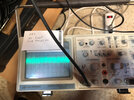
Yes, the circles are the 2 gain pots. At least Marshall labeled them left to right on the front panel so VR1 is the clean channel gain and VR2 is the next one to the right and so on. First thing I did was to replicate Robert’s issue was just simply turning it on and inserting an input Jack which lifts the grounding prong in the input Jack. Could hear the white noise on both channels. So I used the o-scope to look at the power for the analog ICs and that was clean. I then injected a 1KHz sine wave and looked at it throughout the signal chains. Noisier than heck. Since the noise was on both channels it had to be coming from the very first gain stage area. I removed the sine wave and just stuck a plug into the input Jack. I then looked at R82 and the white noise was there. To me that indicated that TR1, the first transistor the signal hits could be defective.@Don O, I love schematics, especially clearly notated ones.
From your circled places, I am seeing a VR1 and VR5 = both Gain pots, correct? Then on the actual board, I always try to read a schematic, then find the designated part(s) in the PHYSICAL component within the circuit. SO<<<<<<<<<<<<<<<< short of xray eyes to see part numbers on my computer screen, or a spec sheet with breakdowns of each part #, I am surmising you knew the spec by reading the markings on the TR1 and that TR5 is not in your pic of the actual board? Did you only replace ONE VN2410 and this fixed it? Or you needed a 2nd one because NEWARK sent a 2N3906 but not a 2nd VN2410?
I would have ordered more of the VN2410s as I have the same amp in a combo, an 8280. Newark only had 2 in stock and everyone else had them on back order.
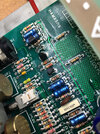
A lesson I learned very early on in my career designing circuit cards is re-numbering the components left to right and top to bottom after the card is laid out. You them back annotate the schematic and parts list accordingly. So when you are troubleshooting a card when looking at the schematic and having to find R27, instead of having to look all over the card you know right where to find it. Not many designers do that.
See how these components are easy to find…
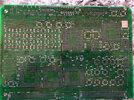
Also, another lesson learned the hard way, is on multi-layer circuit cards. Most amps use a 2 sided card, meaning there are traces (wire like connections) on both sides of the green circuit board. On more complex cards 2 two sided cards can be sandwiched together to make a 4 layer card and so one. The most complex one I was ever involved with was a 16 layer card. Back in the early 90’s I did a 80386 custom sized computer board that was 8 layers. When the first blank card came in, the first thing you do is check for a short between the power and grounds planes (each on of the layers). No short, so I had the board stuffed with all the components and when we put it in a fixture and powered it up, nothing, zip, nada. Tuned out the vendor that made the 8 layer board used the ground plane artwork for the power plane too. So I had a $5,000 paper weight.
From that point on, I had the circuit card layout person add the layer number on each of the circuit card artwork sheets. We then added a note for the incoming inspection team to hold the card up and make sure you see the numbers in ascending order, indicating that the correct artwork layer was indeed used properly to manufacture the bare card. See the numbers 1-8 in this pic.
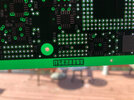

Far Rider
Ambassador Of The Cataverse

Ahhhhh.... high school days!I need a pill that would do the opposite. Spontaneous errections can be embarrassing.

chilipeppermaniac
Ambassador of Decibels
LOL AHHH 2nd grade ( Teacher) I was Hot for Teacher 12 years before Alex and Eddie showed their chops and 1984. Me Circa 1972 LOL.Ahhhhh.... high school days!
Good ol Mrs Miller!!!!
OP
Ahhhhh.... high school days!
I'm still blessed with that "malfunction. "
Last edited:
chilipeppermaniac
Ambassador of Decibels
A lesson I learned very early on in my career designing circuit cards is re-numbering the components left to right and top to bottom after the card is laid out. You them back annotate the schematic and parts list accordingly. So when you are troubleshooting a card when looking at the schematic and having to find R27, instead of having to look all over the card you know right where to find it. Not many designers do that.
See how these components are easy to find…
Dono, Thanks for posting this. I learned something yet again. I have seen these numbers in squares before and never knew what they were. Also,
Having cut my teeth on Point to Point amps, and these usually had super hard to learn on for a 50+ year old budding electronics learner, hand written schematics ( often hard to read handwriting that was nearly 50 years old itself. This is why I would PORE over schematics once I learned the symbols, and then match up what the symbols were in the actual bits and pieces. Resistors (check) Diodes (check) Capacitors, ( check) Bias Pots ( check) VARIABLE resistors ( haha Tricky way to say POTs) check. Valves, Bridge Rectifier, Screen Grid Resistor, And next to Fuses, Tubes/Valves, Filter Caps, Transformers, the first thing I learned what the heck it was was Snubber caps,,,,,,,,,,,,,,,,,, because mine did not look Kosher in my one amp.
Once I began to understand the bits and pieces, I was blessed to do a lot of reading, you tube viewing, and pow wow's with Ivan, DonP, 67plexi, Amp Mad Bea, and a fella named nekeil on Marshall amp forum, and of course sysco, smitty and BastardDon.
Dono, I sure like looking at P2P amps better than Solid State, but I am learning them too.
OP
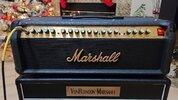
This old Valvestate Bi-Chorus 8200 is getting old, but it's a very good amp. It's super versatile and the onboard chorus is really wide and dynamic. This amp really shines on clean passages.
OP
Nonetheless, despite how bad it looked when I fist got it....
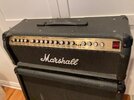
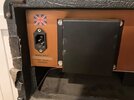
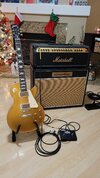
It cleaned up nicely....
It cleaned up nicely....
Last edited: