Wow. Very interesting!
Fender needs to update their manuals. They don’t specify to use a capo at the first fret when checking the action at the 17th fret. However, immediately prior to discussing action, the manual does say to use a capo when checking relief, so maybe the intention is that you just progress from checking/setting relief to checking/setting action and the idea is that the capo would still be attached?
Anyway, let me ask…what do you do if you set everything and you still encounter some fret buzz? Do you have to make a judgement call on how much buzz is acceptable? Also, what gauge of strings is used? I think my Strat came with 9-42, but I don’t quite recall.
Exactly!!!! The capo at the first fret is used to check relief. The reason fender gives a 17th fret spec is only so you don't have to remove the capo. It's an 'economy of movement' thing only.
I'm setting up 72-85 guitars in a 10 hour day.
(Setup defined: Visual inspection under fluorescent light, Tune to pitch, check/adjust relief, check/adjust action height, check/adjust 1st fret height @ nut, check/adjust pickup height, check electronics function, play scales to ensure no fretting out or buzzing)
So, keep this in mind...
Gibson's spec is .070" at the 12th fret unfretted. It's exactly the same as 4/64" at the 17th with a capo at the first. It doesn't matter which method you use.
(Gretsch specifies checking relief at the 8th fret with a capo on the 1st, then checking action height at the 12th, but it doesn't matter...it's all gonna give you .070" at the 12th, regardless of the method used.)
I also snap the capo on the 3rd fret and check the action at the first fret, even though both fender and Gibson only give a spec for checking the first fret height unfretted.
My Personal Time-Saving Tip:
I also do "overflow" setups for a couple of local Luthiers and I work as an independent (extra help) tech for a couple of factory warranty techs on the "down low."
If you are evaluating a guitar for nut height, then a capo at the 3rd fret will be fastest method. What you want to see is 'perceptible movement" between the string and the first fret. What this will give you is a quick 'snapshot' of whether or not you have minimum 1st fret clearance. It won't tell you how much clearance you have, but when diagnosing problems, you really don't care. You just want to know you have 'adequate' first fret action height and this is the fastest method.
TBTH, when calculating/evaluating action height, the string gauge is meaningless. We are only measuring the height from the bottom of the string to the top of the fret. As long as the string is seated in the nut slot, that's all we care about.
Now, here's where things really started to make sense to me in my training.
IF you have .008" to .012" relief at the 7th fret
IF you have .022"/.025" 1st fret unfretted action
IF you have .070" at the 12th fret unfretted
You will have ZERO issues with buzzing.
Period. End of story.
IF you have buzzing at these specs, you have a hump in the fretboard (which you would have seen during your "rifle sight" neck inspection) or a lifted fret.
Pickup adjustment is another thing. Even though we are given a 'spec' for pole piece to string adjustment, most people will alter this, not realizing that the spec is really a product of scientific research by engineers. On a Fender single coil, 3/32" is the minimum spec on both sides and this is specifically to prevent/reduce "wolftones" or the "Stratitus" harmonic oscillation brought on by magnetic pull. I tend to shhot for 4?32" on just about everything to increase speed and productivity.
I even paint colored marks on my Stewie-Mac rulers so I don't have to "look for the spec."
If the pickup’s magnet pulls on a vibrating string, it can actually affect both intonation and sustain, because the pull of the magnetic field deadens/impedes the string's vibration. (I'm sure you all now this fact) This is less of a problem with humbuckers, but many people still move them too close - or too far away - for optimum performance. The engineering documents even show a shaded magnetic field around the pole pieces/bobbins and describe how far into this field the string should intrude for both maximum output an sustain,
both of which are effectively "juggled" by the specification.
Back in the day, with the old vintage, low-output pickups, players would move their pickups very high in order to push an amp to overdrive. My friend, Fil Oliveri, of 'Solo Dallas' fame, confirmed this when he inspected many of Angus Young's older guitars. On some of those old SG's the strings actually wore grooves in the pickups.
That’s one of the reasons aftermarket pickups began being offered in hotter and hotter versions. The thing to remember is that the hotter variations, don't need to be quite so close to the strings and older, lower output versions still shouldn't be too far from the strings for maximum efficiency.
This is one variable that we leave to the end user. But there really is science involved in finding the right spot.
Here's my personal specs for doing setups for private clients based on trial and error:
- Don’t set humbuckers closer than 4/64” (1.6mm)
- Don’t set Fender Single Coil pickups closer than 6/64” (2.4mm)
- Don’t set P-Bass closer than 6/64”(2.4mm) and J-Bass closer than 5/64” (2mm)
- EMG's and other actives should be as close to the strings as possible. I set them to about 2/64" with strings fretted at the last fret
- Other pickups will probably be somewhere around these figures, although it’s worth noting that hotter pickups can have very powerful magnets and will often need to be a lot lower.
For Fender Singe Coils with Magnetic Pole Pieces, this is the factory spec.
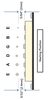 (On private client's guitars, I set Single Coils to 8/64" (4/32" or 1/8" same measurement) on both sides of the bobbin evenly.
Now, when older, low output pickups are mentioned, Gibson always comes to mind, so I thought referencing the Gibson service publications would be worthwhile...
Gibson's current service documentation recommends
1/16" (1.6 mm) for the bridge pickup and 3/32" (2.4 mm) for the neck for all humbuckers on all Gibson models. Now, I personally feel this is too close for pickups like the 498T and 500T, but thus far, Gibson hasn't published a revision for the higher output pickups.
My 2021 Gibson 50's Standard has not been touched since it left the factory. Fretting all strings at the last fret, The bride pickup is 8/64's on both sides and the neck is 6/64" on the bass side and 4/64" on the treble side, just for reference. This is with factory installed BB3 bridge and BB1 Neck Pickup-to-pickup balance is dead-nuts straight out of the case.
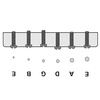
The ONLY adjustment that I performed on my Les Paul was to adjust the induvial pole pieces for accurate and even string-to-string balance. This is 'SOP' on all guitars that I setup for private clients and has been for several years. Some will poo-poo on this, but the VU meter doesn't lie.
Setup really is fascinating to be honest and it's steeped in well spun mythology and personal preferences being sold as absolute facts.
Every time I have a complaint about buzzing or other anomalies, the guitar is always out of spec.
Yesterday, I was given a Kirk Hammet ESP (purple metal flake!) that fretted out in some spots and had intonation problems.
Sure as could be, it was totally out of spec. Clearly personal preference was afoot here.
1. 12th fret action at .035"
2. Neck relief at .025"
3. Pickups almost touching the strings
4. Tremolo bridge (Floyd) adjusted like a "stink bug"
It took me 7 minutes to bring everything into "Fender specs" and it played like a dream. The guy was just elated and admitted he had been trying adjustments that he "read on some discussion forums," which wasn't at all surprising to me, because I re-live this exact scenario over and over again.